Saucepans & Sauciers
The Best Stainless Steel Pasta Pots
A pasta pot boils water, and boiling water is the one job where fully clad construction buys you almost nothing. That single fact reverses most of the advice on this site - and it changes which pot you should buy.
Disclosure: Ply & Pan earns a commission on qualifying purchases made through links on this page. We take no free product and no sponsorship, and every price here is read from Amazon on the date shown. How we are funded.
Quick picks
The short answer. Tap any row for the full write-up.
| # | Product | Best for | Score | Price |
|---|---|---|---|---|
| 1 | 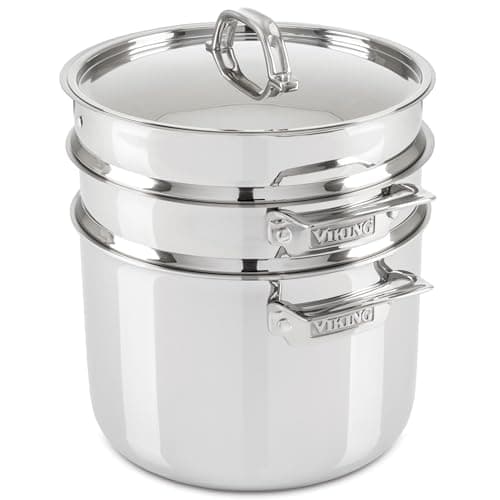 Viking 3-Ply 8-Quart Multipot with Pasta and Steamer InsertsGenuinely clad walls, both the pot and the insert dishwasher safe, and four pieces for roughly half what the 5-ply systems cost. The catch is that Viking publishes almost nothing about it. | One purchase that covers pasta, steaming and stock without a second pot | 8.4 | $179.99 · View on Amazon $299.99 · 40% off |
| 2 | 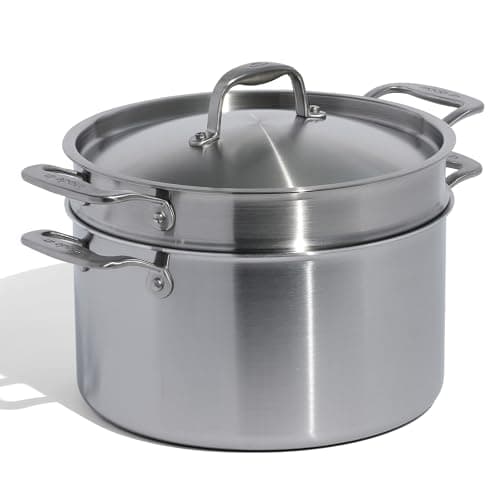 Made In 8-Quart Stainless Clad Multi-Pot SetFive bonded plies, an 800F ceiling and a lifetime warranty, in the only system here whose pot is as good as the best stock pots on the site. You pay about three times the Cuisinart for it. | A pot bought once, used for everything, and expected to outlive the kitchen | 8.5 | |
| 3 | 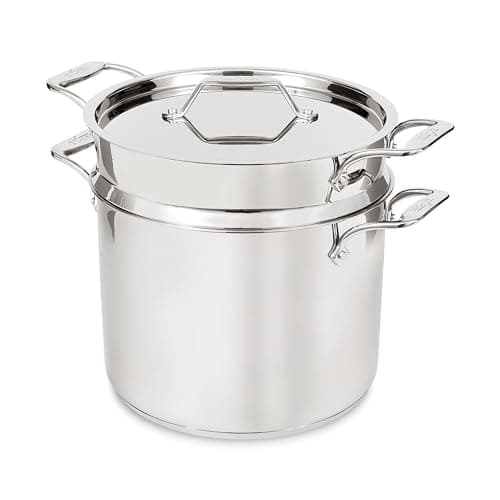 All-Clad Simply Strain 12-Quart Multipot with InsertTwelve quarts, a 600F ceiling and the best-designed insert here - but read the spec carefully, because this pot carries the All-Clad name without All-Clad's bonded construction. | Two pounds of pasta, a lobster boil, or canning jars | 7.6 | |
| 4 | 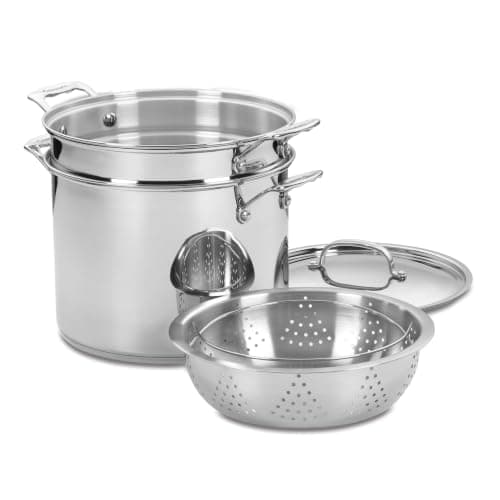 Cuisinart Chef's Classic 12-Quart Pasta/Steamer SetTwelve quarts, four pieces, 18/10 on an encapsulated base, for less than the price of one premium insert. For pure pasta duty it is the rational buy and we will not pretend otherwise. | Anyone who only ever boils in this pot and refuses to overpay for it | 7.6 | |
| 5 | 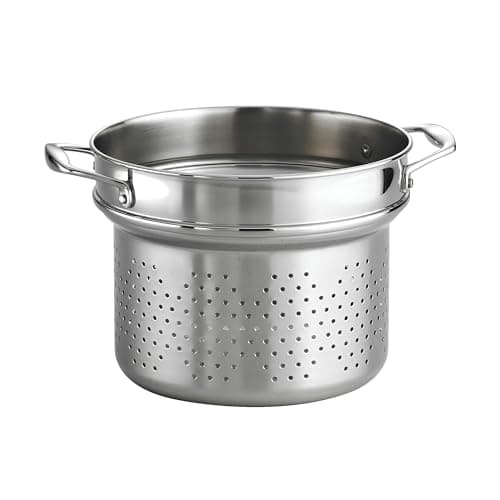 Tramontina Signature Stainless Steel Pasta Strainer InsertAn 18/10 insert built for a pot this site already recommends. If you own that pot, this is a fifty-dollar route to a fully clad pasta pot and the cheapest right answer on the page. | Anyone with a Tramontina Signature 8-quart already in the cupboard | 7.8 |
#ad Buy links are affiliate links. Prices come straight from Amazon, are stamped with the date they were read, and disappear rather than go stale if the feed stops. How we are funded.
What actually matters in a pasta pot
1. Where the drain holes are. This is the spec that separates a good pasta pot from an annoying one, and it is almost never mentioned. An insert perforated only around the sides holds half an inch of water in its base when you lift it, which drips across the stove and sits in the pasta. An insert perforated at the base as well drains in about two seconds. All-Clad's Simply Strain insert is the best example of the second kind on this page. A straining lid - holes in the cover, tip the whole pot - is a third design, cheaper and much worse: you are tipping twenty-five pounds of boiling water at arm's length.
2. Water volume, not quart markings. Pasta needs roughly four quarts of water per pound to keep the temperature from crashing when it goes in and to stop the starch concentration turning the pot into glue. A nominal eight-quart pot filled to a safe level holds about six quarts of water, which is a pound and a half of pasta at most. Twelve quarts is the size that comfortably does two pounds. Buy for the number of people you actually cook for, and read the sizing argument in what size stock pot you need before you assume bigger is better.
3. The lid, and what it is made of. A stainless lid shares the pot's temperature rating. A glass lid caps it, usually at 350F, and on the Viking line the glass lids are rated far below the pot. For pasta that does not matter much, because nothing goes in an oven. For a pot you will also use for stock or a braise, it matters a lot, and the full argument is in glass vs stainless steel lids. Every complete pot on this page ships a stainless or metal cover, which is one of the reasons these five made the list.
4. Whether the pot earns its keep when the insert is out. This is the criterion that decides the ranking. A pasta pot gets used for pasta perhaps once a week. The same vessel could be your stock pot, your chili pot, your corn pot and your canning pot - but only if the walls are clad, because single-ply walls scorch anything thick. Cladding is worth nothing for the pasta and everything for the other five jobs, and that is the real reason to pay for it.
5. Handles and loaded weight. Twelve quarts of water is about twenty-five pounds, and you will be lifting an insert out of it with one hand while the pot stays on the burner. Two short side handles beat one long one here, riveted or welded both work, and the handles need enough gap behind them for a thumb in a mitt. If your pan handles run hot, the physics behind it is in why stainless steel pan handles get hot.
Why cladding barely matters here - and when it does
Almost every page on this site argues for fully clad construction, so it is worth being straight about the one category where that argument collapses. Cladding exists to spread heat sideways through the metal before it reaches the food, which is what stops a burner ring scorching a sauce and what makes a pan brown evenly edge to edge. Water does none of that. Water convects: it mixes itself, it equalizes its own temperature, and it refuses to go above 212F at sea level no matter how hard you heat the pot. A disc-bottom pot and a five-ply pot bring the same volume of water to the same boil, and the cheaper one often does it faster because there is less metal to heat first.
So if your pasta pot will only ever hold water, the Cuisinart is not a compromise - it is the correct answer, and the extra two hundred dollars for five plies buys you nothing you will taste. What changes the math is everything else you might put in an eight or twelve quart pot. Chili, bolognese, a reduced stock, risotto for a crowd, a pot of beans: all of those sit against the walls and all of those scorch on single-ply steel. That is why both of our top two picks are clad, and why the reason we give is never about the pasta. The physics in full is in what clad means.
Buy an insert instead if this is you
We would rather send you to the cheaper right answer than sell you a pot you do not need. If you already own a good stock pot - a Tramontina Signature, an All-Clad D3, a Made In, a Cuisinart MultiClad Pro - do not buy a pasta pot. Buy the insert that fits it. You will spend forty-five to a hundred dollars instead of a hundred and eighty, you will not add a second large pot to a cupboard that probably cannot take one, and the pot doing the boiling will be better than the one in any pasta set.
The only hard part is fit, and it is genuinely hard, because most brands publish no insert dimensions at all. Measure the inside diameter of your pot at the rim with a tape measure and write the number down before you shop. Then buy the insert made by your pot's own manufacturer for your pot's own size if one exists, because that is the only purchase where fit is guaranteed. Tramontina, Made In, Hestan and All-Clad all sell one. The full fit method, including what to do when your pot's maker sells nothing, is in the best stainless steel steamer inserts.
What size to buy
Eight quarts is right for one to three people, and it is the size most worth buying as a clad pot because it is also the most useful general stock pot capacity. Twelve quarts is right for a household of four or more, for anyone who cooks a pound and a half of pasta at a time, and for anyone who boils corn, crab or canning jars. Sixteen quarts exists and is a specialist purchase: full of water it weighs more than thirty pounds and most home burners struggle to bring it to a boil in a sensible amount of time.
Below six quarts, skip the category entirely. A five-quart pasta pot cannot hold enough water to cook a pound of pasta properly, and what you actually want at that size is a large saucepan - see what size saucepan you need.
What we left off, and why
Straining-lid pots. Several cheap pots replace the insert with a lid full of holes and a twist-lock handle. They are the most common design under fifty dollars and we will not recommend one. Draining means inverting a pot of boiling water over a sink while holding it by two handles, the lock is the only thing between that water and your hands, and the holes clog with short pasta. An insert you lift straight up is safer by design, not by care.
Marketplace-brand pasta sets. There are dozens, they are cheap, several looked fine, and not one of them publishes a steel grade, an oven rating or a warranty address. We do not rank cookware on photographs, and a pot bought to last is the wrong place to start trusting a brand with no published specification.
Pots with glass straining lids. Glass and draining are a bad combination: the lid is the part taking thermal shock from the sink while the pot is still at a boil. Where glass lids do and do not belong is covered in glass vs stainless steel lids.
Premium clad inserts from brands whose pots we do not cover. Cristel, Mauviel and Demeyere all sell excellent pasta inserts at premium prices. They are sized to their own pots, those pots are outside the price range most readers are shopping in, and an insert bought without the matching pot is a fit gamble. If you own one of those pots, buy that brand's insert and ignore this page.
Draining it without burning yourself
Three habits, and the first one is the whole safety argument for an insert over a straining lid. Lift the insert straight up and rest it across the rim of the pot for ten seconds before you move it - the pot catches the drips, the pasta keeps draining, and your hands never go near the water. Second, never fill above about two-thirds: a pot filled to the rim boils over the instant the pasta goes in, and the overflow is starchy water on a hot burner. Third, keep a cup of the water before you drain if there is any sauce involved, because the starch in it is what makes a sauce cling.
Afterwards, the pot needs almost nothing. Starchy water leaves a dull film and sometimes white spots, which are minerals rather than damage - the fix is in white spots on a stainless steel pan. The one thing that does real harm is running cold water into a hot empty pot, because a wide thin base can warp and a warped pot rocks on the hob forever after. The repair options, such as they are, are in warped stainless steel pan.
The picks in full
1. Best overall
Viking 3-Ply 8-Quart Multipot with Pasta and Steamer Inserts
Viking
Genuinely clad walls, both the pot and the insert dishwasher safe, and four pieces for roughly half what the 5-ply systems cost. The catch is that Viking publishes almost nothing about it.
- Construction
- 8.2
- Insert design
- 8.0
- Versatility
- 9.0
- Value
- 8.6
- 8 quarts; three bonded layers - induction-capable stainless exterior, aluminum alloy core, 18/10 stainless interior
- Amazon listing describes four pieces: pot, lid, pasta strainer insert and steamer basket
- Pot and steamer insert both dishwasher safe
- Induction compatible on any cooktop; limited lifetime parts and labor warranty
- Oven safe; Viking publishes no spec page for this model and retailer oven ratings conflict
What it gets right
- Genuinely clad walls at roughly half the price of the 5-ply systems
- Dishwasher safe on both the pot and the insert, which the premium clads are not
- The pot works as an ordinary 8-quart stock pot once the inserts come out
Who should skip it
- Viking has no live product page for this model, so every spec comes from retailers and they disagree
- Retailer oven ratings run from 400F to 600F, and glass lids in the line are rated far lower
- Origin is unconfirmed: Viking's own catalog lists the 3-Ply line as imported while one retailer lists this pot as made in the USA
This is the pot to buy if you want one vessel rather than two. Three bonded layers - an induction-capable stainless exterior, an aluminum alloy core, an 18/10 interior - mean that when the pasta insert and the steamer basket come out of it, what is left is a real eight-quart clad stock pot: the kind of pot that holds a simmer for stock and does not scorch a thick chili at the waterline. That is the whole argument for spending above the Cuisinart, and it is an argument about the pot, not about the pasta.
The practical wins are the two inserts and the dishwasher rating. The pasta strainer is a full-depth basket rather than a shallow tray, so a pound of spaghetti lifts clear of the water in one motion, and the separate steamer basket means the pot does double duty on nights when nobody wants pasta. Both the pot and the insert are listed as dishwasher safe, which neither the Made In nor the All-Clad can claim without a caveat - and a pot you have just drained two gallons of starchy water out of is a pot you want to put in a machine.
Against it, and this is a real knock: Viking has no live product page for this model, so every number has to come from retailers, and they disagree. Oven ratings quoted for it run from 400F to 600F. Piece counts differ - Amazon lists four pieces, one retailer lists three. Origin is worse: Viking's own catalog describes the 3-Ply line as imported, while one retailer lists this pot as made in the USA. We have not been able to confirm which is right, so treat origin as unknown rather than as a selling point. The broader picture of what Viking does and does not stand behind is in our Viking stainless steel review.
2. Best buy-it-for-life
Made In 8-Quart Stainless Clad Multi-Pot Set
Made In
Five bonded plies, an 800F ceiling and a lifetime warranty, in the only system here whose pot is as good as the best stock pots on the site. You pay about three times the Cuisinart for it.
- Construction
- 9.4
- Insert design
- 8.4
- Versatility
- 9.2
- Value
- 6.8
- 8 quarts; premium 5-ply construction (Made In published spec)
- Includes stock pot, fitted lid, removable pasta insert and steamer basket
- Oven safe to 800F / 430C
- Gas, electric and induction; hand washing preferred
- Stock pot crafted in Italy; pasta and steamer inserts made in Thailand; lifetime warranty
What it gets right
- Fully clad walls, so the pot is still the right pot for chili and stock when the inserts are in the cupboard
- The 800F ceiling is the highest published rating of any pot on this page
- One purchase covers boiling, draining and steaming with nothing left to measure or match
Who should skip it
- Costs roughly three times the Cuisinart to do the same job with pasta water
- Hand washing preferred on the piece of cookware most likely to go in the dishwasher
- Made In does not publish a steel grade or a gauge figure for the pot
Made In sells this as a multi-pot set, and the honest way to read the price is that you are buying an excellent eight-quart clad stock pot and getting two inserts with it. The pot is five-ply, rated to 800F - the highest published ceiling of any vessel on this page by a wide margin - crafted in Italy, and covered by a lifetime warranty. It is the same body we recommend in the stock pot roundup, which is where the money actually goes.
The inserts are good, and Made In publishes their dimensions, which almost nobody else does: the pasta insert is 10.75 inches across the top with a 7.75-inch cooking diameter, the steamer basket is the same 10.75 inches wide and 4.625 inches deep. Both are rated to 800F. Measurements you can check before buying are worth more in this category than any marketing adjective, because the single most common complaint about pasta inserts is that they do not fit.
Against it: five plies of cladding are close to wasted on a vessel whose main job is holding water at 212F, so a lot of this price buys nothing for pasta specifically. Made In prefers hand washing on all three pieces. The brand publishes no steel grade and no gauge figure for the pot, which is the gap we keep flagging in pan thickness and gauge. And the pot is made in Italy while the inserts are made in Thailand, which is fine but worth knowing if origin is why you are here.
#ad Price as of November 12, 2026. How we are funded
3. Best for big batches
All-Clad Simply Strain 12-Quart Multipot with Insert
All-Clad
Twelve quarts, a 600F ceiling and the best-designed insert here - but read the spec carefully, because this pot carries the All-Clad name without All-Clad's bonded construction.
- Construction
- 6.6
- Insert design
- 9.2
- Versatility
- 7.4
- Value
- 7.0
- 12 quarts; stainless steel body from 90% recycled stainless, with a wide heavy-duty stainless base
- All-Clad publishes no bonded, clad or tri-ply claim for this line
- Oven safe to 600F; above 500F can discolor the steel without affecting performance
- Dishwasher safe, though All-Clad recommends handwashing; compatible with induction
- Limited lifetime warranty; designed in Canonsburg, PA and made in China
What it gets right
- 600F is the highest oven rating of any complete pot on this page
- The insert is deep and perforated at the base as well as the sides, so no separate colander is needed
- 12 quarts is genuinely enough water for two pounds of pasta without crowding
Who should skip it
- Carries the All-Clad name without All-Clad's bonded construction - this is not a D3 pot
- Made in China while the bonded lines are made in Pennsylvania, which the price does not reflect
- Dishwasher safe on paper, handwashing recommended in the same spec sheet
The insert is the reason to look at this one. It is deep, and it is perforated at the base as well as up the sides, which means it drains in seconds instead of holding a half-inch of water in the bottom the way a side-perforated basket does. All-Clad's own description makes the point plainly: with drainage holes at the base, no separate colander is needed. At twelve quarts there is genuinely enough water for two pounds of pasta without the temperature crashing when the pasta goes in, and the pot is rated to 600F, the highest complete-pot figure on this page.
Now the part that matters on a site about clad cookware. All-Clad's published specification for Simply Strain does not use the words bonded, clad or tri-ply anywhere. It says stainless steel, 90% recycled, with a wide heavy-duty stainless base. Compare that to All-Clad's D3 listings, which say 3-Ply Bonded in the product name. This is not a D3 pot and it is not sold as one. If you are unsure why the distinction matters for a pot you will also use for sauce, that is exactly what fully clad vs disc bottom is about.
Against it: it is made in China while the bonded lines are bonded in Pennsylvania, and the price does not fully reflect that. The spec sheet says dishwasher safe and then recommends handwashing in the same breath. All-Clad also notes that sustained use above 500F can discolor the steel, which is harmless but surprises people - the reason why is in stainless steel pan discoloration. And twelve quarts of water weighs about twenty-five pounds, which brings us to the handles. Use two mitts, every time.
#ad Price as of November 12, 2026. How we are funded
4. Best value
Cuisinart Chef's Classic 12-Quart Pasta/Steamer Set
Cuisinart
Twelve quarts, four pieces, 18/10 on an encapsulated base, for less than the price of one premium insert. For pure pasta duty it is the rational buy and we will not pretend otherwise.
- Construction
- 6.0
- Insert design
- 7.6
- Versatility
- 6.2
- Value
- 9.6
- 12 quarts; 18/10 stainless steel with an aluminum encapsulated base
- Four pieces: stock pot, lid, pasta insert and steamer basket (model 77-412P1)
- Encapsulated base is induction ready
- Retailers list the oven rating inconsistently, with 550F the highest figure quoted
- Limited lifetime warranty; dishwasher guidance differs between retailers
What it gets right
- The cheapest complete four-piece pasta and steaming system from a named brand
- Encapsulated base is all the construction boiling water actually needs
- 12 quarts of capacity at a price where clad pots are half the size
Who should skip it
- Disc base with single-ply walls, so it scorches thick sauces the way any disc-bottom pot does
- Spec data is inconsistent: capacity is quoted from 11.6 to 12 quarts and oven ratings vary by retailer
- Thin gauge and tall sides make it top-heavy when full
If the pot's entire job is to boil water and drain pasta, this is the one to buy, and most of the money anybody spends above it in this category is spent on physics that boiling never uses. You get a twelve-quart 18/10 pot, a lid, a pasta insert and a steamer basket, on an aluminum encapsulated base that is induction ready. Water does not care whether the heat spread evenly before it arrived; it only cares that the pot reached 212F.
The encapsulated base is the right construction here rather than a compromise. A disc welded to the bottom of a tall pot puts the aluminum exactly where the burner is and nowhere it is not needed, and it is the reason this pot costs a quarter of the Made In. The four-piece configuration is also the most useful shape of the set: a pot that boils, a basket that lifts, and a steamer that turns it into a vegetable pot.
Against it: single-ply walls above the base, so the moment you use this pot for a thick sauce, chili or a long-reduced stock, it will scorch at the waterline where a clad pot would not. That is a real limit, not a theoretical one, and it is why we did not make it the overall pick. The published data is also a mess - capacity is quoted anywhere from 11.6 to 12 quarts, oven ratings vary by retailer with 550F the highest figure we found, and dishwasher guidance contradicts itself between sellers. And the gauge is thin, so a full pot feels top-heavy. If you want the difference between this pot and a clad one explained properly, start with saucepan vs stock pot.
#ad Price as of November 12, 2026. How we are funded
5. Best upgrade for a pot you already own
Tramontina Signature Stainless Steel Pasta Strainer Insert
Tramontina
An 18/10 insert built for a pot this site already recommends. If you own that pot, this is a fifty-dollar route to a fully clad pasta pot and the cheapest right answer on the page.
- Construction
- 8.0
- Insert design
- 7.4
- Versatility
- 6.0
- Value
- 9.4
- 18/10 stainless steel; dishwasher safe (Tramontina published spec)
- Designed to fit the Tramontina Signature 8-quart stock pot
- Tramontina lists it at $49.95 on its own store, SKU 80116/042DS
- Tramontina publishes no oven rating, dimensions or country of origin for the insert
- Backordered on Tramontina's own store at the time of writing; stock moves between retailers
What it gets right
- By far the cheapest route to a fully clad pasta pot if you already own the Signature 8-quart
- Dishwasher safe, which the premium inserts mostly are not
- Nothing extra to store: the insert stacks inside the pot it belongs to
Who should skip it
- Only worth buying with the matching 8-quart pot - it is not a universal insert
- Tramontina publishes no dimensions, so fit in any other brand's pot is a guess
- Availability is the weak point; it goes out of stock regularly
Here is the move most buying guides never mention. The Tramontina Signature eight-quart stock pot is fully clad tri-ply 18/10, NSF certified, dishwasher safe and oven safe to 500F, and it is one of the best-value pots in the whole category - it has held a place in our stock pot roundup for exactly that reason. This insert is Tramontina's own 18/10 basket, designed to drop straight into it. If that pot is already yours, you can stop reading: buy the insert, keep the pot, and you now own a fully clad pasta pot for the price of a takeout dinner.
The insert itself is dishwasher safe, which puts it ahead of both Made In inserts on the only chore that matters after a pasta night. It also stacks inside the pot it belongs to, so it costs no extra cupboard space - a genuine consideration if the reason you have not bought a twelve-quart multipot is that there is nowhere to put one.
Against it: this is not a universal insert and should not be bought as one. Tramontina publishes no dimensions for it at all, so fit in any other brand's eight-quart pot is a guess, and a basket that binds halfway down is worse than no basket. Tramontina also publishes no oven rating and no country of origin for the insert, and it was backordered on Tramontina's own store while we were writing this, so stock moves between retailers. If your pot is a different brand, the fit problem and how to solve it is the whole subject of the steamer insert roundup.
#ad Price as of November 12, 2026. How we are funded
Frequently asked questions
Do you need a fully clad pasta pot?
No. Boiling water mixes and equalizes its own temperature and will not go above 212F, so cladding does nothing a disc-bottom pot cannot do. Cladding is worth paying for only if the same pot will also cook thick things - chili, bolognese, reduced stock - because single-ply walls scorch those at the waterline.
What size pasta pot should I buy?
Eight quarts for one to three people, twelve for four or more. Pasta wants about four quarts of water per pound, and a nominal eight-quart pot safely holds about six quarts of water - a pound and a half at most. Sixteen quarts weighs over thirty pounds full and most home burners struggle to boil it.
Is a pasta insert better than a straining lid?
Yes, and it is a safety difference rather than a convenience one. An insert lifts straight up out of a pot that stays on the burner. A straining lid means inverting twenty-five pounds of boiling water over a sink with a plastic latch as the only thing holding it. Straining lids also clog with short shapes.
Can I just buy a pasta insert for the stock pot I already own?
If your pot's manufacturer sells one in your pot's size, yes, and it is usually the better buy. Measure your pot's inside diameter at the rim first. Tramontina, Made In, Hestan and All-Clad all sell inserts for their own pots; a generic insert in a pot of unpublished diameter is a gamble.
Why does my pasta pot have brown or rainbow stains after boiling?
Starch film and dissolved minerals, not damage. A rainbow tint is a harmless oxide layer and white chalky spots are mineral deposits from hard water; both come off with a vinegar soak or Bar Keepers Friend. Nothing about either affects the steel.
What is the best stainless steel pasta pot?
For most people the Viking 3-Ply 8-quart multipot: genuinely clad walls, a pasta insert and a steamer basket, both pot and insert dishwasher safe, at roughly half the price of the 5-ply systems. If the pot will only ever boil water, the Cuisinart Chef's Classic 12-quart four-piece set is the rational buy. If you already own a good clad stock pot, buy your pot maker's insert instead and skip the category.
Sources
- Abt - Viking 3-Ply 8-Quart Multi-Cooker, Pasta Pot and Steamer Insert (model 4013-6008), published specification and retailer origin claim
- Viking Culinary - cookware collection, current line-up and list prices (3-ply stainless, nonstick and hard-anodized lines)
- Made In - 8 QT Stainless Clad Multi-Pot Set, published specification (5-ply, 800F, stock pot crafted in Italy, pasta and steamer inserts made in Thailand)
- Made In - Stainless Steel Pasta Insert, published specification (fits 6 and 8 QT stock pots, 10.75in total diameter, 800F, hand wash, made in Thailand)
- All-Clad - Simply Strain Stainless Steel Multipot with Insert, 12-quart, published specification (600F, 90% recycled stainless, designed in Canonsburg PA, made in China)
- Abt - Cuisinart Chef's Classic 12-Quart Pasta/Steamer 4-Piece Set (77-412P1), published specification (18/10 with aluminum encapsulated base, induction ready)
- Tramontina - Stainless Steel Pasta Insert, published specification (18/10, designed to fit the 8-quart stock pot, dishwasher safe)
- Tramontina — Signature Tri-Ply Clad Stainless Steel Fry Pan, published specification