Saucepans & Sauciers
What Size Saucepan Do You Need?
Most kitchens own three saucepans and use one. Here is which one, and what the other two were for.
Disclosure: Ply & Pan earns a commission on qualifying purchases made through links on this page. We take no free product and no sponsorship, and we never print a price. How we are funded.
Quick picks
The short answer. Tap any row for the full write-up.
| # | Product | Best for | Score | Price |
|---|---|---|---|---|
| 1 | 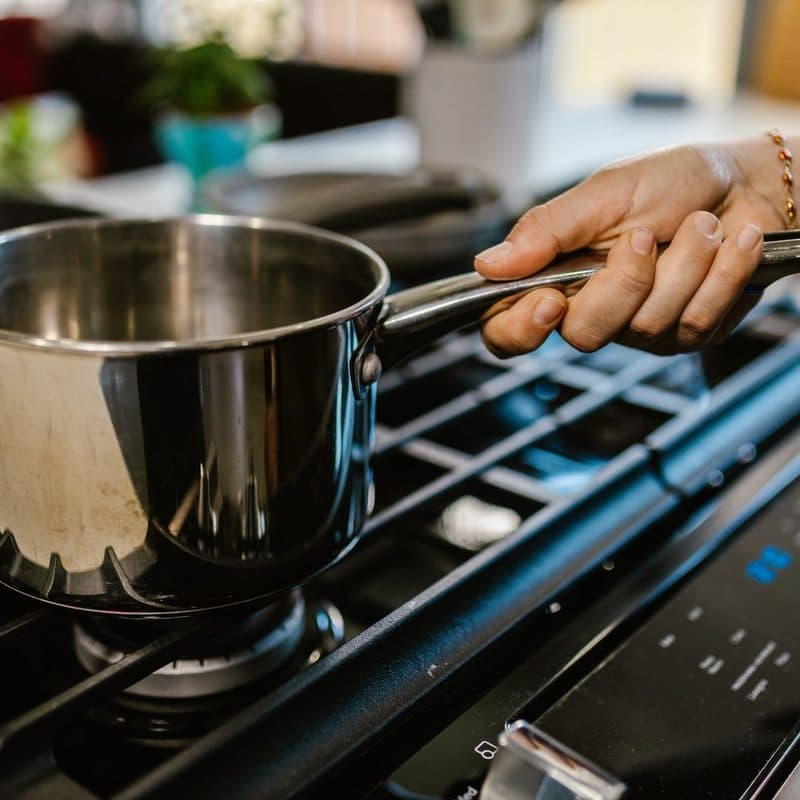 All-Clad D3 Stainless SaucepanStraight walls and a narrow mouth hold a simmer with very little evaporation, and the stainless lid does not cap the pan's rating. | The everyday size, with a lid that shares the oven rating | 8.9 | |
| 2 |  Tramontina Signature Tri-Ply Clad Cookware SetFully clad through the saucepan walls, not disc-bottomed, which is the specification that decides whether a saucepan scorches. | Covering 2-quart and 3-quart together without overpaying | 8.8 | |
| 3 |  Made In Stainless Clad SaucierRounded walls with no corner for a whisk to miss, five plies and 800F. The pan a saucepan is worse at. | Sauces, custards and risotto, where walls get in the way | 8.7 |
#ad Buy links are affiliate links. We never print a price — prices change weekly and a printed one is wrong within a month, so every link goes to the live Amazon listing. How we are funded.
The short answer
Buy a 3-quart saucepan if you are buying one, and add a 2-quart as the second. A 3-quart handles rice for four, a pound of pasta at a push, a litre of stock, blanching vegetables and a sauce for a family meal. A 2-quart is the one you reach for daily: oatmeal, a single portion of grains, reheating, melting butter, two eggs on a boil. A 1-quart is a specialist pan and a 4-quart is a small stockpot that is worse at being either.
Capacity matched to task
| Capacity | What it actually does | Who needs it |
|---|---|---|
| 1 quart | Melting butter, warming milk, one portion of sauce, a single egg poach | Nobody, as a first saucepan. A nice third pan. |
| 1.5 to 2 quarts | Oatmeal, grains for one or two, reheating, small-batch sauces, boiling a couple of eggs | One or two people. The most-used pan in most kitchens. |
| 3 quarts | Rice for four, a litre of stock, blanching, family-size sauces, pasta at a squeeze | The right single saucepan for a household of three or more. |
| 4 quarts | Small-batch soup, boiling pasta properly, steaming with an insert | Only if you will not own a stockpot. Otherwise redundant. |
Why two sizes and not three
Nearly every cookware set ships two or three saucepans, and nearly every kitchen uses one of them. The reason is that saucepan jobs do not spread evenly across capacities: there is a small-daily cluster (reheating, one portion, melting) and a medium-family cluster (rice, stock, blanching), and almost nothing in between or beyond.
So two pans cover the real distribution, and the third is the one that ends up at the back of the cupboard. This is the same logic behind the two-pan kitchen and the reason we generally argue against large sets in set vs buying piece by piece.
If you do want a third vessel, buy a different shape rather than a different capacity. A saucier at 2 or 3 quarts does everything a saucepan does and handles sauces, custards and risotto materially better — saucier vs saucepan sets out the difference, and what size saucier you need sizes it.
Depth and width matter more than the number
Two 3-quart saucepans can behave quite differently. A tall, narrow pan has a small base, so it heats slowly on a large burner and loses little to evaporation. A wide, shallow pan has a large base, heats faster, and reduces a liquid much more quickly.
For simmering grains, holding stock and anything you want to leave alone, narrow and tall is better. For reducing a sauce, wide and shallow is better — and at that point you are describing a saucier.
Base diameter also has to suit your hob. A narrow 2-quart pan on a large gas ring wastes flame up the sides and cooks the handle; a wide pan on a small radiant element heats in a disc. That matching problem is the same one worked through in what size skillet do you need.
What to look for at any size
- Fully clad walls, not a disc bottom. This matters more in a saucepan than in a skillet, because saucepan food clings to the walls. Fully clad vs disc bottom.
- A stainless lid rather than glass, if you ever use the oven. A glass lid caps the pan at the lid's rating and is the component most likely to fail.
- A pouring rim. A flared or tapered rim is the difference between pouring stock and dribbling it down the outside.
- A handle that stays cool, which on a saucepan means a long handle set away from the body, because the walls get hotter than a skillet's.
- 18/10 or 18/8 on the interior. Saucepans hold acidic and salty liquid for hours, which is the one condition where alloy genuinely matters — 304 vs 316 stainless steel.
When a saucepan is the wrong vessel
If what you actually want is to boil a pound of pasta, make stock, or cook a large batch of soup or chili, a saucepan is too small and the right answer is a stockpot. The crossover sits around 4 quarts, where a saucepan starts being a bad stockpot and a stockpot starts being an awkward saucepan — saucepan vs stock pot draws that line, and what size stock pot you need sizes the larger vessel.
The picks in full
1. Best 2 to 3-quart saucepan
All-Clad D3 Stainless Saucepan
All-Clad
Straight walls and a narrow mouth hold a simmer with very little evaporation, and the stainless lid does not cap the pan's rating.
- Simmer
- 9.2
- Construction
- 9.2
- Durability
- 9.6
- Value
- 6.8
- Tri-ply bonded construction with an aluminum core
- Oven and broiler safe to 600F
- Induction compatible; handwash only
- Straight walls and a tight-fitting stainless lid
- Limited lifetime warranty; made in Canonsburg, PA
What it gets right
- Straight walls and a narrow mouth hold a simmer with very little evaporation
- The same rivet and handle construction that survives ATK's abuse testing
- A stainless lid rather than glass, so the lid shares the 600F rating
Who should skip it
- A saucier does most of what this does, and does sauces better
- Handwash only, on a pan you will use several times a week
- Priced well above a Tramontina saucepan that boils water identically
The 2 to 3-quart size is the saucepan you will actually reach for, and this is the reference version of it. Tri-ply bonded with an aluminum core, oven and broiler safe to 600F, induction compatible, handwash only, limited lifetime warranty, made in Canonsburg, Pennsylvania.
Two details matter at this size specifically. Straight walls and a narrow mouth mean a long simmer loses very little liquid to evaporation, which is what you want for rice, grains and anything reducing on a timer rather than by eye. And the lid is stainless rather than glass, so it shares the pan's 600F rating instead of capping it at the lid's.
The honest caveats: a saucier does most of what this does and does sauces better, it is handwash only on a pan you will use several times a week, and a Tramontina saucepan boils water identically for a fraction of the price.
2. Best way to buy two sizes at once
Tramontina Signature Tri-Ply Clad Cookware Set
Tramontina
Fully clad through the saucepan walls, not disc-bottomed, which is the specification that decides whether a saucepan scorches.
- Simmer
- 8.4
- Construction
- 8.6
- Durability
- 7.8
- Value
- 9.7
- Tri-ply clad throughout, not disc-bottomed on the pots
- 18/10 stainless interior over an aluminum core
- Oven safe to 500F; dishwasher safe; NSF-certified
- Induction compatible across the set
- Tramontina lifetime warranty
What it gets right
- Fully clad at a price where most sets quietly switch to disc bottoms
- The one set we would hand to someone furnishing a first kitchen
- The dishwasher-safe rating applies across the set, not just the skillets
Who should skip it
- Sets always include a piece or two you will never reach for
- The 500F ceiling limits oven work compared with buying pieces individually
- Lids are the weakest component; treat their rating as lower than the pans'
Saucepans are where set makers cut corners, because buyers inspect the skillet. The standard move is to clad the fry pans and disc-bottom the pots, and a disc-bottom saucepan has single-layer stainless walls that scorch milk, rice and anything that thickens where it clings.
Tramontina clads the pots as well, which is why it is the sensible answer if you want both of the sizes worth owning rather than one. 18/10 interior over an aluminum core, 500F oven rating, dishwasher safe, NSF-certified, induction compatible, lifetime warranty.
The compromises: a 500F ceiling, lighter gauge that is more prone to warping under thermal shock, and lids that are the weakest component in the set. Sets also always include a size you will not use.
3. Buy this instead of a third saucepan
Made In Stainless Clad Saucier
Made In
Rounded walls with no corner for a whisk to miss, five plies and 800F. The pan a saucepan is worse at.
- Simmer
- 8.8
- Construction
- 9.0
- Durability
- 8.6
- Value
- 8.6
- Five-ply stainless clad construction
- Heat safe to 800F (Made In published spec)
- Induction compatible; handwash preferred
- Rounded walls with no corner for a whisk to miss
- Lifetime warranty on stainless cookware
What it gets right
- Cheapest route into a genuinely good saucier from a fully-clad brand
- The 800F rating makes oven-finishing a braise or a gratin uncomplicated
- Wide mouth reduces sauces faster than a straight-walled saucepan
Who should skip it
- That wide mouth is a liability if you mostly boil small quantities
- Rounded base means less contact area on a small induction ring
- Five plies are slower off the heat than a copper-core saucier
If you already own one good saucepan, the next pan should not be another saucepan. A saucier has the same capacity in a rounded shape, and the rounded wall-to-base junction is the whole point: a whisk reaches everywhere, so a roux, a custard or a risotto has nowhere to seize.
Five-ply stainless clad, heat safe to 800F by Made In's published specification, induction compatible, lifetime warranty on stainless. The wide mouth also reduces a sauce faster than a straight-walled saucepan of the same volume.
That wide mouth is the trade: it is a liability if you mostly boil small quantities, because evaporation works against you. Five plies are also slower off the heat than a copper-core saucier, and handwashing is preferred.
Frequently asked questions
What size saucepan do I need?
A 3-quart if you are buying one, and a 2-quart as the second. Three quarts handles rice for four, a litre of stock and family-size sauces; two quarts is the pan most kitchens reach for daily.
What size saucepan is considered medium?
Between 2 and 3 quarts. Small is roughly 1 to 1.5 quarts, medium is 2 to 3, and anything 4 quarts and over is effectively a small stockpot rather than a large saucepan.
What size saucepan for pasta?
A 3-quart will cook a pound of pasta at a squeeze, but it crowds and the water drops off the boil. For pasta regularly, use a stockpot of 6 quarts or more.
What size saucepan for rice?
Two quarts for one or two people, three quarts for four. Rice wants a narrow pan with a tight lid so steam stays in, which is where straight-walled saucepans beat sauciers.
Do I need three saucepans?
No. Saucepan jobs cluster into small-daily and medium-family, so two capacities cover almost everything. If you want a third vessel, buy a saucier rather than another saucepan.
Is a 4-quart saucepan useful?
Only if you will never own a stockpot. At 4 quarts you are carrying stockpot weight without stockpot capacity, and the shape is worse at both jobs than a dedicated pan.
Sources
- All-Clad — D3 Stainless 12-inch Fry Pan, published specification
- Tramontina — Signature Tri-Ply Clad Stainless Steel Fry Pan, published specification
- Made In — Stainless Clad Frying Pan, published specification
- America's Test Kitchen — The Best Saucepans
- All-Clad — Care and use instructions for stainless cookware