Saucepans & Sauciers
Saucier vs Saucepan
One design decision separates them, and it decides what each pan is good at.
Disclosure: Ply & Pan earns a commission on qualifying purchases made through links on this page. We take no free product and no sponsorship, and we never print a price. How we are funded.
Quick picks
The short answer. Tap any row for the full write-up.
| # | Product | Best for | Score | Price |
|---|---|---|---|---|
| 1 | 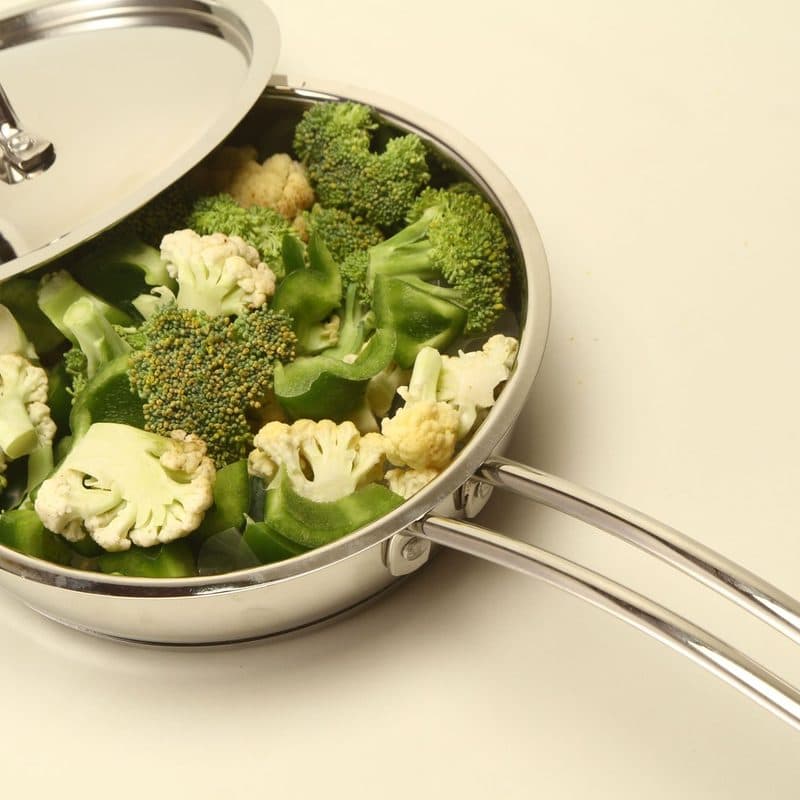 Made In Stainless Clad SaucierThe saucier to buy if this page convinces you. Five plies, 800F, reasonable money. | Sauces, risotto, custard and anything whisked | 8.9 | |
| 2 | 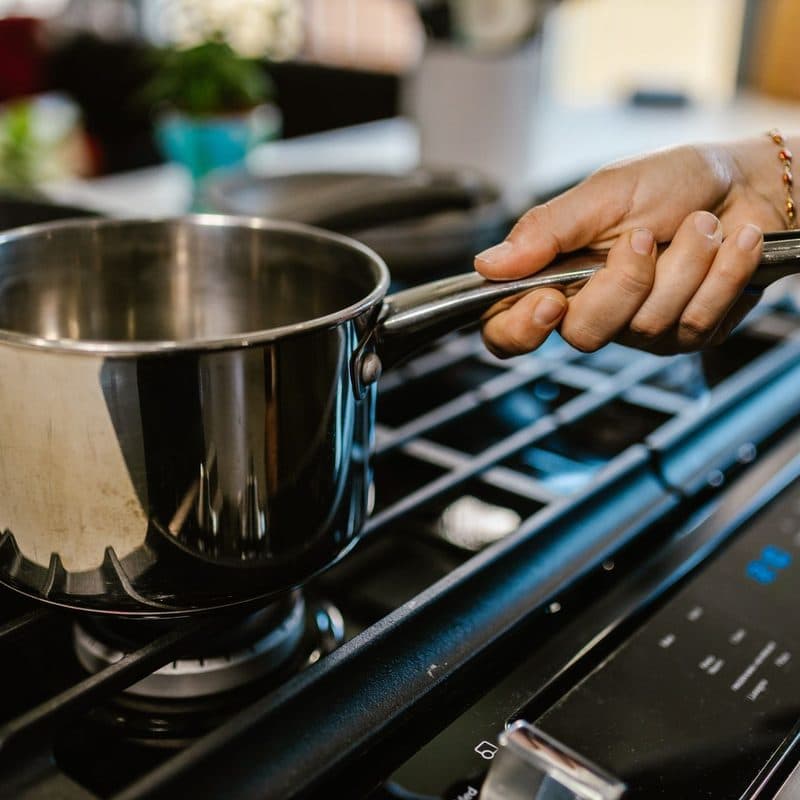 All-Clad D3 Stainless SaucepanIf straight walls are what you actually need, this is the one with the stainless lid and the record. | Boiling, long simmering and holding liquid | 9.0 |
#ad Buy links are affiliate links. We never print a price — prices change weekly and a printed one is wrong within a month, so every link goes to the live Amazon listing. How we are funded.
The quick answer
A saucepan has straight walls meeting the base at a right angle. A saucier has walls that curve up from the base in a continuous sweep. The saucier has no corner, so a whisk reaches everywhere and nothing collects and scorches; the saucepan has a narrower mouth, so it loses less liquid to evaporation and holds a long simmer better. Buy the saucier for sauces and stirred dishes, the saucepan for boiling and holding.
Side by side
| Saucier | Saucepan | |
|---|---|---|
| Wall shape | Curved, continuous with the base | Straight, right angle at the base |
| Whisk access | Complete | Misses the corner |
| Mouth | Wide relative to volume | Narrow relative to volume |
| Evaporation | Fast, good for reducing | Slow, good for simmering |
| Best at | Sauces, risotto, custard, polenta, grits | Rice, stock, pasta, blanching, holding |
| Worst at | Long simmers, boiling small volumes | Anything requiring constant whisking |
| Stirring | Sweeping motion, spoon stays in contact | Must deliberately work the corner |
| Pouring | Excellent, flared rim | Good, often with a lip |
Why one corner matters this much
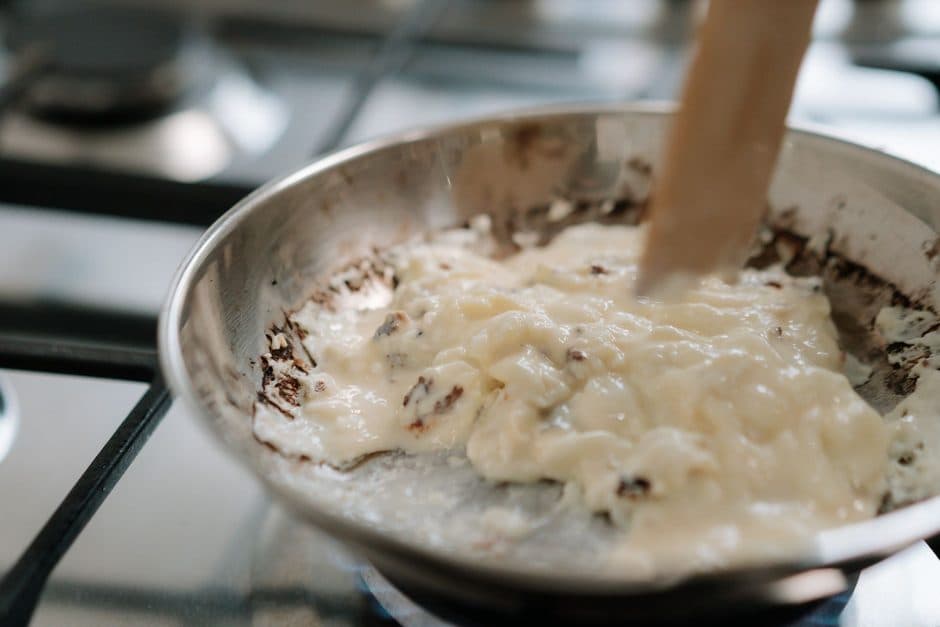
Scorching is a local phenomenon. It happens where food sits against hot metal without moving. In a straight-walled pan, the join between base and wall is a narrow trough that a round whisk physically cannot enter — you can work a spatula into it deliberately, but you will not do that continuously while also whisking the middle.
So a roux browns unevenly, a custard develops lumps that started as scorched film in the corner, risotto sticks in a ring you cannot see until you smell it. These are not exotic failures; they are the ordinary frustrations of making those dishes, and most cooks attribute them to technique rather than geometry.
The curved wall removes the trough. A spoon or whisk held against the surface sweeps from the center up the wall in one continuous motion and touches everywhere. That is the whole innovation, and it is several hundred years old.
Why the saucepan is not obsolete
Evaporation rate scales with exposed surface area. A three-quart saucier has a much wider mouth than a three-quart saucepan, so the same volume of liquid loses water faster. For a reduction that is exactly what you want. For a two-hour stock, or rice absorbing a measured quantity of water, or holding a sauce warm while everything else finishes, it is a genuine problem.
The narrow mouth also means less energy is needed to hold a boil, which matters if you boil a lot of water. And straight walls stack and store better — a mundane point that decides a lot of real kitchens.
Does one last longer?
Not meaningfully, if both are fully clad from the same brand. They share construction, warranty terms and failure modes. Two small differences are worth knowing.
A saucier's curved base-to-wall transition distributes thermal stress slightly better than a right-angled join, where stress concentrates at the corner. In practice neither shape fails there; warping happens across the base in both.
A saucepan is more prone to chloride pitting in one specific way: salt dropped into still water settles into the corner and concentrates there. Sauciers have no corner for it to settle into. Stir the salt in and neither pan has the problem.
The real longevity question for both is the lid. Glass lids crack, knobs loosen, and replacements are often unavailable — which retires perfectly good pans. Buy stainless lids where you can.
Which should you buy?
Buy the saucepan first if you own neither. It is the more fundamental pan and covers boiling, which you will do daily.
Buy the saucier next, and this is the recommendation most guides miss. Once you own a saucepan, the saucier adds far more capability than a second saucepan, a sauté pan or a stockpot. It is the highest-value third pan in a home kitchen, which is why it features in the two-pan kitchen.
Buy only the saucier if you are equipping a very small kitchen and cook sauces more than you boil. It will handle boiling adequately; it just will not be the best tool for it.
The picks in full
1. Best saucier
Made In Stainless Clad Saucier
Made In
The saucier to buy if this page convinces you. Five plies, 800F, reasonable money.
- Shape
- 9.2
- Heat
- 9.0
- Durability
- 8.6
- Value
- 8.8
- Five-ply stainless clad construction
- Heat safe to 800F (Made In published spec)
- Induction compatible; handwash preferred
- Rounded walls with no corner for a whisk to miss
- Lifetime warranty on stainless cookware
What it gets right
- Cheapest route into a genuinely good saucier from a fully-clad brand
- The 800F rating makes oven-finishing a braise or a gratin uncomplicated
- Wide mouth reduces sauces faster than a straight-walled saucepan
Who should skip it
- That wide mouth is a liability if you mostly boil small quantities
- Rounded base means less contact area on a small induction ring
- Five plies are slower off the heat than a copper-core saucier
If you decide the curved wall is what you need, this is the best balance of specification and price in the shape. Full reasoning in best stainless sauciers.
2. Best saucepan
All-Clad D3 Stainless Saucepan
All-Clad
If straight walls are what you actually need, this is the one with the stainless lid and the record.
- Simmer
- 9.2
- Durability
- 9.6
- Handling
- 7.8
- Value
- 7.0
- Tri-ply bonded construction with an aluminum core
- Oven and broiler safe to 600F
- Induction compatible; handwash only
- Straight walls and a tight-fitting stainless lid
- Limited lifetime warranty; made in Canonsburg, PA
What it gets right
- Straight walls and a narrow mouth hold a simmer with very little evaporation
- The same rivet and handle construction that survives ATK's abuse testing
- A stainless lid rather than glass, so the lid shares the 600F rating
Who should skip it
- A saucier does most of what this does, and does sauces better
- Handwash only, on a pan you will use several times a week
- Priced well above a Tramontina saucepan that boils water identically
Straight walls and a narrow mouth hold a simmer with very little evaporation, and the stainless lid shares the pan's 600F rating rather than capping it. If your cooking is rice, stock and pasta water, buy this and skip the saucier entirely.
Frequently asked questions
What is the difference between a saucier and a saucepan?
A saucepan has straight walls meeting the base at a right angle; a saucier's walls curve up from the base continuously. The curve removes the corner a whisk cannot reach, which is where food scorches.
Do I need a saucier if I already have a saucepan?
If you make sauces, risotto, custard, polenta or anything whisked, yes. If you mostly boil and simmer, your saucepan is already the better pan and a saucier adds little.
Can you boil pasta in a saucier?
Yes, but less efficiently. The wide mouth means faster evaporation and more energy needed to hold a boil. A straight-walled saucepan or stockpot is the better tool.
Is a saucier the same as a sauteuse?
Nearly. Both describe rounded-wall pans. Sauteuse usually implies a wider, shallower body with two handles; saucier a taller one with a single handle. Judge the photograph, not the name.
Which is better for making risotto?
The saucier, clearly. Risotto needs constant stirring and the starch it releases will stick in a saucepan's corner, where a spoon does not reach, and scorch.
Which size saucier replaces a 3-quart saucepan?
A 3-quart saucier. Capacity is stated the same way in both shapes, so like for like. The saucier will be wider and shallower for that volume.