Care & Technique
White Spots on a Stainless Steel Pan
Two different problems look almost identical. One wipes off with vinegar. The other is a permanent hole in the passive layer.
Disclosure: Ply & Pan earns a commission on qualifying purchases made through links on this page. We take no free product and no sponsorship, and we never print a price. How we are funded.

Quick picks
The short answer. Tap any row for the full write-up.
| # | Product | Best for | Score | Price |
|---|---|---|---|---|
| 1 | 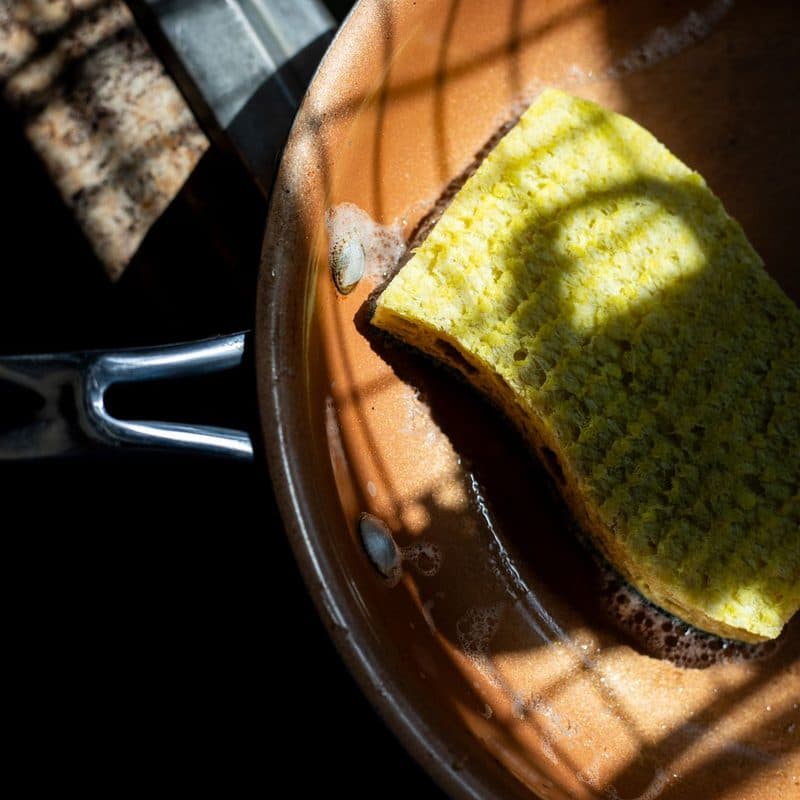 Bar Keepers Friend Cookware CleanserMildly acidic and mildly abrasive, which is the right combination when calcium has bonded to a layer of cooking residue. | Scale that has survived a vinegar soak | 9.2 | |
| 2 |  Heritage Steel Titanium Series Fry PanA 316Ti cooking surface resists chloride pitting materially better than the 18/10 used by almost everyone else. | Cooks who salt heavily or simmer acidic sauces for hours | 9.0 |
#ad Buy links are affiliate links. We never print a price — prices change weekly and a printed one is wrong within a month, so every link goes to the live Amazon listing. How we are funded.
The short answer
Chalky white spots that you can feel as a film are calcium from hard water, and white vinegar removes them in minutes. Small, shiny, slightly sunken spots are pits caused by salt or chloride attacking the steel, and those are permanent. Run a fingernail across the marks: if they sit on top of the surface, it is scale. If the surface is dimpled, it is pitting.
How to tell which you have
| Clue | Hard-water scale | Salt pitting |
|---|---|---|
| Appearance | Chalky, cloudy, often streaky or ring-shaped | Small bright dots, sometimes clustered on the base |
| Texture | Sits on the surface; you can feel a film | Sunken; the surface is dimpled |
| Vinegar test | Dissolves and wipes away | No change at all |
| Where it appears | Wherever water dried — walls and base | Almost always on the base, where salt settles |
| Reversible | Yes, completely | No |
Hard-water scale, and how to remove it
Scale is dissolved calcium and magnesium left behind when water evaporates. It is more obvious in stainless than in other pans because the surface is reflective, and it is worst where water boiled away rather than being poured off.
- Fill the pan with a one-to-three mix of white vinegar and water, enough to cover the marks.
- Bring it to a gentle simmer for five minutes, then turn it off and leave it for ten.
- Tip it out, wash normally with hot water and dish soap.
- If a haze remains, make a paste of Bar Keepers Friend, work it over the area with a damp non-scratch pad, and rinse thoroughly.
- Dry the pan with a cloth. This is the step that stops it coming back — air-drying in a hard-water area deposits the next layer immediately.
The same vinegar treatment handles the cloudy film that builds up on the inside of a kettle or a pasta pot. For heat tint and the other discolourations people lump in with white spots, see stainless steel pan discoloration.
Salt pitting, and why it is permanent
Stainless steel is corrosion resistant because chromium in the alloy reacts with oxygen to form an invisible passive film across the surface. That film repairs itself continuously — which is why a scratched pan is fine.
Chloride ions break the film locally and prevent it reforming at that spot. The exposed metal underneath then corrodes in a narrow pit. The classic cause is salt poured into cold water: undissolved crystals sink, sit on the base, and sit in a concentrated brine at the point of contact for as long as the water takes to boil.
Once a pit exists, nothing fills it. The pan is still perfectly safe and cooks exactly the same — pits are cosmetic in any practical sense — but they do not polish out. The alloy chemistry behind this is in 304 vs 316 stainless steel and 18/10 vs 18/8 vs 18/0.
Preventing both
- Add salt after the water boils, and stir it in. This single habit eliminates most pitting.
- Do not leave salted or acidic liquid in a pan overnight. Stock, brine and tomato sauce all attack the passive layer given enough hours.
- Dry pans with a cloth rather than air-drying, especially in a hard-water area.
- Rinse cleansers off completely. Dried cleanser residue can pit steel in exactly the same way salt does.
- Never use bleach or chlorine-based cleaners on stainless cookware. Chloride is the mechanism behind every pit on this page.
Does any of it matter?
Not for cooking, and not for safety. A pitted or scaled pan performs identically to a pristine one, and the stainless alloys used for cookware interiors are stable food-contact materials. What actually ends a clad pan's life is the base losing its flatness, which has nothing to do with either problem — when to replace stainless steel cookware sets out the real criteria, and does stainless steel cookware rust covers the one case where corrosion is genuinely worth worrying about.
If the marks bother you aesthetically and you are replacing a pan anyway, buying a 316-family cooking surface is the only purchasing decision that measurably reduces pitting. The brand-level view is in best stainless steel cookware brands.
The picks in full
1. Best for stubborn mineral film
Bar Keepers Friend Cookware Cleanser
Bar Keepers Friend
Mildly acidic and mildly abrasive, which is the right combination when calcium has bonded to a layer of cooking residue.
- Effectiveness
- 9.2
- Gentleness
- 8.4
- Availability
- 9.8
- Value
- 9.6
- Oxalic acid based: dissolves heat tint rather than grinding it off
- Powder and liquid formulations; the liquid is gentler on polished finishes
- Safe on stainless, not on anodized aluminum or nonstick coatings
- Rinse thoroughly and never leave it sitting on the surface
- Sold nearly everywhere, which matters more than it sounds
What it gets right
- The only product that reliably removes rainbow heat tint
- Cheap enough that there is no reason to tolerate a stained pan
- Restores the surface rather than polishing metal away
Who should skip it
- The abrasive powder will dull a mirror-polished exterior over time
- Does nothing for warping, which is the failure that actually matters
- Needs a thorough rinse; residue left on steel can pit it
Vinegar handles most hard-water scale on its own. What it does not handle is scale that has formed on top of, or mixed with, a film of polymerised cooking oil — which is what you usually have when the marks will not shift from a pan that is in daily use.
Bar Keepers Friend works on both at once: oxalic acid dissolves the mineral deposit and the mild abrasive lifts the organic film. Safe on stainless, widely stocked, and cheap enough that there is no reason to live with a marked pan.
Keep it off anodized aluminum and nonstick coatings entirely, use the liquid rather than the powder on mirror-polished exteriors, and rinse thoroughly — residue left sitting on steel can pit it, which is exactly the problem you are trying to avoid.
2. Best pan if salt pitting keeps happening
Heritage Steel Titanium Series Fry Pan
Heritage Steel
A 316Ti cooking surface resists chloride pitting materially better than the 18/10 used by almost everyone else.
- Resistance
- 9.6
- Build
- 9.2
- Oven
- 9.8
- Value
- 7.8
- 316Ti cooking surface: stainless strengthened with titanium and molybdenum
- Five-ply fully clad construction
- Oven safe to 800F and broiler safe (Heritage Steel published spec)
- Induction compatible; handwashing recommended
- Lifetime warranty; manufactured in Clarksville, TN
What it gets right
- 316Ti resists pitting from salt and acid better than the 18/10 everyone else uses
- The 800F oven rating matches Made In and beats All-Clad by 200F
- Made in a family-owned Tennessee factory, not assembled from imported bodies
Who should skip it
- Least-known brand here, so resale and second-hand parts are thin
- Priced against All-Clad without All-Clad's service history
- The clad steel is sourced from South Korea, so made-in-USA means built, not mined
If the marks on your pan are pits rather than deposits, and they keep appearing, the alloy is a legitimate part of the answer. Chloride ions attack the passive chromium oxide film, and the standard 304-family alloys used for almost all cookware interiors are only moderately resistant to them.
Heritage Steel's Titanium Series uses 316Ti — stainless strengthened with titanium and molybdenum — on the cooking surface. Molybdenum is specifically what raises a steel's chloride threshold, which is why 316 alloys are the marine and food-processing standard. Five-ply, 800F oven rating, induction compatible, lifetime warranty, made in Clarksville, Tennessee.
It is not immunity, just a higher threshold: salt left sitting in any pan will eventually mark it. Heritage Steel is also the least-known brand we recommend, so parts and resale are thin, and it is priced against All-Clad without All-Clad's service history.
Frequently asked questions
What causes white spots on a stainless steel pan?
Two different things. Chalky white film is calcium left by hard water. Small shiny dimples are pits caused by salt or chloride breaking the steel's passive layer. The first wipes off; the second is permanent.
How do you remove white marks from a stainless steel pan?
Simmer a one-to-three mix of white vinegar and water in the pan for five minutes, leave it ten, wash normally and dry with a cloth. If a haze remains, use Bar Keepers Friend and rinse thoroughly.
Are white spots on a pan dangerous?
No. Both hard-water scale and salt pitting are cosmetic. Cookware-grade stainless is a stable food-contact material and a pitted pan cooks exactly the same as a new one.
Why does salt pit stainless steel pans?
Undissolved salt sinks to the base and sits in concentrated brine. Chloride ions break the passive chromium oxide film locally and stop it reforming, so the metal under that spot corrodes into a pit.
Can salt pitting be repaired?
No. The pits are missing metal, so nothing fills them. They are harmless, but they do not polish out. Adding salt only after the water boils prevents new ones.
Does 316 stainless resist pitting better than 18/10?
Yes. 316-family alloys contain molybdenum, which raises the chloride threshold. Heritage Steel's Titanium Series uses 316Ti on the cooking surface; almost every other brand uses a 304-family 18/10.
Sources
- Klingspor — The passive layer on stainless steel (abrasives technical reference)
- Boulder Engineering Studio — 304 vs 316 stainless steel: composition and chloride thresholds
- Heritage Steel — Titanium Series 10.5-inch Fry Pan, published specification
- Xometry — 18/8 vs 18/10 vs 18/0 stainless steels compared
- All-Clad — Care and use instructions for stainless cookware