Construction & Materials
Why Stainless Steel Pan Handles Get Hot
A steel handle on a steel pan is one continuous piece of metal, so heat travels up it. Whether it reaches your hand depends on three things the manufacturer decided: length, cross-section, and whether the handle is hollow.
Disclosure: Ply & Pan earns a commission on qualifying purchases made through links on this page. We take no free product and no sponsorship, and every price here is read from Amazon on the date shown. How we are funded.
Quick picks
The short answer. Tap any row for the full write-up.
| # | Product | Best for | Score | Price |
|---|---|---|---|---|
| 1 | 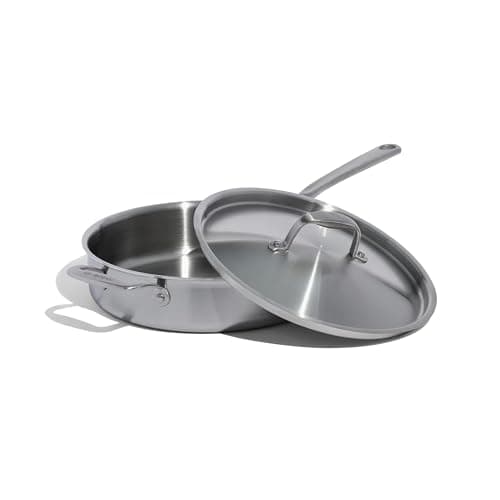 Made In Stainless Clad 3.5 Quart Sauté PanA hollow stay-cool handle is the most effective design here - the air gap breaks the conduction path, which is why it stays usable when a solid handle of the same length does not. | A pan you hold with a bare hand while it is full | 8.8 | |
| 2 | 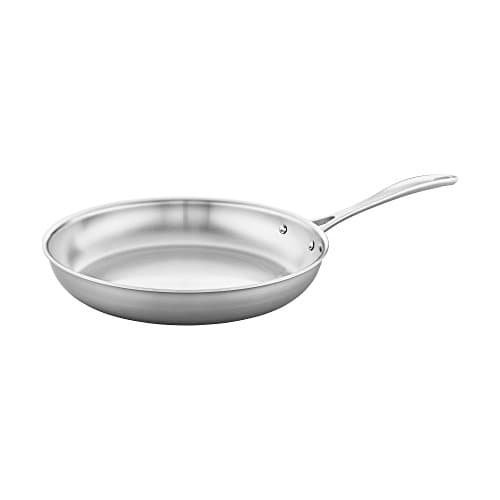 Zwilling Spirit 3-Ply Fry PanZwilling's V-shaped handle is shaped to be gripped with oven mitts on rather than to stay cool - a different and more honest solution to the same problem. | Oven work, where the handle will be hot whatever the design | 8.0 | |
| 3 | 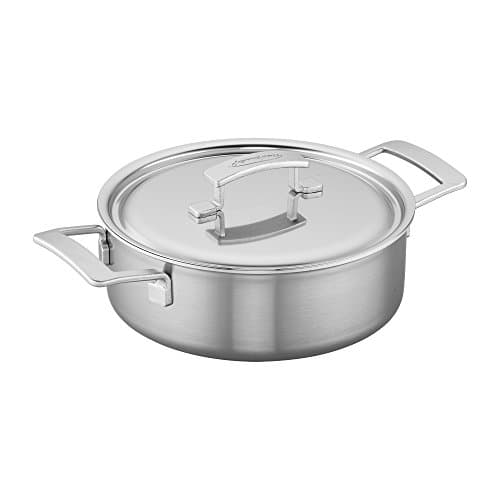 Demeyere Industry 5 3-Qt Deep Sauté PanWelded handles instead of riveted ones - flush walls inside the pan and nothing to work loose, at the cost of a joint that cannot be re-tightened. | Someone who wants nothing protruding inside the pan | 8.4 |
#ad Buy links are affiliate links. Prices come straight from Amazon, are stamped with the date they were read, and disappear rather than go stale if the feed stops. How we are funded.
Why it happens at all
A stainless pan with a stainless handle is one continuous piece of metal from the cooking surface to the end of the grip. Heat moves through metal by conduction, so heat put into the base travels outward and upward — through the wall, across the rivets or the weld, and along the handle toward your hand. There is no insulating break unless the manufacturer built one.
The useful thing to know is that stainless steel is a surprisingly poor conductor for a metal. That is why clad cookware has an aluminum core in the first place: aluminum conducts roughly fifteen times better than stainless, which is what makes the base heat evenly. The same property works in your favour at the handle, where slow conduction is exactly what you want. A solid aluminum or copper handle would be unusable.
So a warm handle is not a defect. It is the predictable result of making a handle out of the same material as the pan, which is also what makes it oven safe, dishwasher safe, and impossible to melt — the three things a plastic handle is not. The broader material comparison is in stainless vs aluminum.
The three things that decide how hot it gets
Length. The further your hand is from the pan, the more metal the heat has to travel through and the more surface area it has to radiate from on the way. A long handle on a small pan stays cool indefinitely on the hob. A short handle on a big pan does not.
Cross-section. A thick solid bar carries far more heat per second than a thin one. This is why All-Clad's narrow stick handle, which is the pan's least comfortable feature under load, is also one of its cooler ones — there is not much metal in it.
Whether it is hollow. This is the biggest single factor. A hollow handle has a fraction of the metal in cross-section and a column of air inside, and air is close to an insulator. Made In's stay-cool handles work this way. It is the only design that reliably keeps a large loaded pan handle comfortable on the hob.
One more factor is about you rather than the pan: which burner you use and how. A gas flame that licks up the side of the pan heats the wall and the rivets directly, which is a much faster path to the handle than conduction from the base. Turning the flame down so it stays under the pan makes a noticeable difference. Induction heats only the base, which is why handles generally run coolest on induction hobs.
The four handle designs you will meet
| Design | How it stays cool | Oven safe | Trade-off |
|---|---|---|---|
| Solid stainless stick | Length and thin cross-section | Yes, to the pan's rating | Can bite into the palm under load |
| Hollow stainless | Air gap breaks the conduction path | Yes, to the pan's rating | Bulkier; can trap water if not sealed |
| V-shaped stainless | Shaped for mitts rather than to stay cool | Yes, to the pan's rating | Still gets hot; relies on you using a cloth |
| Silicone or phenolic sleeve | Insulating material, not metal | Only to the sleeve's rating | Caps the pan's oven rating, and degrades |
That last row is the trap. A pan with a plastic or silicone handle sleeve may be a fine pan, but its oven rating is now the sleeve's rating, and the sleeve will discolor, harden and eventually crack. It is the main reason this site favours all-metal handles on cookware you intend to keep.
In the oven, every handle is hot
No handle design helps once the pan has been in a 425F oven for forty minutes, because the entire pan — handle included — is at oven temperature. Hollow handles slow conduction from a hot base; they do not insulate against ambient heat.
This is where people get burnt, and it is worth a habit rather than a hope: drape a cloth over the handle of any pan that has come out of the oven and leave it there until the pan is cold. A hot steel handle looks identical to a cold one.
Does a hot handle mean a badly made pan?
Usually not — but it can be a symptom of a thin one. Cuisinart's MultiClad Pro handles heat up faster than the clad competition, and the reason is related to why the pan is cheaper: a lighter-gauge pan has less mass to absorb the heat going into it, so more of that heat ends up travelling outward. A heavy pan sinks heat into itself.
A genuinely suspicious handle is a loose one. Rivets working loose is the commonest clad-pan failure, and a handle that wobbles is both a burn risk and a warranty claim. Check the rivets on a pan that has had a few years of use, and if the joint has play in it, contact the manufacturer rather than tightening it yourself — on most lifetime warranties this is covered. What the warranties actually say is in cookware lifetime warranties compared.
Helper handles, and when to insist on one
Above about four quarts, or on any skillet 12 inches and up, a second short handle opposite the main one is the difference between carrying a full pan and spilling it. It also moves one of your hands further from the hot zone over a burner.
It is one of the most checkable specifications on a listing and one of the most overlooked. If you are buying a large saute pan or a stock pot, look for it: Cuisinart's 5.5-quart saute pan includes one, and it is the main reason to choose a big pan that has it over one that does not.
What to do about a hot handle
Keep the flame under the pan. Gas licking up the sides heats the wall and rivets directly. Turning the burner down by a notch is often the whole fix.
Hold it further out. The last inch of a handle is dramatically cooler than the inch nearest the pan.
Use a cloth, not a silicone handle cover, for oven work. Slip-on covers are rated well below the pan and can melt onto the handle.
Buy a hollow handle if it bothers you. It is a design choice you can shop for, and it is the only one that reliably works.
The bottom line
A stainless handle gets warm because it is the same piece of metal as the pan, which is also why it is oven safe and will outlast you. Length, thin cross-section and a hollow interior all slow it down; a hollow handle is the only one that makes a large loaded pan genuinely comfortable. Nothing helps after a spell in the oven, so treat every handle as hot and keep a cloth over it. And avoid pans whose handles are kept cool with a plastic sleeve, because the sleeve becomes the pan's oven rating and then becomes the pan's first failure.
The picks in full
1. Best stay-cool handle
Made In Stainless Clad 3.5 Quart Sauté Pan
Made In
A hollow stay-cool handle is the most effective design here - the air gap breaks the conduction path, which is why it stays usable when a solid handle of the same length does not.
- Handle comfort
- 9.4
- Stay cool
- 9.2
- Build
- 8.8
- Value
- 8.4
- 3.5 quarts; five-ply stainless clad, crafted in Italy
- Oven safe to 800F (Made In published spec)
- 9.8 in cooking surface, 2.5 in deep; rolled pouring rim
- Dishwasher safe; gas, electric and induction
- Lifetime warranty on stainless cookware
What it gets right
- The 800F rating puts broiler finishing and hard oven braises inside spec
- Nearly 10 inches of cooking surface, more than the 4-quart All-Clad
- Hollow stay-cool handle is the most comfortable here when the pan is full
Who should skip it
- Five plies respond more slowly off the heat than a tri-ply pan
- The lid is a separate purchase on some listings — confirm before checkout
- Young company, so there is no long warranty-service record yet
Hollow is the design that actually works. A solid steel bar conducts heat along its whole length; a hollow tube has far less metal in cross-section and a column of air inside it, and air is a poor conductor. The result is a handle that heats much more slowly for the same pan temperature and the same length.
It matters most on a pan like this one — a 3.5-quart saute pan with nearly ten inches of cooking surface, which you will be lifting full. The pan is also five-ply and published to 800F, so it is the kind of pan that genuinely goes in a hot oven, where the handle question becomes a mitt question instead.
Against it: no handle design survives a 450F oven, hollow included — once the whole pan is at oven temperature, so is the handle. The lid is a separate purchase on some listings. And five plies respond more slowly off the heat than tri-ply.
#ad Price as of October 17, 2026. How we are funded
2. Best handle to grip through mitts
Zwilling Spirit 3-Ply Fry Pan
Zwilling
Zwilling's V-shaped handle is shaped to be gripped with oven mitts on rather than to stay cool - a different and more honest solution to the same problem.
- Handle comfort
- 9.2
- Stay cool
- 7.0
- Build
- 8.0
- Value
- 7.8
- Tri-ply: 18/10 stainless over a thick aluminum core
- Oven safe to 500F (Zwilling published spec)
- Dishwasher safe; induction compatible
- V-shaped handle designed to be gripped with oven mitts
- Flared rims for clean pouring
What it gets right
- The most comfortable handle of any tri-ply pan we looked at
- Zwilling's retail footprint makes warranty contact straightforward
- Dishwasher safe, unlike All-Clad's tri-ply
Who should skip it
- Zwilling does not publish clear warranty terms on the product page
- A 500F ceiling at a mid-tier price makes it hard to place
- The line is muddied by ceramic-nonstick versions sold under the same Spirit name
This is the other approach: accept that the handle gets hot and make it easy to hold anyway. The V-section is designed around a mitted hand, which is a genuinely different problem from a bare one — a handle that is comfortable in the fingers is often too thin to grip securely through thick fabric.
It is the most comfortable handle on any tri-ply pan we have looked at, bare hand or not, and the pan around it is honest tri-ply with an 18/10 interior over a thick aluminum core, dishwasher safe and induction compatible.
Against it: Zwilling does not publish clear warranty terms on the product page, and a 500F ceiling at a mid-tier price is hard to place. The Spirit name is also used for ceramic-nonstick versions, so check you are buying the stainless line.
#ad Price as of October 17, 2026. How we are funded
3. No rivets, welded handle
Demeyere Industry 5 3-Qt Deep Sauté Pan
Demeyere
Welded handles instead of riveted ones - flush walls inside the pan and nothing to work loose, at the cost of a joint that cannot be re-tightened.
- Handle comfort
- 8.4
- Stay cool
- 7.6
- Build
- 9.6
- Value
- 6.0
- 3 quarts; five-ply from rim to rim
- Oven safe to 500F (Zwilling published spec)
- Dishwasher safe; induction compatible
- Silvinox surface treatment; welded, not riveted, handles
- Lifetime warranty; made in Belgium
What it gets right
- Welded handles leave no rivet heads inside to trap fond and scrub around
- Silvinox is the only treatment here that measurably slows cosmetic aging
- Dishwasher safe despite sitting at the top of the price bracket
Who should skip it
- A 500F ceiling is low for the money
- Heaviest 3-quart pan here; genuinely tiring to deglaze one-handed
- Thin US retail presence, so a replacement lid takes effort to source
Welded handles change the inside of the pan rather than the temperature of the outside. There are no rivet heads to clean around, which on a saute pan — where you are scraping fond off the walls — is a real convenience, and nothing that can work loose over decades of use.
The pan is five-ply rim to rim, dishwasher safe, with the Silvinox surface treatment that slows cosmetic aging. It is built to a commercial-kitchen specification and the gauge shows it.
Against it: a welded joint cannot be re-tightened if it ever fails, where a loose rivet sometimes can. The 500F ceiling is low for the money. It is heavy. And US availability is thin enough that replacing a lid takes effort. The trade-off in full is in riveted vs welded handles.
#ad Price as of October 17, 2026. How we are funded
Frequently asked questions
Why does my stainless steel pan handle get so hot?
Because the handle and the pan are one continuous piece of metal, so heat conducts along it. How hot it gets depends on the handle's length, how much metal is in its cross-section, and whether it is hollow. A gas flame licking up the side of the pan heats the wall and rivets directly, which is a much faster path than conduction from the base - turning the flame down so it stays under the pan often fixes it.
Which stainless steel pans have handles that stay cool?
Hollow-handle designs, which put an air gap in the conduction path - Made In's stay-cool handles are the clearest example. Long, thin solid handles also stay cooler than short thick ones, which is why All-Clad's narrow stick handle runs cool even though it is uncomfortable under load. No handle stays cool after the pan has been in a hot oven.
Are silicone handle covers safe on stainless pans?
On the hob, broadly yes within their own temperature rating. In the oven, no - a slip-on cover is rated well below the pan and can soften or melt onto the handle. Use a dry cloth for oven work instead, and avoid pans with permanently bonded plastic or silicone sleeves, because the sleeve caps the pan's oven rating and will eventually harden and crack.
Does a hot handle mean the pan is poorly made?
Not by itself. But handles on lighter-gauge pans do heat faster, because a thin pan has less mass to absorb the heat going into it, so more of that heat travels outward - Cuisinart's MultiClad Pro is a known example. A handle that is loose rather than hot is the real warning sign, and on most lifetime warranties a working rivet is a covered claim.
Do induction hobs make handles cooler?
Generally yes. Induction heats only the magnetic base of the pan, so there is no flame or radiant element heating the walls and rivets from outside. Gas is the worst case, because flames that curl up the side feed heat straight into the wall and the handle join.
Sources
- Made In — Stainless Clad 3.5 Quart Sauté Pan, published specification
- Zwilling — Spirit 3-Ply 12-inch Frying Pan, published specification
- Zwilling — Demeyere Industry 5 11-inch Frying Pan, published specification
- Cuisinart — MultiClad Pro Stainless Cookware Set, published specification
- The Engineering ToolBox — Thermal conductivity of metals and alloys
- All-Clad — D3 Stainless 12-inch Fry Pan, published specification