Construction & Materials
Glass vs Stainless Steel Lids
A lid is not part of the pan's oven rating, and buyers almost always assume it is. Glass lids are commonly rated 150F to 200F below the pan they ship with - which is the number that limits you, because a saucepan spends most of its life covered.
Disclosure: Ply & Pan earns a commission on qualifying purchases made through links on this page. We take no free product and no sponsorship, and every price here is read from Amazon on the date shown. How we are funded.
Quick picks
The short answer. Tap any row for the full write-up.
| # | Product | Best for | Score | Price |
|---|---|---|---|---|
| 1 | 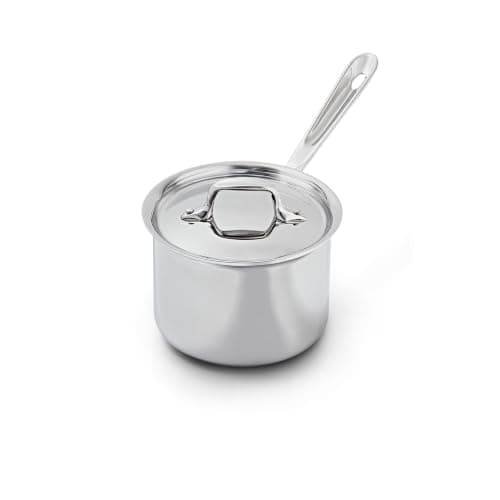 All-Clad D3 Stainless SaucepanShips with a stainless lid rather than glass, so the lid shares the pan's 600F rating. That is the whole argument for stainless lids, in one product. | Starting on the hob and finishing covered in the oven | 8.4 | $159.95 · View on Amazon $179.99 · 11% off |
| 2 | 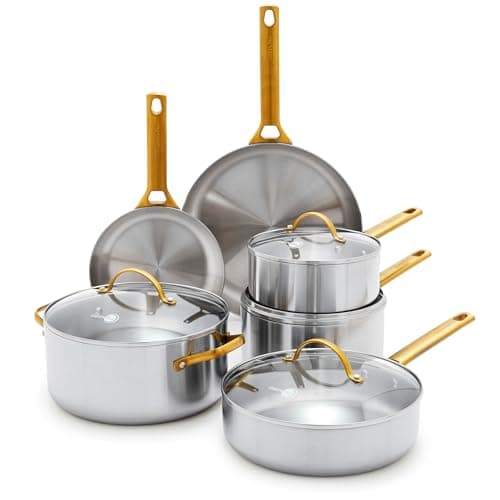 GreenPan Reserve Tri-Ply Stainless 10-Piece SetPans rated 600F and broiler safe; glass lids rated 425F. A 175F gap between a pan and its own lid, published by the manufacturer - and the reason to read both numbers. | Seeing the trade-off written on one spec sheet | 8.0 | $432.34 · View on Amazon $499.99 · 14% off |
| 3 | 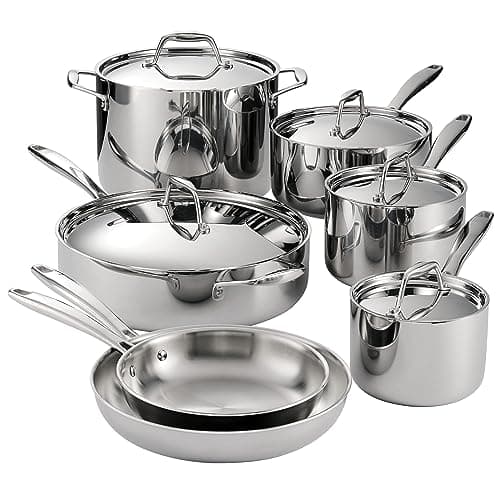 Tramontina Signature Tri-Ply Clad Cookware SetFully clad tri-ply across the set, NSF-certified and dishwasher safe - with lids that are the first thing to limit you. Assume a lower rating than the pans and you will not be caught out. | A value set where the pans outlast the lids | 8.4 | $299.95 · View on Amazon $399.95 · 25% off |
#ad Buy links are affiliate links. Prices come straight from Amazon, are stamped with the date they were read, and disappear rather than go stale if the feed stops. How we are funded.
The short answer
Glass for the hob, stainless for the oven. Glass lets you watch a simmer without lifting the lid and releasing the steam, which is genuinely useful and is why most cookware ships with it. Stainless shares the pan's oven rating, which is the only thing that matters once the pan goes in the oven covered. If you have to choose one, choose based on whether you finish dishes in the oven with a lid on.
A lid has its own rating, and it is usually lower
This is the fact that surprises people. When a manufacturer publishes "oven safe to 600F", that number describes the pan. The lid is rated separately, and if it is glass it is almost always rated lower — sometimes much lower.
GreenPan publishes Reserve stainless pans at 600F and broiler safe, and the glass lids at 425F. All-Clad's roasting pan rack is rated 375F while the pan is rated 600F, the same pattern in a different accessory. Tramontina describes its set's lids as the weakest component. Caraway does not publish a lid rating at all.
The consequence is simple and easy to miss: the ceiling of a covered dish is the lower of the two numbers. If you have a 600F pan and a 425F lid, you have a 425F covered pan. We keep the pan-side figures in oven-safe temperatures by brand.
What glass lids do well
You can see in. That sounds cosmetic and is not. Every time you lift a lid to check a simmer, you release the steam that was doing the cooking and drop the pan temperature. For rice, a reduction, or anything where the point is a steady covered environment, being able to look without opening is a real cooking advantage.
They are usually tempered and usually vented. Most come with a steam vent, which stops a lid rattling and boiling over, and tempered glass is designed to break safely if it does break.
They are cheaper to replace. Universal glass lids in standard diameters are widely sold, which matters because lids are the piece most often broken.
What they do badly: the oven ceiling, thermal shock, and dishwasher life. A hot glass lid put under a cold tap can fail, and the seal or rim trim on some designs degrades in a dishwasher long before the glass does.
What stainless lids do well
They share the pan's rating. A stainless lid on a 600F pan is a 600F lid. If you braise, make a pilaf, or start anything on the hob and move it covered into the oven, this is the specification that decides whether you can.
They are effectively unbreakable. Dented, maybe. Broken, no. On a buy-it-for-life purchase a lid you cannot smash is worth something.
They tolerate the dishwasher and the broiler. No seal, no trim, no tempering to worry about.
What they do badly: you cannot see in, so you will lift them more, and a stainless lid gets hot all over, handle included — the same mechanism described in why stainless steel pan handles get hot. Keep a cloth to hand.
Which pans need which lid
Saucepans: stainless, if you can get it. A saucepan is the pan most often used covered and most often moved to the oven. It is also the pan where a low lid ceiling costs you specific dishes. Our picks are in best stainless steel saucepans.
Skillets: usually no lid at all. The jobs a steel skillet is good at — searing, browning, deglazing — are uncovered, and putting a lid on a searing pan traps steam and ruins the crust. An 8-inch or 10-inch skillet does not need one.
Saute pans and Dutch ovens: either, and glass is fine. These get covered for braising at moderate temperatures, where 425F is plenty.
Stock pots: glass or stainless, it barely matters. A stock pot lives on the hob at a simmer. Lid rating is close to irrelevant: best stainless steel stock pots.
The foil workaround
If you own a 600F pan with a 425F glass lid and you want to braise at 450F, you do not need to buy anything. Cover the pan tightly with heavy foil, or with foil under the glass lid if you want the weight. Foil is rated as high as your oven goes and costs nothing.
This is worth saying because the lid question makes people spend money unnecessarily. The lid is the cheapest part of a pan to work around and the easiest to replace. Buy the pan on the pan's specification, and treat the lid as an accessory.
Buying a lid separately
Two things to check. First, lid diameters are measured across the pan rim, not the cooking surface, and a 10-inch skillet does not always take a 10-inch lid — measure the rim. Second, many pans are sold without a lid at all, including several of the single skillets on this site, so read the listing before assuming one is included; it is one of the commonest surprises in cookware buying.
The bottom line
Lids have their own oven ratings and glass lids are usually well below the pans they ship with — 425F against 600F is a published, real example. Glass is the better lid on the hob because you can see a simmer without disturbing it. Stainless is the better lid in the oven because it shares the pan's ceiling and cannot break. Buy the pan on the pan's numbers, read the lid's number separately, and keep foil in the drawer for the gap.
The picks in full
1. The stainless-lid benchmark
All-Clad D3 Stainless Saucepan
All-Clad
Ships with a stainless lid rather than glass, so the lid shares the pan's 600F rating. That is the whole argument for stainless lids, in one product.
- Lid ceiling
- 9.6
- Visibility
- 4.0
- Build
- 9.6
- Value
- 6.6
- Tri-ply bonded construction with an aluminum core
- Oven and broiler safe to 600F
- Induction compatible; handwash only
- Straight walls and a tight-fitting stainless lid
- Limited lifetime warranty; made in Canonsburg, PA
What it gets right
- Straight walls and a narrow mouth hold a simmer with very little evaporation
- The same rivet and handle construction that survives ATK's abuse testing
- A stainless lid rather than glass, so the lid shares the 600F rating
Who should skip it
- A saucier does most of what this does, and does sauces better
- Handwash only, on a pan you will use several times a week
- Priced well above a Tramontina saucepan that boils water identically
This is the clearest illustration of why the lid matters. The pan is rated 600F and broiler safe, and because the lid is stainless rather than glass, the lid is rated to the same temperature. There is no asterisk and no separate ceiling to remember.
A saucepan is where this pays off, because covered cooking is most of what a saucepan does: rice, a pilaf, beans, a braise started on the hob and finished in the oven. With a 425F glass lid, the last of those is off the table; with a stainless lid, it is not.
Against it: you cannot see in, which genuinely matters when you are learning a dish. It is handwash only, like all of All-Clad's bonded cookware. And it costs well above a Tramontina saucepan that boils water identically.
2. Where the glass-lid limit bites
GreenPan Reserve Tri-Ply Stainless 10-Piece Set
GreenPan
Pans rated 600F and broiler safe; glass lids rated 425F. A 175F gap between a pan and its own lid, published by the manufacturer - and the reason to read both numbers.
- Lid ceiling
- 5.6
- Visibility
- 9.0
- Build
- 7.8
- Value
- 8.6
- 10 pieces: 8-inch and 11-inch frypans, 2-qt and 3-qt saucepans, a 3-qt saute pan and a 5-qt stockpot, with four lids
- Tri-ply clad bodies; oven and broiler safe to 600F, lids to 425F (GreenPan published spec)
- Uncoated interiors, rated safe for metal utensils
- Dishwasher safe; induction compatible
- Limited lifetime warranty against manufacturing defects
What it gets right
- Six pans rather than a piece count padded with gadgets
- 600F and broiler safe across the whole set, which is rare at any price
- Dishwasher safe end to end, so the set survives a household that does not handwash
Who should skip it
- The biggest skillet is 11 inches, so there is no 12-inch in the box
- Four of the ten pieces are lids
- No published steel grade or plate thickness anywhere in the line
GreenPan deserves credit for publishing both figures plainly, because most brands do not. The Reserve stainless pans are rated 600F and broiler safe; the glass lids are rated 425F. That is a 175F gap inside a single boxed set, and it means the set's real covered-oven ceiling is 425F, not 600F.
In practice this is not a reason to avoid the set. 425F covers the great majority of covered oven work — braises, beans, rice — and the glass is genuinely useful on the hob, where most covered cooking happens anyway. It only bites if you want to cover something at a high roast temperature.
The rest of the set is strong: six clad pans, dishwasher safe, metal-utensil safe, limited lifetime warranty. What GreenPan does not publish is a steel grade or a plate thickness anywhere in the line.
3. Treat the lids as the weak component
Tramontina Signature Tri-Ply Clad Cookware Set
Tramontina
Fully clad tri-ply across the set, NSF-certified and dishwasher safe - with lids that are the first thing to limit you. Assume a lower rating than the pans and you will not be caught out.
- Lid ceiling
- 6.0
- Visibility
- 8.0
- Build
- 8.0
- Value
- 9.6
- Tri-ply clad throughout, not disc-bottomed on the pots
- 18/10 stainless interior over an aluminum core
- Oven safe to 500F; dishwasher safe; NSF-certified
- Induction compatible across the set
- Tramontina lifetime warranty
What it gets right
- Fully clad at a price where most sets quietly switch to disc bottoms
- The one set we would hand to someone furnishing a first kitchen
- The dishwasher-safe rating applies across the set, not just the skillets
Who should skip it
- Sets always include a piece or two you will never reach for
- The 500F ceiling limits oven work compared with buying pieces individually
- Lids are the weakest component; treat their rating as lower than the pans'
The pans here are genuinely clad throughout, including the pots, which is the thing that matters most and the thing cheap sets cheat on. The lids are the weakest component in the box, and that is worth knowing rather than discovering: treat their working ceiling as below the pans' 500F.
This is normal rather than scandalous. Lids take the least abuse in cooking and the most in storage, where they get stacked, knocked and dropped. Across a whole kitchen the lid is usually the first piece to fail, whatever it is made of.
The practical move with any value set is to keep one piece of heavy foil in the drawer. Foil covers anything at any oven temperature your pan is rated for, which makes a low lid ceiling a non-issue for oven work and leaves the glass lid to do what it is good at on the hob.
Frequently asked questions
Are glass lids as oven safe as the pan?
Almost never. A lid carries its own rating and glass lids are commonly rated well below the pan they ship with - GreenPan publishes 425F lids on 600F broiler-safe pans, for example. The real ceiling for a covered dish is the lower of the two numbers, so a 600F pan with a 425F lid is a 425F covered pan.
Are stainless steel lids better than glass?
In the oven, yes: a stainless lid shares the pan's rating and cannot break. On the hob, glass is better, because you can watch a simmer without lifting the lid and releasing the steam that is doing the cooking. The deciding question is whether you finish dishes covered in the oven.
Can you put a glass lid under the broiler?
No. Broiler heat is radiant and far above any glass lid rating, and most manufacturers exclude broiler use for glass entirely. Use a stainless lid, cover with heavy foil, or finish the dish uncovered.
Do stainless steel skillets need lids?
Usually not. The jobs a steel skillet is best at - searing, browning, deglazing - are uncovered, and a lid traps steam and softens the crust you were building. Saucepans, saute pans and stock pots need lids; an 8-inch or 10-inch skillet rarely does, which is why many are sold without one.
Can glass lids go in the dishwasher?
Most are published as dishwasher safe, but the glass is rarely what fails first - it is the rim trim or seal on designs that have one, which degrades over repeated hot cycles. Avoid thermal shock in particular: do not run cold water over a lid that has just come off a simmering pan.
Sources
- All-Clad — D3 Stainless 12-inch Fry Pan, published specification
- GreenPan - Reserve Stainless Steel 10-Piece Cookware Set, published specification
- GreenPan - Reserve Stainless Steel collection, current line-up and prices
- Tramontina — Signature Tri-Ply Clad Stainless Steel Fry Pan, published specification
- All-Clad - Specialty Stainless Steel Large Roaster with Rack 13 x 16 inch, published specification