Construction & Materials
Fully Clad vs Disc Bottom
Two products sold under the same words at very different prices. This is the distinction that matters most.
Disclosure: Ply & Pan earns a commission on qualifying purchases made through links on this page. We take no free product and no sponsorship, and we never print a price. How we are funded.
Quick picks
The short answer. Tap any row for the full write-up.
| # | Product | Best for | Score | Price |
|---|---|---|---|---|
| 1 |  Tramontina Signature Tri-Ply Clad Cookware SetFully clad across the whole set, including the pots. That is the corner most budget sets cut. | Not paying a premium to avoid disc bottoms | 8.9 | |
| 2 | 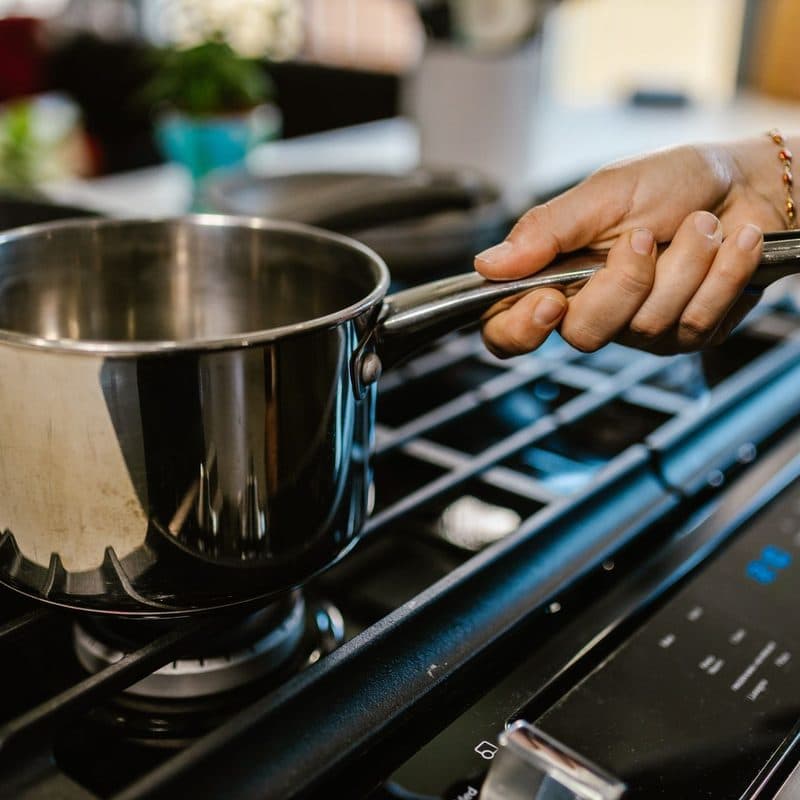 All-Clad D3 Stainless SaucepanSaucepans are where disc bottoms fail visibly, and where full cladding earns its money. | Milk, rice and anything that clings to a wall | 9.0 |
#ad Buy links are affiliate links. We never print a price — prices change weekly and a printed one is wrong within a month, so every link goes to the live Amazon listing. How we are funded.
The two constructions
Fully clad. The aluminum-and-stainless laminate is formed as a single bonded sheet and pressed into a pan, so the layers run continuously from the base up through the walls to the rim. Heat moves up the sides as well as across the bottom.
Disc bottom. Also sold as impact-bonded or encapsulated base. A slab of aluminum, usually capped with a layer of magnetic stainless, is welded onto the base of a pot whose walls are single-layer stainless. The base conducts; the walls do not.
Why the walls matter
Everyone imagines cooking as something that happens on the base of a pan. For a skillet that is nearly true. For anything containing liquid, it is not: the food is in contact with the walls for most of its depth, and the walls are also where things climb, cling and dry out.
A single-layer stainless wall over a hot base runs hot in an uneven, unpredictable pattern, because stainless conducts poorly and there is nothing spreading the heat. Milk scorches in a ring at the liquid line. Rice sticks to the sides. A thickening sauce catches wherever it touches. That is the disc-bottom failure, and it is not subtle.
It is why we treat this distinction as more important than ply count. Tri-ply versus five-ply changes how a pan behaves. Clad versus disc changes whether a pot works for a whole class of cooking.
Side by side
| Fully clad | Disc bottom | |
|---|---|---|
| Wall construction | Bonded laminate | Single-layer stainless |
| Heat up the sides | Yes | No |
| Scorching risk on walls | Low | High |
| Boiling water | Fine | Fine |
| Milk, rice, sauces | Fine | Scorches |
| Weight distribution | Even | Heavy base, light walls |
| Failure point | None specific; the bond is continuous | The weld attaching the disc |
| Repairable if it fails | No, but failure is rare | No |
| Price | Higher | Lower |
How to tell them apart
- Look at the cut edge of the rim. Fully clad shows a fine laminate sandwich; disc bottom shows a uniform single layer.
- Look at the base from the side. A disc bottom has a visible step or seam where the disc is attached.
- Feel the weight. A disc-bottom pot is heavy at the base and noticeably thin higher up.
- Read the wording. Impact-bonded, encapsulated base and aluminum-clad bottom all mean disc.
- Check whether a ply claim covers the whole pan. Some listings say 3-ply base, which is a disc bottom described flatteringly.
When a disc bottom is genuinely fine
We are not going to pretend disc bottoms are worthless. They are the right answer in specific cases.
Stockpots. A stockpot boils water and simmers liquid that never gets thick enough to scorch. Wall conduction adds little, and a fully-clad stockpot costs a lot more for no gain. If you buy one piece disc-bottomed, make it this.
Pasta pots and boiling vessels. Same reasoning.
Very large vessels generally. Cladding a 12-quart pot adds substantial weight and cost for a benefit you will not use.
Where a disc bottom is the wrong answer: saucepans, sauciers, sauté pans, and anything you will use for milk, rice, custard or a thickening sauce.
Which lasts longer?
Fully clad, and the reason is structural rather than a matter of quality tiers.
A bonded laminate has no discrete joint. The layers are fused across their whole area, so there is no single point where separation starts. Delamination does happen, but it is rare and it is a manufacturing defect — the one failure every lifetime warranty in this category actually covers.
A disc bottom has a weld, and a weld is a discrete joint. Repeated thermal cycling stresses it, and a disc can loosen or separate, typically announcing itself as a rattle or a visible gap at the edge. A separated disc is unrepairable and retires the pot, and whether it counts as a defect after ten years of use is exactly the argument you do not want to be having with a manufacturer.
Disc bottoms are also more prone to trapping moisture at the seam, which can produce corrosion at the join on cheaper pots.
For a buy-it-for-life purchase, that difference is the argument. For a stockpot you will boil water in, it is not worth paying for.
The picks in full
1. Fully clad at a disc-bottom price
Tramontina Signature Tri-Ply Clad Cookware Set
Tramontina
Fully clad across the whole set, including the pots. That is the corner most budget sets cut.
- Construction
- 8.6
- Coverage
- 8.8
- Durability
- 7.8
- Value
- 9.7
- Tri-ply clad throughout, not disc-bottomed on the pots
- 18/10 stainless interior over an aluminum core
- Oven safe to 500F; dishwasher safe; NSF-certified
- Induction compatible across the set
- Tramontina lifetime warranty
What it gets right
- Fully clad at a price where most sets quietly switch to disc bottoms
- The one set we would hand to someone furnishing a first kitchen
- The dishwasher-safe rating applies across the set, not just the skillets
Who should skip it
- Sets always include a piece or two you will never reach for
- The 500F ceiling limits oven work compared with buying pieces individually
- Lids are the weakest component; treat their rating as lower than the pans'
The practical point of this page is that you do not have to pay premium prices to avoid disc-bottom pots. Tramontina's Signature set is fully clad throughout.
2. The shape where it matters most
All-Clad D3 Stainless Saucepan
All-Clad
Saucepans are where disc bottoms fail visibly, and where full cladding earns its money.
- Simmer
- 9.2
- Construction
- 9.2
- Durability
- 9.6
- Value
- 7.0
- Tri-ply bonded construction with an aluminum core
- Oven and broiler safe to 600F
- Induction compatible; handwash only
- Straight walls and a tight-fitting stainless lid
- Limited lifetime warranty; made in Canonsburg, PA
What it gets right
- Straight walls and a narrow mouth hold a simmer with very little evaporation
- The same rivet and handle construction that survives ATK's abuse testing
- A stainless lid rather than glass, so the lid shares the 600F rating
Who should skip it
- A saucier does most of what this does, and does sauces better
- Handwash only, on a pan you will use several times a week
- Priced well above a Tramontina saucepan that boils water identically
A skillet mostly uses its base. A saucepan uses its walls constantly, which is why disc-bottom construction shows up as scorched milk and stuck rice in this shape first.
Frequently asked questions
What is the difference between fully clad and disc bottom cookware?
Fully clad has bonded metal layers running from base to rim, so the walls conduct heat. Disc bottom welds an aluminum slab to the base of a pot with single-layer stainless walls that scorch.
How can I tell if cookware is disc bottom?
Look for a step or seam around the base seen from the side, and a uniform single-layer rim rather than a visible laminate sandwich. Impact-bonded and encapsulated base both mean disc.
Is disc bottom cookware bad?
Not for boiling. It is genuinely fine for stockpots and pasta pots, where wall conduction adds nothing. It is the wrong choice for saucepans, sauciers and anything that thickens.
Why does my disc-bottom saucepan scorch milk?
Because the walls are single-layer stainless with no conductive core. They run hot and uneven, and milk clinging to the sides at the liquid line burns there.
Can a disc bottom come off?
It can separate, usually announcing itself as a rattle or a visible gap at the edge. The weld is a discrete joint that thermal cycling stresses, and a separated disc is unrepairable.
Is fully clad worth the extra cost?
For saucepans, sauciers and skillets, yes. For a large stockpot, generally not: cladding adds weight and cost for a benefit that boiling water does not use.
Sources
- Tramontina — Signature Tri-Ply Clad Stainless Steel Fry Pan, published specification
- All-Clad — D3 Stainless 12-inch Fry Pan, published specification
- All-Clad — Cookware Limited Lifetime Warranty (PDF)
- Cuisinart — MultiClad Pro Stainless Cookware Set, published specification
- Consumer Reports — Best cookware sets