Saucepans & Sauciers
Saucepan vs Stock Pot
They are not the same pot in two sizes. The proportions are different, and the proportions are the point.
Disclosure: Ply & Pan earns a commission on qualifying purchases made through links on this page. We take no free product and no sponsorship, and we never print a price. How we are funded.
Quick picks
The short answer. Tap any row for the full write-up.
| # | Product | Best for | Score | Price |
|---|---|---|---|---|
| 1 | 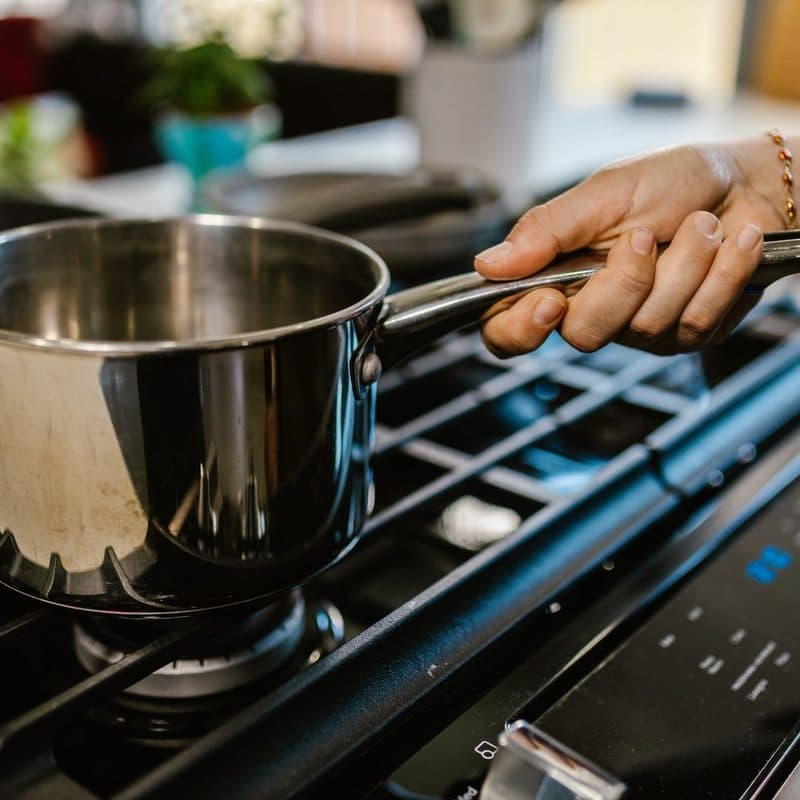 All-Clad D3 Stainless SaucepanStraight walls and a narrow mouth hold a simmer, and the stainless lid shares the pan's 600F rating. | One dish at a time, with minimal evaporation | 8.9 | |
| 2 | Tramontina Signature Tri-Ply Clad Stock PotEight quarts, fully clad through the walls rather than disc-bottomed, dishwasher safe and NSF-certified. | Chili, thick soup and anything that clings to the wall | 8.9 | |
| 3 | 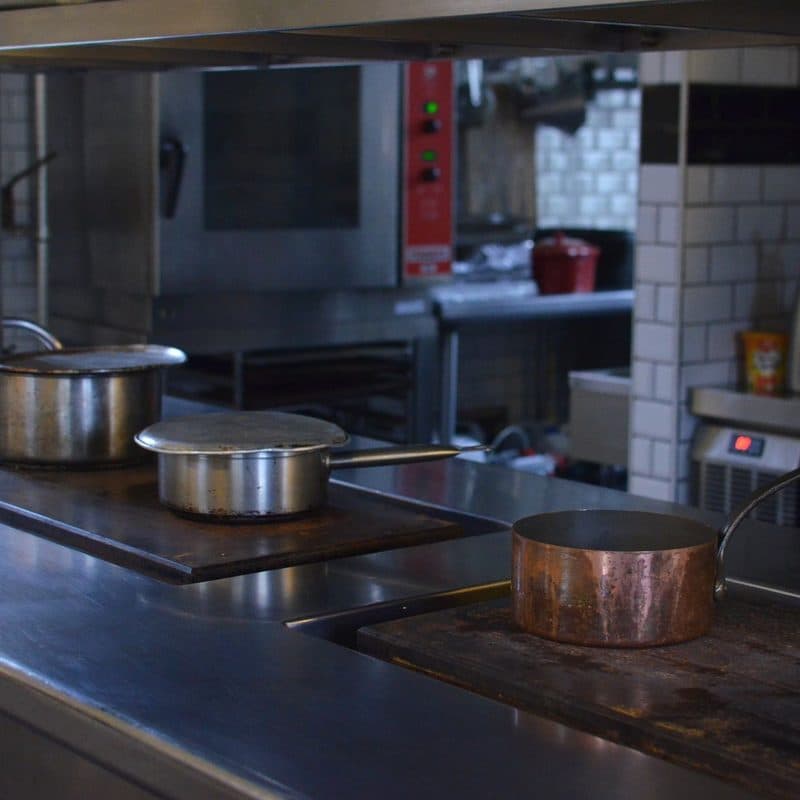 Winco SST-12 Commercial Stock PotTwelve quarts, NSF-listed, welded handles, encapsulated base. The right pot when the contents are only ever liquid. | Pasta, stock and blanching, where walls do not matter | 8.7 |
#ad Buy links are affiliate links. We never print a price — prices change weekly and a printed one is wrong within a month, so every link goes to the live Amazon listing. How we are funded.
The short answer
A saucepan is a 1 to 4-quart pan roughly as wide as it is tall, sized for one dish and built to reach a simmer quickly. A stock pot is a 6 to 16-quart vessel that is taller than it is wide, built to hold a large volume of liquid for hours with as little evaporation as possible. The line sits around 4 to 6 quarts. Below it the shape favours one dish; above it the shape favours volume and time.
Side by side
| Saucepan | Stock pot | |
|---|---|---|
| Typical capacity | 1 to 4 quarts | 6 to 16 quarts and up |
| Proportions | Roughly as wide as it is tall | Noticeably taller than it is wide |
| Handle | One long handle | Two loop handles, because it is heavy when full |
| Evaporation | Moderate — a usable amount of surface area | Low — small surface relative to volume |
| Time to simmer | Fast | Slow, and limited by your burner |
| Built for | Sauces, grains, reheating, one or two portions | Stock, pasta, boils, batch soup and chili |
| Cladding matters? | Yes — food clings to saucepan walls | Only if the contents thicken |
| Lid | Tight, to hold steam in for grains | Often partly open, to let stock reduce |
Why the shape is the real difference
Capacity is the obvious distinction and the shallow one. The useful difference is the ratio of surface area to volume, because that ratio decides how fast liquid evaporates and how fast the contents heat.
A stock pot is deliberately tall and narrow. Over a four-hour stock simmer, a narrow pot loses far less water than a wide one of the same volume, so the stock concentrates slowly and predictably instead of needing topping up. The same geometry is why a stock pot is slow to come to temperature: a small base relative to a large mass.
A saucepan is proportioned for the opposite job. It has a usefully large base for its volume, so it heats quickly and a sauce reduces at a rate you can watch. That is also why the shape stops working at scale: a 6-quart pan with saucepan proportions would be too wide to sit on a domestic burner and would boil away over a long simmer.
And a saucier is a third shape again, with the walls curved into the base so a whisk reaches everywhere — saucier vs saucepan covers that comparison.
Which jobs belong in which
Saucepan: rice and grains, oatmeal, pan sauces and reductions, custards, melting butter or chocolate, boiling eggs, reheating, blanching a handful of vegetables, gravy.
Stock pot: stock and broth, pasta by the pound, soup and chili in batch, seafood boils, corn, brining, canning, cooking beans from dry, steaming with an insert.
Either, awkwardly: soup for two, blanching in moderate volume, a pound of pasta. These are the jobs that sit on the boundary, and they are why 4-quart saucepans and 6-quart stock pots both exist and both feel like compromises.
The construction priorities are different too
In a saucepan, fully clad walls matter a great deal. Saucepan food clings to the sides — milk, rice, a thickening sauce — and a single-layer stainless wall scorches where it touches.
In a stock pot it depends entirely on the contents. For water-based jobs, an encapsulated commercial base is just as good and far cheaper, because heat enters through the bottom and convection does the rest. For chili and thick soup, clad walls are worth paying for. That is why our stock pot ranking in best stainless steel stock pots includes both constructions rather than ranking clad above commercial by default, and fully clad vs disc bottom explains the mechanism.
Handles differ for a physical reason: a full 12-quart pot can weigh 25 pounds or more, which is a two-handed lift, so stock pots get loop handles on both sides while saucepans get one long handle you can hold and pour with.
Do you need both?
Yes, and in that order. A 2 to 3-quart saucepan earns its place in any kitchen within a week. A stock pot is a less frequent tool but there is no substitute for it when you need volume — a saucepan cannot boil a pound of pasta properly, and crowding pasta into too little water is the single most common cause of gummy pasta.
If you are buying from nothing, buy the saucepan first and the stock pot second, and buy the stock pot cheap unless you make chili and thick soup in it. Sizing for both is in what size saucepan do you need and what size stock pot do you need, and the broader argument about how few pans a kitchen actually needs is in the two-pan kitchen.
The picks in full
1. Best saucepan
All-Clad D3 Stainless Saucepan
All-Clad
Straight walls and a narrow mouth hold a simmer, and the stainless lid shares the pan's 600F rating.
- Simmer
- 9.2
- Construction
- 9.2
- Durability
- 9.6
- Value
- 6.8
- Tri-ply bonded construction with an aluminum core
- Oven and broiler safe to 600F
- Induction compatible; handwash only
- Straight walls and a tight-fitting stainless lid
- Limited lifetime warranty; made in Canonsburg, PA
What it gets right
- Straight walls and a narrow mouth hold a simmer with very little evaporation
- The same rivet and handle construction that survives ATK's abuse testing
- A stainless lid rather than glass, so the lid shares the 600F rating
Who should skip it
- A saucier does most of what this does, and does sauces better
- Handwash only, on a pan you will use several times a week
- Priced well above a Tramontina saucepan that boils water identically
Tri-ply bonded with an aluminum core, 600F oven and broiler safe, induction compatible, handwash only, straight walls, a tight stainless lid, limited lifetime warranty, made in Canonsburg, Pennsylvania. The saucepan reference, in the 2 to 3-quart size that actually gets used.
2. Best stock pot for food that thickens
Tramontina Signature Tri-Ply Clad Stock Pot
Tramontina
Eight quarts, fully clad through the walls rather than disc-bottomed, dishwasher safe and NSF-certified.
- Capacity
- 8.6
- Construction
- 8.8
- Durability
- 7.8
- Value
- 9.6
- 8 quarts; tri-ply clad, 18/10 stainless over an aluminum core
- Fully clad through the walls, not an encapsulated base
- Oven safe to 500F; dishwasher safe
- Induction compatible; NSF-certified
- Riveted cast stainless handles and a stainless lid; made in Brazil
What it gets right
- Fully clad walls, so it handles chili and thick sauces that a disc-bottom pot scorches
- Stainless lid shares the pot's oven rating rather than capping it
- Dishwasher safe and NSF-certified, neither of which All-Clad's tri-ply is
Who should skip it
- The 500F ceiling is the lowest here, so broiler finishing is out of spec
- You are paying for wall cladding that pure boiling never uses
- Lighter gauge than the commercial pots, so it is more prone to warping
Tri-ply clad walls, 18/10 over an aluminum core, 500F oven rating, dishwasher safe, induction compatible, NSF-certified, riveted cast stainless handles and a stainless lid. Clad walls are what stop a pot scorching food that sticks to the side.
3. Best stock pot for water
Winco SST-12 Commercial Stock Pot
Winco
Twelve quarts, NSF-listed, welded handles, encapsulated base. The right pot when the contents are only ever liquid.
- Capacity
- 9.6
- Construction
- 7.4
- Durability
- 8.6
- Value
- 9.8
- 12 quarts; 18/8 stainless with an encapsulated tri-ply heavy-duty base
- Aluminum core in the base only; single-layer walls
- Induction ready; NSF listed for commercial kitchens
- Welded handles rather than riveted, with 6-point welds
- Cover included; 11 in diameter x 7.1 in high, 8.25 lb
What it gets right
- The welded handles have no rivets to work loose, which is the commonest clad-pot failure
- NSF listing is a real commercial standard, not a marketing badge
- Cheap enough that it is the obvious answer for a pot that only boils
Who should skip it
- Single-layer walls will scorch anything that thickens or clings
- Welded handles trap residue at the join and cannot be re-tightened
- Sold mainly through foodservice suppliers, so retail availability varies
Twelve quarts of 18/8 stainless with an encapsulated heavy-duty tri-ply base, single-layer walls, induction ready, NSF listed, cover included, six-point welded handles with no rivets to work loose.
Frequently asked questions
What is the difference between a saucepan and a stock pot?
A saucepan is 1 to 4 quarts and roughly as wide as it is tall, built to heat fast for one dish. A stock pot is 6 quarts or more and taller than it is wide, built to hold a large volume of liquid for hours with little evaporation.
Can I use a saucepan instead of a stock pot?
For small jobs, yes. For a pound of pasta, a batch of stock or soup for six, no — a saucepan does not hold enough water, and crowding pasta into too little water is what makes it gummy.
Can I use a stock pot as a saucepan?
You can, but it is slow and awkward. The small base relative to the mass means it takes a long time to reach a simmer, and the two loop handles make pouring a two-handed job.
Where does a saucepan end and a stock pot begin?
Around 4 to 6 quarts. Four-quart saucepans and 6-quart stock pots both exist and both feel like compromises, because the proportions stop suiting their intended jobs at that size.
Does a stock pot need clad walls?
Only if the contents thicken or cling. For pasta water, stock and blanching, an encapsulated commercial base performs identically and costs far less. For chili and thick soup, clad walls prevent scorching.
Which should I buy first?
The saucepan. A 2 to 3-quart saucepan earns its place within a week in any kitchen. Buy the stock pot second, and buy it cheap unless you intend to cook thick food in it.
Sources
- All-Clad — D3 Stainless 12-inch Fry Pan, published specification
- All-Clad — Care and use instructions for stainless cookware
- Tramontina — Signature Tri-Ply Clad Stainless Steel Fry Pan, published specification
- America's Test Kitchen — The Best Saucepans
- The Engineering ToolBox — Thermal conductivity of metals and alloys