Skillets & Fry Pans
The Best Skillet for Searing Steak
Searing is a thermal-mass problem before it is a pan-brand problem. Here is what actually decides it.
Disclosure: Ply & Pan earns a commission on qualifying purchases made through links on this page. We take no free product and no sponsorship, and we never print a price. How we are funded.

Quick picks
The short answer. Tap any row for the full write-up.
| # | Product | Best for | Score | Price |
|---|---|---|---|---|
| 1 |  All-Clad D3 Stainless Fry PanEnough mass to sear, enough responsiveness to make the sauce afterwards. Cast iron cannot do the second half. | Searing then building a pan sauce in the same pan | 9.0 | |
| 2 | 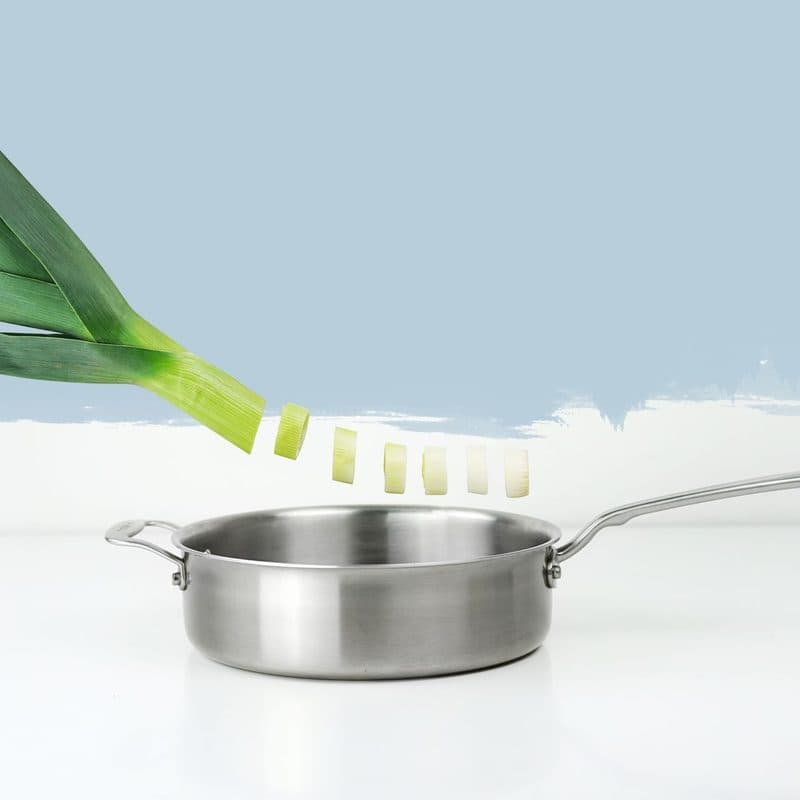 Made In Stainless Clad Frying PanThe 800F rating means the broiler-and-oven half of the method is inside spec rather than a gamble. | Thick cuts that need a sear then a rest in the oven | 8.8 |
#ad Buy links are affiliate links. We never print a price — prices change weekly and a printed one is wrong within a month, so every link goes to the live Amazon listing. How we are funded.
What searing actually demands
A sear is the Maillard reaction plus evaporation, and both need the pan surface to stay above roughly 300F while a cold, wet steak sits on it pulling energy out. That imposes two requirements that have nothing to do with brand.
Stored heat. When the steak lands, the surface temperature crashes. How far and for how long depends on how much energy the pan was holding. This is thermal mass, and it is why a thin pan sears badly no matter how hot you got it.
A surface that grips then releases. Browning has to stick to happen, and then let go. Bare stainless does this well: the crust forms, bonds briefly, then releases as it dries. Nonstick actively prevents the bond, which is exactly why steaks seared in nonstick come out gray. A nonstick pan is also the wrong tool for the heat involved.
Stainless or cast iron?
Cast iron holds more heat per pan than any clad stainless skillet, so on a pure crust contest it wins. It is also cheap, effectively indestructible, and happy at any temperature you can produce.
The case for stainless is what happens next. Deglaze a cast-iron pan and you will strip seasoning; try to control a reducing sauce in it and you cannot, because it responds to heat changes over minutes rather than seconds. Clad stainless gives up some crust and buys you the entire second half of the dish. It is also non-reactive, so wine, tomato and lemon are all fine.
The honest recommendation is to own both and use the one that suits the dish. Full comparison in stainless vs cast iron.
The method that makes the pan work
- Dry the steak thoroughly on both sides. Surface water must boil off before browning starts.
- Preheat the dry pan over medium-high until it passes the water test.
- Add a high-smoke-point oil and swirl to coat, then wait for it to shimmer.
- Lay the steak away from you and do not move it for two to three minutes.
- Lift only when it releases. If it grips, it is not ready.
- Flip once, add butter and aromatics, and baste.
- Rest the meat off the heat, then build the sauce in the same pan.
Step two is the one people skip, and it is the one that decides whether the steak sticks. The test takes four seconds and is set out in the water test.
Size matters more than brand here
Two steaks in a 10-inch pan is crowding, and crowding is fatal to searing: the released moisture cannot evaporate, the surface temperature falls below browning range, and the meat steams. A 12-inch gives you roughly 40% more usable area, which is the difference between a crust and a gray exterior. If you sear regularly, buy the larger pan — see 10-inch vs 12-inch.
What searing does to a pan over time
Searing is the hardest routine thing you will do to a skillet. You are running it near the top of its temperature range, often with an empty preheat, which is precisely the condition every warranty in this category excludes from coverage. All-Clad's terms exclude discoloration, warping and metal separation from high heat or prolonged heating when empty.
Practically: keep empty preheats short, preheat at medium rather than maximum and let the pan come up gradually, and never take a searing-hot pan to the sink. Expect heat tint — the rainbow sheen is normal on a pan used this way, it is cosmetic, and an oxalic cleanser removes it. See pan discoloration explained.
The picks in full
1. Best all-round searing pan
All-Clad D3 Stainless Fry Pan
All-Clad
Enough mass to sear, enough responsiveness to make the sauce afterwards. Cast iron cannot do the second half.
- Heat retention
- 8.6
- Fond
- 9.4
- Response
- 8.8
- Durability
- 9.6
- Tri-ply: stainless interior, aluminum core, magnetic stainless exterior
- Oven and broiler safe to 600F (All-Clad published spec)
- Induction compatible on any stovetop
- Handwash only, per the manufacturer
- Limited lifetime warranty; bonded, engineered and assembled in Canonsburg, PA
What it gets right
- Survived America's Test Kitchen's concrete-strike abuse testing with barely a ding
- Rivets and handle join are the sturdiest in the category
- Decades of parts and service history standing behind the warranty
Who should skip it
- Costs roughly three times a Tramontina that cooks nearly as evenly
- The stick handle is narrow and bites into your palm on a loaded 12-inch pan
- Handwash only, which is a real constraint if you hate washing up
Cast iron stores more heat and will out-sear this pan on raw crust. What it will not do is let you deglaze and reduce a sauce with any control, because it takes minutes to respond when you pull the heat down. If the steak is the whole dish, use cast iron. If there is a sauce afterwards, use this.
2. Best for oven finishing
Made In Stainless Clad Frying Pan
Made In
The 800F rating means the broiler-and-oven half of the method is inside spec rather than a gamble.
- Heat retention
- 9.0
- Fond
- 9.2
- Response
- 8.0
- Durability
- 8.6
- Five-ply construction, 2.7mm thick (Made In published spec)
- Heat safe to 800F / 430C, 200F above All-Clad's rating
- Gas, electric and induction; handwash preferred
- Lifetime warranty on stainless; the frying pans are made in Italy
- Flared rim pours cleanly, which sounds trivial until you deglaze
What it gets right
- The 800F rating puts broiler work and hard oven finishes in spec rather than in hope
- Longer, flatter handle is more comfortable than All-Clad's stick handle
- Direct-to-consumer pricing undercuts All-Clad at an equivalent ply count
Who should skip it
- No decades-long warranty service record yet; the company is young
- Five plies make it slower to respond than a tri-ply of the same size
- Warranty excludes warping from thermal shock, same as everyone else's
Thick steaks want a hard sear then gentle oven heat. Five plies give more stored energy for the sear, and the published 800F rating means a broiler finish is within the manufacturer's own spec — which matters because heat damage is excluded from every warranty in this category.
Frequently asked questions
Should you sear steak in stainless steel or cast iron?
Cast iron for pure crust, because it holds more heat. Stainless if you want a pan sauce afterwards, because it responds to heat changes in seconds rather than minutes and is non-reactive with wine and acid.
Can you sear a steak in a nonstick pan?
Badly. Searing needs the crust to bond briefly to the surface, which is exactly what nonstick prevents, and the temperatures involved are above what most nonstick coatings should see.
Why does my steak stick to the stainless pan?
The pan was not hot enough when the steak went in, or you moved it too early. Properly seared meat releases by itself once the crust forms. If it grips, wait another thirty seconds.
What size skillet is best for searing steak?
A 12-inch for two steaks. Crowding traps released moisture, which drops the surface temperature below browning range and steams the meat instead of searing it.
Does searing damage a stainless pan?
It ages it faster. High heat produces heat tint, which is cosmetic, and empty preheating risks warping, which is not. Keep empty preheats short and never take a hot pan to cold water.
What oil should I use for searing in stainless?
One with a high smoke point: refined avocado, grapeseed, or a neutral vegetable oil. Add it after the pan is preheated, not before, and add butter only at the basting stage.