Construction & Materials
Stainless Steel Pan Thickness: What Gauge Actually Matters
Five thin plies can be a worse pan than three thick ones. Thickness is the specification that decides even heating and warp resistance, and most brands refuse to publish it.
Disclosure: Ply & Pan earns a commission on qualifying purchases made through links on this page. We take no free product and no sponsorship, and every price here is read from Amazon on the date shown. How we are funded.

Quick picks
The short answer. Tap any row for the full write-up.
| # | Product | Best for | Score | Price |
|---|---|---|---|---|
| 1 | 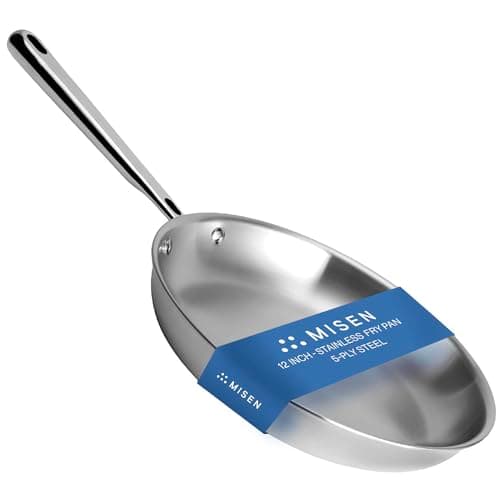 Misen 5-Ply Stainless SkilletFive plies at a published 3.0mm — the thickest figure anyone on this site publishes — rated to 800F and dishwasher safe. | Maximum thermal mass per dollar | 9.0 | $109.65 · View on Amazon $129.00 · 15% off |
| 2 | 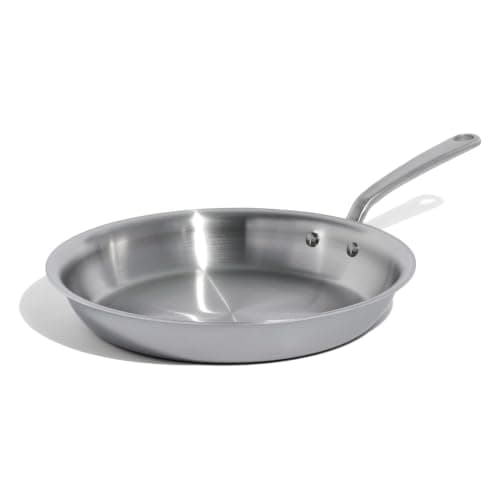 Made In Stainless Clad Frying PanPublished at 2.7mm with an 800F oven rating — a tenth of a millimetre either way is not the point, publishing the figure at all is. | Heavy enough to cook well, light enough to use daily | 9.0 | |
| 3 | 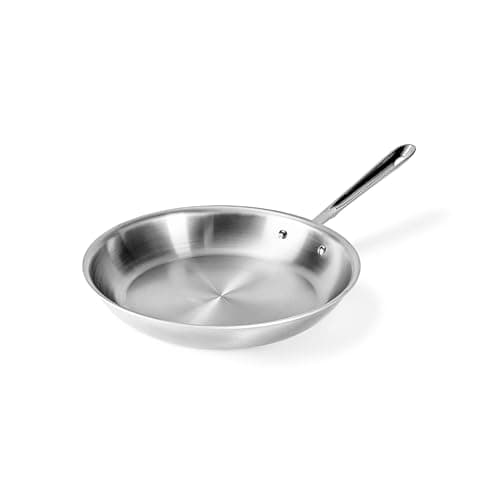 All-Clad D5 Stainless Brushed Fry PanAll-Clad publishes no millimetre figure, but the heavier D5 gauge means less flexing at the base over a decade — and decades of independent testing stand behind it. | A heavy-gauge pan where track record substitutes for a spec sheet | 8.2 | |
| 4 | 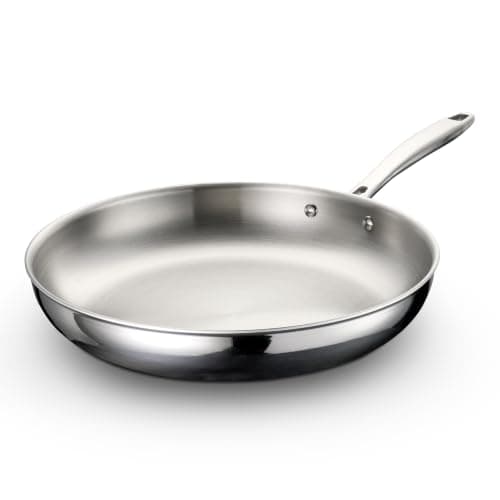 Tramontina Signature Tri-Ply Clad Fry PanNo published thickness and a base light enough that thermal shock is a real risk — and still the best-value fully-clad pan we cover. | Accepting a lighter base in exchange for the best value here | 7.8 |
#ad Buy links are affiliate links. Prices come straight from Amazon, are stamped with the date they were read, and disappear rather than go stale if the feed stops. How we are funded.
Why thickness beats ply count
Ply count tells you how many layers are bonded together. Thickness tells you how much metal is actually there. The second one is what decides how a pan cooks.
A thick pan has thermal mass: it stores heat, so when you drop a cold steak into it the surface temperature does not collapse, and the steak browns instead of steaming. A thin pan loses its heat to the food instantly and has to recover from the burner, which is the single most common reason a cheap pan sears badly.
A thick base also resists warping, which is the failure that actually ends clad pans. A heavier plate simply has more structure to resist the differential expansion that deforms a base when the pan hits cold water.
Which means a five-ply pan at 2.0mm can genuinely be a worse pan than a tri-ply at 2.7mm. More layers of less metal is not an upgrade. That is why we weight published thickness above ply count, and why tri-ply vs 5-ply is a question about heat behavior rather than about quality tiers.
Who publishes a figure, and who does not
| Brand / line | Published thickness | Plies |
|---|---|---|
| Misen 5-Ply | 3.0mm | 5 |
| Made In Stainless Clad | 2.7mm | 5 |
| Heritage Steel Titanium (stock pot) | 2.3mm | 5 |
| All-Clad D3 / D5 | Not published | 3 / 5 |
| Tramontina Signature | Not published | 3 |
| Calphalon Premier 5-Ply | Not published | 5 |
Three brands publish, three do not, and the ones that publish are generally the newer direct-to-consumer brands competing on specifications. That is the useful read on the disclosure itself: a brand that publishes a number is inviting comparison, and a brand that does not is asking you to trust the badge.
Not publishing is not proof of a thin pan. All-Clad does not publish and its pans are demonstrably heavy. But it does mean you cannot comparison-shop, and when the unpublished pan is also the cheapest pan in the aisle, the silence is informative.
How thick is thick enough?
Below about 2.0mm is thin for a clad skillet. It will cook, it will heat fast, and it will lose temperature the moment food goes in. These are the pans that warp.
2.3 to 2.7mm is the practical band for a pan you use every day. Enough mass to brown properly, light enough that a 12-inch is still comfortable to lift and toss.
3.0mm and above is heavy gauge. Excellent for searing and for an uneven burner, noticeably tiring in a large skillet, and slower to respond when you pull the pan off — which is a real disadvantage for a pan sauce.
There is no single right answer, because the trade is mass against responsiveness. A steak pan wants mass. A sauce pan wants response. If you are buying one pan for everything, the middle of the band is the correct compromise.
Base thickness versus wall thickness
Two different numbers, and listings blur them. In a fully clad pan the whole body is the same construction, so one figure describes it — that is what Made In's 2.7mm and Misen's 3.0mm refer to.
A disc-bottom pan is a different animal: a thick aluminum-and-steel slab under the base and thin single-layer walls above it. A listing can truthfully quote an impressive base thickness while the walls are 0.8mm of bare steel, which is why thick-sounding disc-bottom pots still scorch a sauce at the wall. The distinction is in fully clad vs disc bottom.
When a spec sheet quotes a thickness, check whether it says base or body. If it only says base, assume the walls are thin.
How to judge gauge without a number
Weigh it in your hand. Crude and effective. Two pans of the same diameter, the heavier one has more metal. This is most of what you can do with unpublished pans, and it is better than nothing.
Look at the cut edge of the rim. On a clad pan you can see the layer sandwich and judge the total depth against your fingernail. A hairline is thin; a visibly stepped stack is not.
Press the center of the base, gently. A very thin base will flex under thumb pressure. A heavy one will not move at all.
Put it on a flat surface. A new pan should sit dead flat. Any rock at all, in a new pan, means a base that was not flat when it left the factory — and a base that starts out marginal will not improve. Our guide to the failure mode is warped stainless steel pan.
The bottom line
Read thickness before ply count. 2.3 to 2.7mm is the band that suits most cooking; 3.0mm suits searing and heavy use; anything thin enough to flex under your thumb is a pan that will warp. Prefer brands that publish a figure, because the number is the only way to compare, and weigh the pan in your hand when nobody publishes one.
The picks in full
1. Thickest published gauge
Misen 5-Ply Stainless Skillet
Misen
Five plies at a published 3.0mm — the thickest figure anyone on this site publishes — rated to 800F and dishwasher safe.
- Gauge
- 9.8
- Transparency
- 9.6
- Build
- 8.6
- Value
- 9.0
- Five-ply, 3.0mm construction (Misen published spec)
- Oven safe to 800F / 426C
- Dishwasher safe and induction compatible
- Lifetime warranty against defects
- Manufactured in China
What it gets right
- Thickest pan in its price band; 3.0mm is genuinely heavy gauge
- Dishwasher safe, which almost nothing else in this class claims
- Sloped sides make it more useful for tossing than a straight-walled skillet
Who should skip it
- Overseas manufacturing is a deal-breaker if made-in-USA is the point
- The warranty is defect-only, and the company is younger than the pans it warranties
- 3.0mm is heavy enough to be tiring in a 12-inch
3.0mm is heavy-gauge by any standard in this category, and Misen publishes the number rather than leaving you to infer it from a ply count. That thickness is what makes the pan hold temperature when cold food goes in, and it is the main structural defence against warping.
It is also the honest downside: 3.0mm is heavy enough to be tiring in a 12-inch, and heavier pans are slower to respond when you pull the heat.
Overseas manufacture rules it out if buying American matters, and the warranty is defect-only from a young company. Full write-up in the Misen stainless clad review.
2. Best thickness-to-weight balance
Made In Stainless Clad Frying Pan
Made In
Published at 2.7mm with an 800F oven rating — a tenth of a millimetre either way is not the point, publishing the figure at all is.
- Gauge
- 9.2
- Transparency
- 9.6
- Build
- 9.0
- Value
- 8.6
- Five-ply construction, 2.7mm thick (Made In published spec)
- Heat safe to 800F / 430C, 200F above All-Clad's rating
- Gas, electric and induction; handwash preferred
- Lifetime warranty on stainless; the frying pans are made in Italy
- Flared rim pours cleanly, which sounds trivial until you deglaze
What it gets right
- The 800F rating puts broiler work and hard oven finishes in spec rather than in hope
- Longer, flatter handle is more comfortable than All-Clad's stick handle
- Direct-to-consumer pricing undercuts All-Clad at an equivalent ply count
Who should skip it
- No decades-long warranty service record yet; the company is young
- Five plies make it slower to respond than a tri-ply of the same size
- Warranty excludes warping from thermal shock, same as everyone else's
2.7mm is the sweet spot in our view: enough mass to brown a steak without the pan's temperature collapsing, not enough to make a 12-inch unpleasant to toss. Made In publishes it, along with the 800F rating and the base geometry — a level of disclosure almost nobody else in the category matches.
Five plies are slower off the heat than three, handwashing is preferred, and the company is young enough that nobody has claimed on a fifteen-year-old pan yet.
#ad Price as of October 10, 2026. How we are funded
3. Unpublished but proven
All-Clad D5 Stainless Brushed Fry Pan
All-Clad
All-Clad publishes no millimetre figure, but the heavier D5 gauge means less flexing at the base over a decade — and decades of independent testing stand behind it.
- Gauge
- 8.8
- Transparency
- 5.0
- Build
- 9.4
- Value
- 5.8
- Five-ply: alternating layers of aluminum and stainless steel
- Oven and broiler safe to 600F (All-Clad published spec)
- Induction compatible; handwash only
- Brushed exterior hides scuffs better than the polished D3
- Limited lifetime warranty; made in All-Clad's Pennsylvania factory
What it gets right
- The extra stainless layer genuinely damps hot spots on a weak or uneven burner
- Brushed finish still looks composed after a year; polished D3 shows every scratch
- Heavier gauge means less flexing at the base over a decade
Who should skip it
- Slower to respond when you pull heat, which is the wrong trait for a pan sauce
- Costs meaningfully more than D3 for a difference most cooks will not feel
- Noticeably heavier in a 12-inch, which matters when you are tossing food
Included to make a point: a brand can decline to publish a thickness and still sell a demonstrably heavy pan. All-Clad publishes no gauge for D3 or D5, but D5's heavier five-layer body measurably resists base flexing over a decade, and the pans have been independently abuse-tested for longer than most of the competition has existed.
What you cannot do is comparison-shop on it. If two unpublished pans are in front of you, the only tools you have are weight in the hand and the brand's reputation.
D5 is also slower to respond than D3, heavier in a 12-inch, handwash only and meaningfully more expensive.
#ad Price as of October 10, 2026. How we are funded
4. Thin gauge, honest price
Tramontina Signature Tri-Ply Clad Fry Pan
Tramontina
No published thickness and a base light enough that thermal shock is a real risk — and still the best-value fully-clad pan we cover.
- Gauge
- 6.6
- Transparency
- 5.0
- Build
- 7.8
- Value
- 9.6
- Tri-ply: aluminum core between two layers of 18/10 stainless
- Oven safe to 500F (Tramontina published spec)
- Dishwasher safe; works on gas, electric, ceramic glass and induction
- NSF-certified for commercial kitchens
- Mirror-polished exterior, riveted stainless handle
What it gets right
- Cooks close enough to All-Clad that most people could not pick them apart blind
- Dishwasher safe and NSF-certified, neither of which All-Clad's tri-ply is
- Cheap enough that replacing it in fifteen years still costs less than one D3
Who should skip it
- The 500F oven rating is 100F below All-Clad and 300F below Made In
- Handle is less comfortable and the polished finish scuffs faster
- Lighter gauge base is more prone to warping under thermal shock
This is where gauge shows up as a genuine compromise rather than a spec-sheet quibble. Tramontina's Signature base is lighter than the premium pans', and the consequence is stated plainly in our own notes on it: more prone to warping under thermal shock.
That is a manageable risk — do not run it dry, do not plunge it into cold water — and in exchange you get fully-clad tri-ply, 18/10, NSF certification and a dishwasher rating for a third of the premium price.
The 500F ceiling and the mirror-polished exterior that scuffs are the other two trade-offs.
#ad Price as of October 10, 2026. How we are funded
Frequently asked questions
How thick should a stainless steel pan be?
Between about 2.3mm and 2.7mm for a pan you use daily — enough thermal mass to brown food without the surface temperature collapsing, light enough that a 12-inch is comfortable to lift. 3.0mm and up is heavy gauge, better for searing and worse for pan sauces. Below about 2.0mm is thin and more likely to warp.
Is a 5-ply pan always better than a 3-ply pan?
No. Ply count without a thickness is a marketing number: a five-ply pan made of thin layers can be worse than a well-made tri-ply. Five layers store more heat and smooth out a weak burner; three respond faster off the heat. Total thickness decides more than the number of layers.
Which cookware brands publish their pan thickness?
Misen publishes 3.0mm, Made In publishes 2.7mm, and Heritage Steel publishes 2.3mm for its Titanium Series stock pot. All-Clad, Tramontina and Calphalon do not publish a thickness figure for their stainless lines.
How can I tell how thick a pan is in the store?
Weigh two same-diameter pans in your hands — the heavier one has more metal. Look at the cut edge of the rim to judge the layer stack against your fingernail. Press the center of the base: a very thin base flexes under thumb pressure. And check that the pan sits dead flat, because a new pan that rocks will not improve.
Does base thickness mean the same as pan thickness?
Not on a disc-bottom pan. There, a thick aluminum slab is attached under the base while the walls are thin single-layer steel, so a listing can quote an impressive base figure and still scorch a sauce at the wall. On a fully clad pan the whole body is one construction, so a single figure describes it.
Sources
- Misen — Stainless Steel Skillet, published specification
- Made In — Stainless Clad Frying Pan, published specification
- Made In — 3-Ply vs 5-Ply Stainless Steel Cookware (brand blog)
- Heritage Steel — Titanium Series 10.5-inch Fry Pan, published specification
- All-Clad — D5 Stainless Brushed 12-inch Fry Pan, published specification
- Prudent Reviews — 3-Ply vs 5-Ply Stainless Steel Cookware