Construction & Materials
How to Choose Stainless Steel Cookware
Seven specifications decide whether a stainless pan is worth owning, and the listing will tell you five of them if you know where to look. The two it hides are the two that predict how long the pan lasts.
Disclosure: Ply & Pan earns a commission on qualifying purchases made through links on this page. We take no free product and no sponsorship, and every price here is read from Amazon on the date shown. How we are funded.
Quick picks
The short answer. Tap any row for the full write-up.
| # | Product | Best for | Score | Price |
|---|---|---|---|---|
| 1 | 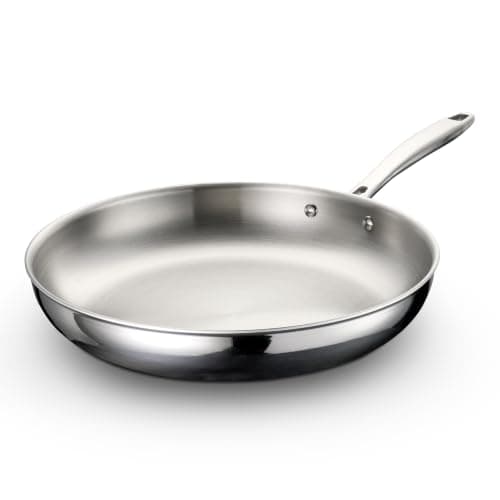 Tramontina Signature Tri-Ply Clad Fry PanFully clad tri-ply with an 18/10 interior, NSF-certified, dishwasher safe, 500F published. It fails the checklist on exactly one line - the oven ceiling - and that is the right thing to fail on at this price. | Someone applying this checklist on a normal budget | 8.6 | |
| 2 | 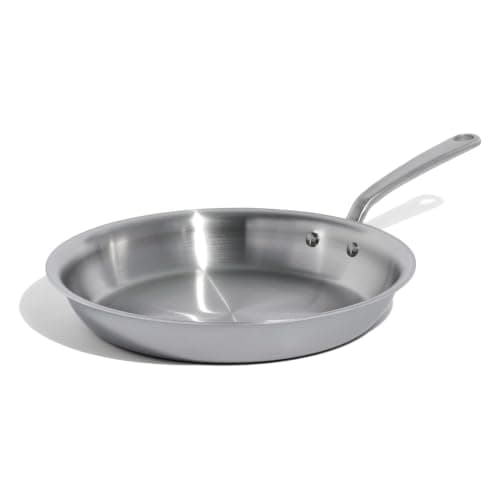 Made In Stainless Clad Frying PanFive plies, a published 2.7mm, 800F, a stated country of manufacture and a lifetime warranty. It answers six of the seven questions on this page in its own spec sheet. | A buyer who wants every number on the page before paying | 8.8 | $129.99 · View on Amazon $149.00 · 13% off |
| 3 | 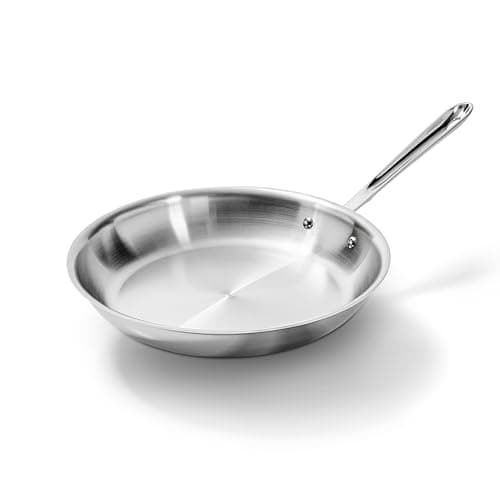 All-Clad D3 Stainless Fry Pan600F and broiler safe, bonded in Canonsburg, Pennsylvania, with a limited lifetime warranty honored since 1971 and an independent abuse-test record behind the build. | A buyer whose deciding question is whether the company will still be there | 8.8 |
#ad Buy links are affiliate links. Prices come straight from Amazon, are stamped with the date they were read, and disappear rather than go stale if the feed stops. How we are funded.
The seven specs, in order of how much they matter
If you read nothing else: buy a fully clad pan with a published oven rating above 500F, a lid rated as high as the pan if you cook covered, a handle you can hold, and a dishwasher rating if nobody in your house will handwash. Everything below is why.
1. Fully clad, not disc-bottomed
This is the only specification that is genuinely non-negotiable. In a fully clad pan, the aluminum core runs from the base up the walls, so the whole cooking surface conducts. In a disc-bottom pan, an aluminum pad is encapsulated under the base and the walls are a single thin layer of steel. Heat stops at the edge of the disc.
The symptom is a ring of scorching just above the base on anything that thickens or clings — a roux, a tomato sauce, milk, rice. It is the most common reason people conclude they hate stainless cookware. Listings for clad pans say "fully clad", "tri-ply" or "5-ply"; if none of those phrases appears, assume a disc base. Full explanation in fully clad vs disc bottom.
2. Plate thickness, if the brand will tell you
Warping is what actually ends a clad pan's life — not wear, not staining, not the finish going dull. A warped base rocks on a glass hob and will not sit flat on an induction ring, and there is no fixing it. Thickness is the best predictor of whether a pan warps.
Almost nobody publishes it. Misen publishes 3.0mm. Made In publishes 2.7mm. All-Clad, Tramontina, Cuisinart, Calphalon, GreenPan and Caraway publish nothing at all, including at premium prices. That absence is information: a brand that will not state its gauge is asking you to take durability on trust. Our detail page is stainless steel pan thickness and gauge.
3. Ply count — and why it tells you less than you think
Three plies versus five is a trade, not an upgrade. More layers means more mass, so the pan takes longer to heat, holds temperature better when cold food hits it, and keeps cooking after you take it off the burner. Tri-ply suits eggs, pan sauces and anything you want to stop cooking on command. Five-ply suits searing, braising, and uneven or weak burners.
Critically, ply count says nothing about thickness. A 2.7mm five-ply and an unspecified five-ply are not comparable products, and a heavy tri-ply can outperform a thin five-ply. Treat ply count as a description of behaviour, not a quality score: tri-ply vs 5-ply.
4. Published oven rating
Oven ratings across clad stainless run from 450F to 1050F, which is an enormous spread for pans that look identical. Calphalon's brushed tri-ply publishes 450F. Tramontina, Cuisinart, Zwilling Spirit and Demeyere publish 500F. Caraway publishes 550F. All-Clad publishes 600F with a broiler rating. Made In and Heritage Steel publish 800F. Hestan publishes 1050F.
Two practical rules. First, a separate broiler rating is a distinct claim — some brands publish an oven number and no broiler number, which means broiler work is not covered. Second, buy a ceiling comfortably above how you cook: a pan used at its limit every week is a pan under stress. The brand-by-brand list is in oven-safe temperatures by brand.
5. The lid rating, separately
A lid is not part of the pan's rating and people assume it is. Glass lids are routinely rated far lower than the pans they come with — GreenPan publishes 425F lids on 600F pans — and on a saucepan, which spends most of its life covered, that is the number that limits you.
Stainless lids share the pan's rating. If you start things on the hob and finish them covered in the oven, buy pans with stainless lids or plan to cover with foil. The comparison is in glass vs stainless steel lids.
6. The handle, which no review can decide for you
Handles are the most personal thing about a pan and the reason people quietly stop using cookware they paid a lot for. All-Clad's narrow stick handle bites into the palm on a loaded 12-inch and is fine on an 8-inch. Zwilling's V-shaped handle is designed to be gripped through oven mitts. Demeyere uses welded handles with no rivets inside the pan.
Two checkable things: whether a large pan has a helper handle (above about four quarts, you want one), and whether the handle is riveted or welded. Rivets are stronger and leave bumps inside the pan to clean around; welds are flush and cannot be re-tightened. Neither is wrong: riveted vs welded handles. Why handles get hot at all is in why stainless steel pan handles get hot.
7. Dishwasher rating, and being honest with yourself
All-Clad's bonded cookware and Made In's stainless are handwash only or handwash preferred. Tramontina, Cuisinart, Misen, Demeyere, Hestan, Calphalon, GreenPan Reserve and Caraway are published dishwasher safe. This is the specification most likely to decide how the pan looks in five years, because it decides whether its owner follows the instructions.
A handwash-only pan in a household that will not handwash is a bad purchase at any price. There is no shame in buying for the kitchen you actually run: best dishwasher-safe stainless steel cookware.
What to ignore
Piece count on a set. Lids count as pieces. A twelve-piece set can be four pans. Count pans.
18/10 versus 18/8 on the cooking surface. Both are austenitic stainless and both are fine for cooking; the difference is nickel content and polish, not performance. The grades are explained in 18/10 vs 18/8 vs 18/0.
Finish. Brushed or mirror-polished changes how the pan ages, not how it cooks: brushed vs polished.
"Professional", "chef-grade" and "commercial" as adjectives. NSF certification is a real commercial standard; the words are not.
Which pieces to buy first
Specifications aside, the commonest mistake is buying a ten-piece set when what you needed was two pans. A 10-inch or 12-inch skillet and a 3-quart saucepan cover the large majority of home cooking, and a saucier is a better third purchase than anything a set will add. The arguments are in the two-pan kitchen and set vs buying piece by piece.
The bottom line
Fully clad is the only hard requirement. After that, buy published numbers over adjectives: a gauge figure if you can get one, an oven ceiling above how you cook, a lid rated as high as the pan, a handle you have actually held, and a dishwasher rating that matches the kitchen you really have. A brand that publishes all of that is telling you something; a brand that publishes none of it is telling you something too.
The picks in full
1. What a well-specified value pan looks like
Tramontina Signature Tri-Ply Clad Fry Pan
Tramontina
Fully clad tri-ply with an 18/10 interior, NSF-certified, dishwasher safe, 500F published. It fails the checklist on exactly one line - the oven ceiling - and that is the right thing to fail on at this price.
- Construction
- 8.4
- Transparency
- 7.6
- Oven ceiling
- 6.0
- Value
- 9.6
- Tri-ply: aluminum core between two layers of 18/10 stainless
- Oven safe to 500F (Tramontina published spec)
- Dishwasher safe; works on gas, electric, ceramic glass and induction
- NSF-certified for commercial kitchens
- Mirror-polished exterior, riveted stainless handle
What it gets right
- Cooks close enough to All-Clad that most people could not pick them apart blind
- Dishwasher safe and NSF-certified, neither of which All-Clad's tri-ply is
- Cheap enough that replacing it in fifteen years still costs less than one D3
Who should skip it
- The 500F oven rating is 100F below All-Clad and 300F below Made In
- Handle is less comfortable and the polished finish scuffs faster
- Lighter gauge base is more prone to warping under thermal shock
Run the checklist on this pan and you see what "good enough" looks like. Fully clad rather than disc-bottomed: yes. 18/10 cooking surface: published. Dishwasher safe: published. Warranty: lifetime. NSF-certified for commercial kitchens, which is a construction and cleanability standard, not a badge.
Two lines it does not pass cleanly. Gauge is not published, so you cannot verify thickness. And the oven ceiling is 500F, the lowest of the pans on this page, which rules out broiler finishing. If you are going to compromise on one specification, the oven ceiling is the right one to give up, because most home cooking never approaches it.
#ad Price as of October 17, 2026. How we are funded
2. What a fully-specified pan looks like
Made In Stainless Clad Frying Pan
Made In
Five plies, a published 2.7mm, 800F, a stated country of manufacture and a lifetime warranty. It answers six of the seven questions on this page in its own spec sheet.
- Construction
- 8.8
- Transparency
- 9.4
- Oven ceiling
- 9.8
- Value
- 8.4
- Five-ply construction, 2.7mm thick (Made In published spec)
- Heat safe to 800F / 430C, 200F above All-Clad's rating
- Gas, electric and induction; handwash preferred
- Lifetime warranty on stainless; the frying pans are made in Italy
- Flared rim pours cleanly, which sounds trivial until you deglaze
What it gets right
- The 800F rating puts broiler work and hard oven finishes in spec rather than in hope
- Longer, flatter handle is more comfortable than All-Clad's stick handle
- Direct-to-consumer pricing undercuts All-Clad at an equivalent ply count
Who should skip it
- No decades-long warranty service record yet; the company is young
- Five plies make it slower to respond than a tri-ply of the same size
- Warranty excludes warping from thermal shock, same as everyone else's
This is what a transparent spec sheet reads like. Five plies at a published 2.7mm — the gauge figure most brands omit. Heat safe to 800F, the highest ceiling in mainstream clad. Frying pans made in Italy, stated rather than implied. Flared rim, lifetime warranty on stainless, induction compatible.
The one thing it does not give you is a dishwasher rating — Made In prefers handwashing — and that is a genuine consideration if nobody in your house will comply. The other caveat is age: a lifetime warranty from a young company is a stated intention rather than a demonstrated record, which is the one line where All-Clad still wins.
3. What a warranty record looks like
All-Clad D3 Stainless Fry Pan
All-Clad
600F and broiler safe, bonded in Canonsburg, Pennsylvania, with a limited lifetime warranty honored since 1971 and an independent abuse-test record behind the build.
- Construction
- 9.4
- Transparency
- 8.6
- Oven ceiling
- 8.6
- Value
- 7.6
- Tri-ply: stainless interior, aluminum core, magnetic stainless exterior
- Oven and broiler safe to 600F (All-Clad published spec)
- Induction compatible on any stovetop
- Handwash only, per the manufacturer
- Limited lifetime warranty; bonded, engineered and assembled in Canonsburg, PA
What it gets right
- Survived America's Test Kitchen's concrete-strike abuse testing with barely a ding
- Rivets and handle join are the sturdiest in the category
- Decades of parts and service history standing behind the warranty
Who should skip it
- Costs roughly three times a Tramontina that cooks nearly as evenly
- The stick handle is narrow and bites into your palm on a loaded 12-inch pan
- Handwash only, which is a real constraint if you hate washing up
Every brand writes "lifetime warranty". Only a few have been honoring one for fifty years. On a purchase you intend never to repeat, the age of the company is a specification, and it is the one All-Clad wins outright. The named factory is part of the same point: a stated manufacturing location is a commitment a blank is not.
Durability is also independently documented here rather than claimed. The D3 came through America's Test Kitchen's concrete-strike abuse testing with barely a ding, and the rivet-and-handle join is the sturdiest in the category — which is the joint that fails first on cheap clad pans.
Where it fails the checklist: handwash only, which is a real daily tax, and no published plate thickness, so even at this price the gauge is unverifiable. It also costs roughly three times a Tramontina that cooks nearly as evenly.
#ad Price as of October 17, 2026. How we are funded
Frequently asked questions
What should I look for when buying stainless steel cookware?
Fully clad construction first - tri-ply or 5-ply, where the aluminum core runs up the walls rather than sitting as a disc under the base. Then a published oven rating above 500F, the lid's own rating if you cook covered, a handle you can comfortably hold, and a dishwasher rating if nobody in your house will handwash. Plate thickness is the best durability predictor, but most brands do not publish it.
Is 5-ply better than tri-ply stainless steel?
Not better, different. Five plies hold more heat, so the pan stays steadier when cold food hits it and keeps cooking after you remove it from the burner - good for searing and braising, awkward for eggs and pan sauces. Tri-ply responds faster. Ply count also says nothing about thickness, so a heavy tri-ply can outperform a thin five-ply.
What grade of stainless steel is best for cookware?
For the cooking surface, 18/10 and 18/8 are both austenitic stainless and both perform the same in a kitchen; the difference is nickel content and how well they polish. 316Ti, used by Heritage Steel, resists pitting from salt and acid better. The exterior layer of a clad pan is usually ferritic 18/0 because it needs to be magnetic for induction.
Does stainless steel cookware need to be dishwasher safe?
Only if your household will use the dishwasher regardless. The best predictor of how cookware looks in five years is whether the owner follows the care instructions, so a handwash-only pan in a house that will not handwash is a poor purchase at any price. Tramontina, Cuisinart, Misen, Demeyere, Hestan, GreenPan Reserve and Caraway all publish dishwasher-safe ratings.
How can I tell if a pan is fully clad or disc-bottom?
Read the construction line on the listing. Fully clad pans are described as 'fully clad', 'tri-ply' or '5-ply'; if none of those phrases appears, assume a disc base. You can also look at the rim: on a clad pan you can usually see the layers at the cut edge, and the wall thickness is uniform rather than stepping down above the base.
Sources
- Tramontina — Signature Tri-Ply Clad Stainless Steel Fry Pan, published specification
- Made In — Stainless Clad Frying Pan, published specification
- Made In — 3-Ply vs 5-Ply Stainless Steel Cookware (brand blog)
- All-Clad — D3 Stainless 12-inch Fry Pan, published specification
- All-Clad — Cookware Limited Lifetime Warranty (PDF)
- Misen — Stainless Steel Skillet, published specification
- America's Test Kitchen — The Best Stainless-Steel Skillets
- Prudent Reviews — 3-Ply vs 5-Ply Stainless Steel Cookware