Construction & Materials
Riveted vs Welded Pan Handles
Handle attachment is the second most common way a clad pan dies, after warping. The two methods fail differently, and which failure you prefer decides what you should buy.
Disclosure: Ply & Pan earns a commission on qualifying purchases made through links on this page. We take no free product and no sponsorship, and every price here is read from Amazon on the date shown. How we are funded.
Quick picks
The short answer. Tap any row for the full write-up.
| # | Product | Best for | Score | Price |
|---|---|---|---|---|
| 1 | 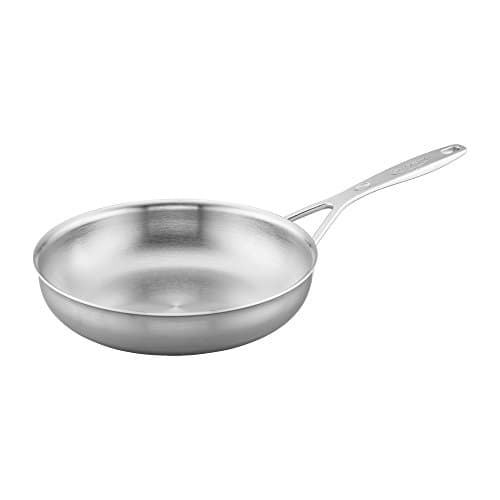 Demeyere Industry 5 Fry PanFive-ply Belgian construction with welded handles, so the interior is one uninterrupted curve with nothing for fond to hide behind. | Someone who hates scrubbing around rivet heads | 8.4 | |
| 2 | 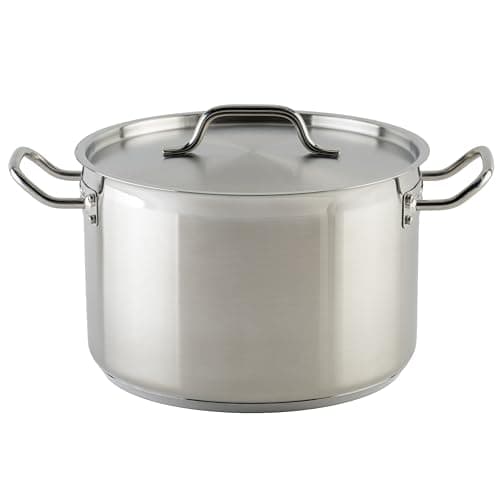 Winco 12-Quart Commercial Stock PotSix-point welded handles on a 12-quart NSF-listed commercial pot — the configuration foodservice uses because rivets loosen under repeated heavy lifts. | A big pot whose handles will never work loose | 8.4 | $68.99 · View on Amazon $72.99 · 5% off |
| 3 | 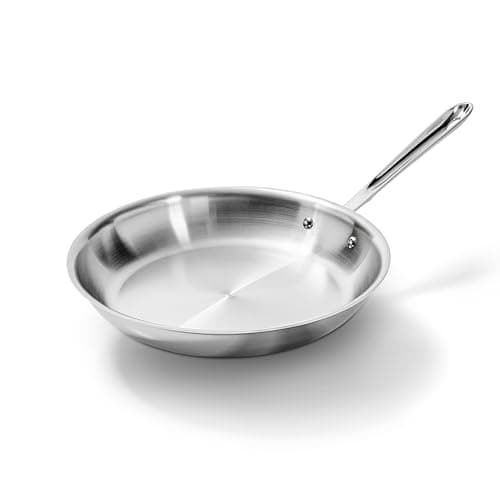 All-Clad D3 Stainless Fry PanAll-Clad's rivet-and-handle join is the sturdiest in the category, and it survived America's Test Kitchen's concrete-strike abuse testing with barely a ding. | Maximum strength on a pan you lift one-handed, loaded | 8.8 |
#ad Buy links are affiliate links. Prices come straight from Amazon, are stamped with the date they were read, and disappear rather than go stale if the feed stops. How we are funded.
How each join works
Riveting puts two or three metal fasteners through the pan wall, with the heads on the inside and the handle bracket on the outside. It is a mechanical join: the strength comes from the fasteners and from the clamping force they apply. It is also the cheapest reliable method, which is why most of the category uses it.
Welding fuses the handle bracket to the outside of the pan wall with no fastener passing through, so the interior stays unbroken. The strength comes from the weld itself — often several discrete spot welds, like the six-point pattern on commercial pots.
Note which side of the wall each method touches. That is the entire cleaning argument, and it is the reason NSF's cleanability standard cares about handle attachment at all, as we cover in NSF-certified stainless cookware.
Side by side
| Property | Riveted | Welded |
|---|---|---|
| Interior cooking surface | Two or three protruding heads | Uninterrupted |
| Strength under leverage | Very high | High, depends on weld quality |
| Common failure | Rivets work loose | Weld cracks |
| Repairable | Sometimes re-tightened | No |
| Residue trap | Behind the heads, inside | At the seam, outside |
| Typical use | Most clad cookware | Commercial pots, Demeyere |
The failures are not equally likely
In home use, neither join is the thing that ends a pan. Warping is, and it beats handle failure by a wide margin — a hot pan plunged into cold water or an empty pan left over a high flame deforms the base, and no lifetime warranty on the market covers it. See warped stainless steel pan.
Among the handle failures that do happen, the pattern is consistent. Rivets work loose over decades, usually on large pans carried one-handed when full — the leverage, not the heat, is what does it. Welds crack rarely and almost always on a pot that has been dropped or had a corner of the weld compromised by repeated thermal cycling.
The important asymmetry is what happens next. A slightly loose rivet is a pan you can keep using and sometimes have serviced. A cracked weld is the end of the pan, because nobody is going to re-weld a 3mm clad body for you. If you intend to own cookware for thirty years, that is an argument for rivets.
The cleaning argument, honestly weighted
Rivet heads collect fond. Anyone who has reduced a wine sauce in a riveted pan knows the two dark rings that will not wipe off. It is a real irritation, and it is the single best reason to want welded handles — particularly on sauté pans and sauciers, where the whole point of the shape is a sticky reduction.
But it is an irritation, not a hygiene problem, and it comes off. A soak, a nylon brush and an acid cleaner clear rivet heads completely; the technique is in how to clean a burnt stainless steel pan.
Welded joins have their own residue trap — the seam on the outside, where the bracket meets the wall. It is less annoying because it is not in the food, and harder to inspect because you cannot see into it.
Which to choose, by shape
Skillets and fry pans: rivets are fine. You are deglazing in the middle of the pan, the rivet heads sit high on the wall, and a skillet is the shape most often carried loaded one-handed — which is exactly where rivet strength earns its keep.
Sauté pans and sauciers: welded if you can. These are the shapes built for reductions and braises, where fond covers the lower wall and the rivets are in it. This is where Demeyere's construction is genuinely worth the premium rather than just interesting.
Large pots: welded, and it is not close. Twelve quarts of liquid on a lever is the load that loosens rivets, and a pot's walls are not where you develop fond anyway. Commercial kitchens settled this question long ago, which is why foodservice pots are welded. Our roundup is the best stainless steel stock pots.
Saucepans: either. Small, light, and rarely used for anything that cakes on. Decide on handle comfort instead.
The bottom line
Rivets are stronger and repairable; welds are cleaner and terminal. For a skillet you will carry loaded, buy riveted and accept the two marks. For a sauté pan or a saucier you will reduce sauces in, welded handles are worth paying for. For a big pot, buy welded and spend the savings elsewhere.
And do not let either decide a purchase on its own. Cladding, published oven ceiling and base gauge all matter more — see pan thickness and gauge.
The picks in full
1. Best welded handles
Demeyere Industry 5 Fry Pan
Demeyere
Five-ply Belgian construction with welded handles, so the interior is one uninterrupted curve with nothing for fond to hide behind.
- Cleanability
- 9.8
- Strength
- 8.8
- Repairability
- 5.0
- Value
- 6.0
- Five-ply construction from rim to rim
- Oven safe to 500F (Zwilling published spec)
- Dishwasher safe; induction compatible
- Patented Silvinox surface treatment resists fingerprints and acidic foods
- Lifetime warranty; made in Belgium
What it gets right
- Silvinox is the only surface treatment here that measurably slows cosmetic aging
- Built to a commercial-kitchen spec, and the gauge shows it
- Dishwasher safe despite the price bracket
Who should skip it
- A 500F ceiling is low for the money
- Heaviest pan on this site; genuinely tiring in the larger sizes
- Rare enough in US retail that replacing one piece takes effort
Demeyere welds its handles on, which means no rivet heads protrude into the cooking surface. On a pan used for braising — where the point is a sticky reduced fond — that is the difference between wiping the pan out and working a brush around two bolts.
Paired with the Silvinox surface treatment, it is the easiest clad pan on this site to actually clean. Built to a commercial-kitchen spec and the gauge shows it.
The costs: a 500F ceiling is low for the money, it is the heaviest pan here, and a cracked weld cannot be re-tightened the way a loose rivet can be. US retail distribution is thin enough that replacing a lid takes effort.
#ad Price as of October 10, 2026. How we are funded
2. Best welded pot
Winco 12-Quart Commercial Stock Pot
Winco
Six-point welded handles on a 12-quart NSF-listed commercial pot — the configuration foodservice uses because rivets loosen under repeated heavy lifts.
- Cleanability
- 8.0
- Strength
- 9.2
- Repairability
- 5.0
- Value
- 9.8
- 12 quarts; 18/8 stainless with an encapsulated tri-ply heavy-duty base
- Aluminum core in the base only; single-layer walls
- Induction ready; NSF listed for commercial kitchens
- Welded handles rather than riveted, with 6-point welds
- Cover included; 11 in diameter x 7.1 in high, 8.25 lb
What it gets right
- The welded handles have no rivets to work loose, which is the commonest clad-pot failure
- NSF listing is a real commercial standard, not a marketing badge
- Cheap enough that it is the obvious answer for a pot that only boils
Who should skip it
- Single-layer walls will scorch anything that thickens or clings
- Welded handles trap residue at the join and cannot be re-tightened
- Sold mainly through foodservice suppliers, so retail availability varies
Commercial kitchens buy welded handles on large pots for a reason: the failure they are avoiding is a rivet working loose under the repeated leverage of lifting ten quarts of stock. Six-point welds distribute that load without any fastener to back out.
NSF-listed, induction ready, cover included, with an encapsulated tri-ply heavy-duty base.
Two honest limits: welded joins trap residue at the seam, which is the trade-off for a clean interior, and single-layer walls will scorch anything that thickens. It is a pot for water and stock, not for chili.
3. Best riveted handles
All-Clad D3 Stainless Fry Pan
All-Clad
All-Clad's rivet-and-handle join is the sturdiest in the category, and it survived America's Test Kitchen's concrete-strike abuse testing with barely a ding.
- Cleanability
- 7.0
- Strength
- 9.8
- Repairability
- 8.4
- Value
- 6.6
- Tri-ply: stainless interior, aluminum core, magnetic stainless exterior
- Oven and broiler safe to 600F (All-Clad published spec)
- Induction compatible on any stovetop
- Handwash only, per the manufacturer
- Limited lifetime warranty; bonded, engineered and assembled in Canonsburg, PA
What it gets right
- Survived America's Test Kitchen's concrete-strike abuse testing with barely a ding
- Rivets and handle join are the sturdiest in the category
- Decades of parts and service history standing behind the warranty
Who should skip it
- Costs roughly three times a Tramontina that cooks nearly as evenly
- The stick handle is narrow and bites into your palm on a loaded 12-inch pan
- Handwash only, which is a real constraint if you hate washing up
This is the counter-argument to welding, and it is a strong one. Rivets are a mechanical join with enormous shear strength, and All-Clad's implementation is the heaviest in the category — the reason the pan survived repeated strikes against concrete in America's Test Kitchen's abuse testing.
A rivet also degrades gracefully. A loose rivet is a nuisance you can live with and sometimes have serviced; a cracked weld is a finished pan.
The costs are the two rivet heads inside the cooking surface, a narrow stick handle that bites into your palm on a loaded 12-inch, handwash-only care, and roughly three times the price of a Tramontina that cooks nearly as evenly.
#ad Price as of October 10, 2026. How we are funded
Frequently asked questions
Are riveted or welded pan handles better?
Rivets are stronger under leverage and can sometimes be re-tightened, which matters on a skillet you carry loaded one-handed. Welded handles leave the interior uninterrupted, so there is nothing for fond to collect behind, but a cracked weld cannot be repaired. Choose rivets for skillets and welds for large pots and sauté pans.
Do rivets in a pan weaken it or leak?
No. Rivets in cookware are a sealed mechanical join with high shear strength — All-Clad's riveted pans survived repeated concrete-strike abuse testing at America's Test Kitchen. The real complaint is cosmetic and practical: the heads protrude into the cooking surface and collect fond.
Why do commercial pots have welded handles?
Because the failure commercial kitchens are avoiding is a rivet working loose under the repeated leverage of lifting ten or twelve quarts. Multi-point welds spread that load with no fastener to back out, and the NSF cleanability standard also looks at handle attachment.
Can a loose rivet on a pan be fixed?
Sometimes. A rivet that has worked slightly loose can occasionally be re-set, and brands with real service operations will look at it under warranty. A cracked weld effectively ends the pan, because nobody is going to re-weld a clad body for a home cook.
Which stainless cookware has welded handles?
Demeyere welds the handles on its Industry 5 line, which is why the interior is one uninterrupted curve. Commercial pots such as Winco's use multi-point welds as standard. Most clad home cookware — All-Clad, Made In, Misen, Tramontina, Calphalon, Zwilling — is riveted.
Sources
- Zwilling — Demeyere Industry 5 11-inch Frying Pan, published specification
- All-Clad — D3 Stainless 12-inch Fry Pan, published specification
- America's Test Kitchen — Getting Whacked (how the abuse testing works)
- Tramontina — Signature Tri-Ply Clad Stainless Steel Fry Pan, published specification
- All-Clad — Warranty and repairs, customer service