Skillets & Fry Pans
What Size Skillet Do You Need?
Most kitchens own the wrong two sizes. Here is the order that actually makes sense.
Disclosure: Ply & Pan earns a commission on qualifying purchases made through links on this page. We take no free product and no sponsorship, and we never print a price. How we are funded.
Quick picks
The short answer. Tap any row for the full write-up.
| # | Product | Best for | Score | Price |
|---|---|---|---|---|
| 1 | 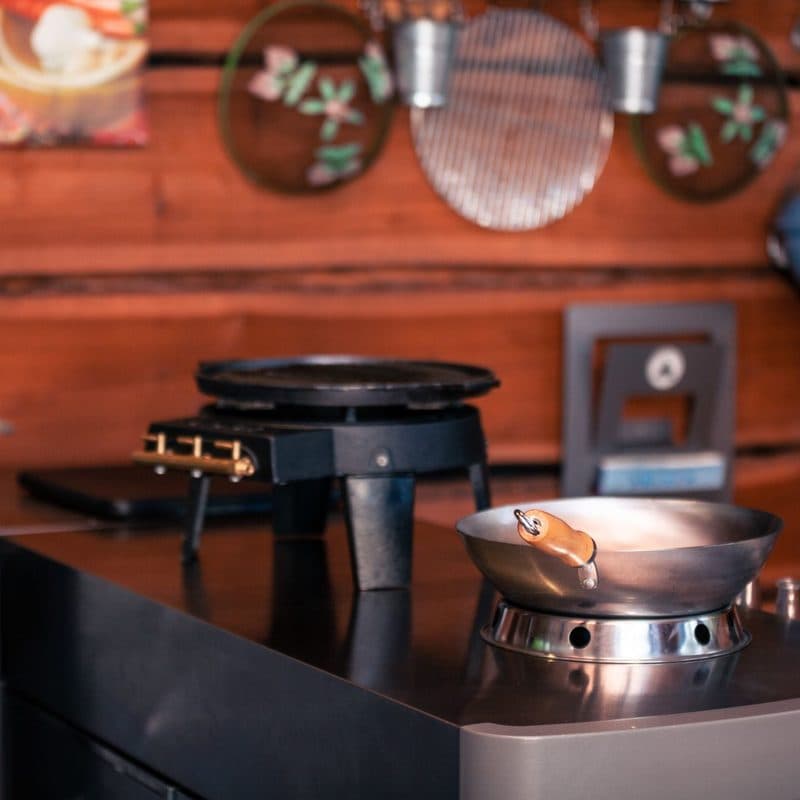 All-Clad D3 Stainless Fry PanIf you buy one skillet, make it a 12-inch of this quality. Everything else is an addition, not a replacement. | A 12-inch that covers most of what you cook | 9.1 | |
| 2 | 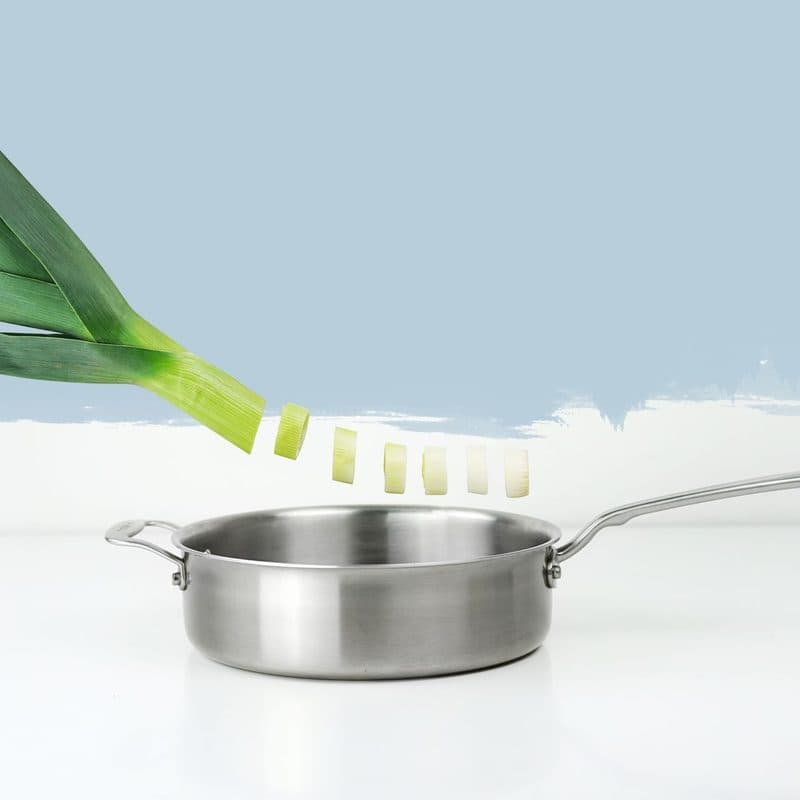 Made In Stainless Clad Frying PanFive plies stop feeling heavy at 10 inches, and the 800F rating makes it the better oven pan. | A 10-inch for eggs, one-person meals and oven work | 8.9 |
#ad Buy links are affiliate links. We never print a price — prices change weekly and a printed one is wrong within a month, so every link goes to the live Amazon listing. How we are funded.
How skillets are measured
Across the top rim, not across the base. Because the walls slope, the flat cooking surface is always smaller than the number on the box — usually by two to three inches. A 12-inch skillet has a base of about nine inches, a 10-inch about seven and a half, an 8-inch about six.
Two consequences. First, the difference between sizes is bigger than the labels imply, because area scales with the square of the radius. Second, when a recipe says "a large skillet", it means the cooking surface, so a 12-inch is usually what is meant.
What each size is genuinely for
8-inch. One or two eggs, toasting spices, a single piece of fish. Too small to be anyone's first or second pan, and almost always the piece in a set that never gets used. Buy one only if you specifically make omelets.
10-inch. The weeknight pan. Two portions of anything, a three-egg scramble, vegetables for two. Light enough to move one-handed even in heavy clad construction, and it fits every burner and every oven. The most-used pan in most households — but not the one to buy first.
12-inch. The pan that does the hard jobs: searing, browning a full batch, a one-pan dinner for four. About 40% more usable surface than the 10-inch. Heavy when loaded, needs a large burner to be at its best, and can foul a small oven. See the direct comparison.
14-inch. A specialist item. Genuinely useful for large-batch cooking, and nearly unusable on a domestic burner — the outer three inches will be cold on most home hobs. Skip it unless you know precisely why you want it.
By household
| You cook for | Buy first | Buy second |
|---|---|---|
| One | 10-inch | 12-inch, when you start cooking in batches |
| Two | 12-inch | 10-inch for weeknights |
| Three or four | 12-inch | A second 12-inch before a 10-inch |
| Five or more | 12-inch | Second 12-inch; cook in two pans, not one huge one |
That last row is the one people resist. Two 12-inch pans beat one 14-inch pan on a domestic hob every time, because you have two burners delivering full heat to two correctly-sized bases instead of one burner failing to heat an oversized one.
Let the burner decide
Measure your largest burner before buying anything. If it is under about eight inches, a 12-inch pan will heat as a hot center with cool edges, and clad construction reduces that without fixing it. On induction it is worse, because there is no flame to spread outward — the hob heats only the metal in contact with the glass.
With small burners, buy the 10-inch and accept cooking in batches. A correctly-heated smaller pan beats an unevenly-heated larger one.
Size and longevity
Larger pans warp more readily. More base area means more room to distort, and a pan that overhangs its burner runs a bigger center-to-edge temperature gradient — the same differential expansion that causes thermal-shock warping, applied slowly.
Bigger pans also stress the handle join harder, because every lift is heavier and the leverage is longer. If you buy a 12-inch, rivet quality matters more than it would at 10 inches, and it is worth spending toward a brand with evidence behind its handle join rather than one with a better spec sheet.
And the unglamorous one: pans get dropped when they are heavy and wet. A 12-inch clad skillet full of water in one hand is how bases get dented against sink edges.
The picks in full
1. The one to buy first
All-Clad D3 Stainless Fry Pan
All-Clad
If you buy one skillet, make it a 12-inch of this quality. Everything else is an addition, not a replacement.
- Durability
- 9.6
- Heat
- 8.8
- Handling
- 7.8
- Value
- 7.2
- Tri-ply: stainless interior, aluminum core, magnetic stainless exterior
- Oven and broiler safe to 600F (All-Clad published spec)
- Induction compatible on any stovetop
- Handwash only, per the manufacturer
- Limited lifetime warranty; bonded, engineered and assembled in Canonsburg, PA
What it gets right
- Survived America's Test Kitchen's concrete-strike abuse testing with barely a ding
- Rivets and handle join are the sturdiest in the category
- Decades of parts and service history standing behind the warranty
Who should skip it
- Costs roughly three times a Tramontina that cooks nearly as evenly
- The stick handle is narrow and bites into your palm on a loaded 12-inch pan
- Handwash only, which is a real constraint if you hate washing up
A 12-inch can do a 10-inch's job with a little more oil. A 10-inch cannot do a 12-inch's job at all, because the surface is not there. That asymmetry is why the larger pan goes first.
2. The best second size
Made In Stainless Clad Frying Pan
Made In
Five plies stop feeling heavy at 10 inches, and the 800F rating makes it the better oven pan.
- Durability
- 8.6
- Heat
- 9.2
- Handling
- 8.8
- Value
- 8.4
- Five-ply construction, 2.7mm thick (Made In published spec)
- Heat safe to 800F / 430C, 200F above All-Clad's rating
- Gas, electric and induction; handwash preferred
- Lifetime warranty on stainless; the frying pans are made in Italy
- Flared rim pours cleanly, which sounds trivial until you deglaze
What it gets right
- The 800F rating puts broiler work and hard oven finishes in spec rather than in hope
- Longer, flatter handle is more comfortable than All-Clad's stick handle
- Direct-to-consumer pricing undercuts All-Clad at an equivalent ply count
Who should skip it
- No decades-long warranty service record yet; the company is young
- Five plies make it slower to respond than a tri-ply of the same size
- Warranty excludes warping from thermal shock, same as everyone else's
The second pan should be smaller, not another 12-inch in a different brand. A 10-inch is the size you actually reach for on a weeknight, and the weight penalty of heavier construction disappears at this diameter.
Frequently asked questions
What size skillet should I buy first?
A 12-inch, unless you cook mainly for one or have small burners. A 12-inch can do a 10-inch's job with a little more oil; a 10-inch cannot do a 12-inch's job, because the surface simply is not there.
Is a 10-inch skillet big enough for a family?
Not for browning. It will hold two portions comfortably; four will crowd, trap moisture and steam rather than brown. For three or more people, a 12-inch is the working minimum.
Is a 14-inch skillet worth it?
Rarely at home. Most domestic burners cannot heat a 14-inch base evenly, so the outer few inches stay cool. Two 12-inch pans on two burners work far better for large batches.
What is the actual cooking surface of a 12-inch skillet?
About nine inches. Skillets are measured across the top rim and the walls slope inward, so the flat base is typically two to three inches smaller than the stated size.
Does skillet size need to match burner size?
Roughly, yes. A pan much larger than the burner heats as a hot center with cool edges. Measure your largest burner before buying; under about eight inches, choose the 10-inch.
Should I buy an 8-inch skillet?
Only if you regularly make one- or two-egg omelets. It is the piece in most cookware sets that goes unused, and it is too small to serve as a first or second pan.