Construction & Materials
304 vs 316 Stainless Steel for Cookware
Almost every pan you can buy is 304. A handful are 316, and the difference is one element and one failure mode.
Disclosure: Ply & Pan earns a commission on qualifying purchases made through links on this page. We take no free product and no sponsorship, and we never print a price. How we are funded.
Quick picks
The short answer. Tap any row for the full write-up.
| # | Product | Best for | Score | Price |
|---|---|---|---|---|
| 1 | 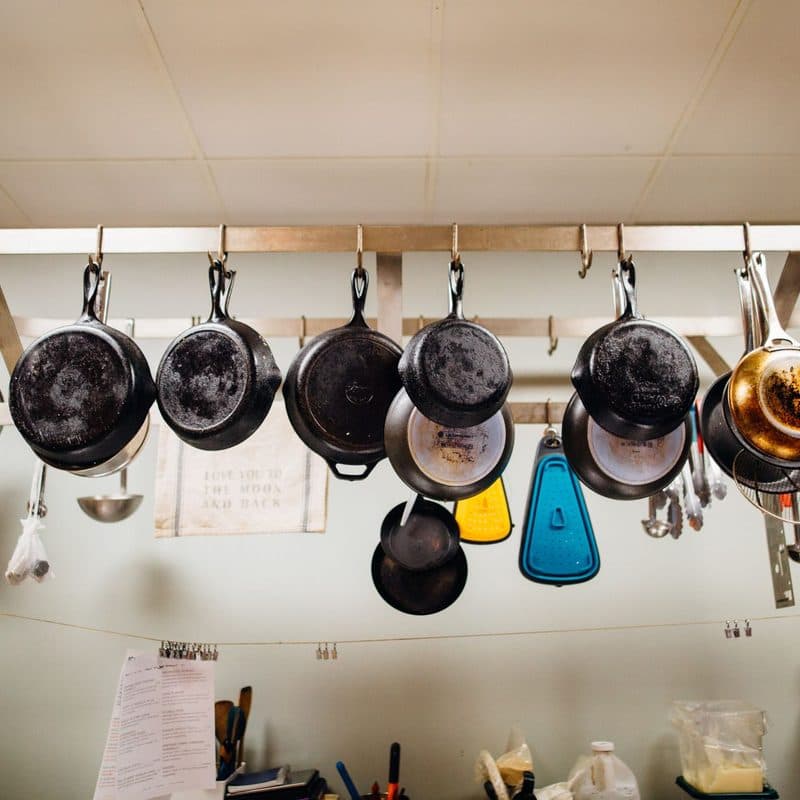 Heritage Steel Titanium Series Fry PanA 316Ti cooking surface — stainless carrying molybdenum and titanium — in a five-ply pan at 800F, made in Tennessee. | Salty and acidic cooking, in a pan you keep for decades | 8.9 | |
| 2 | 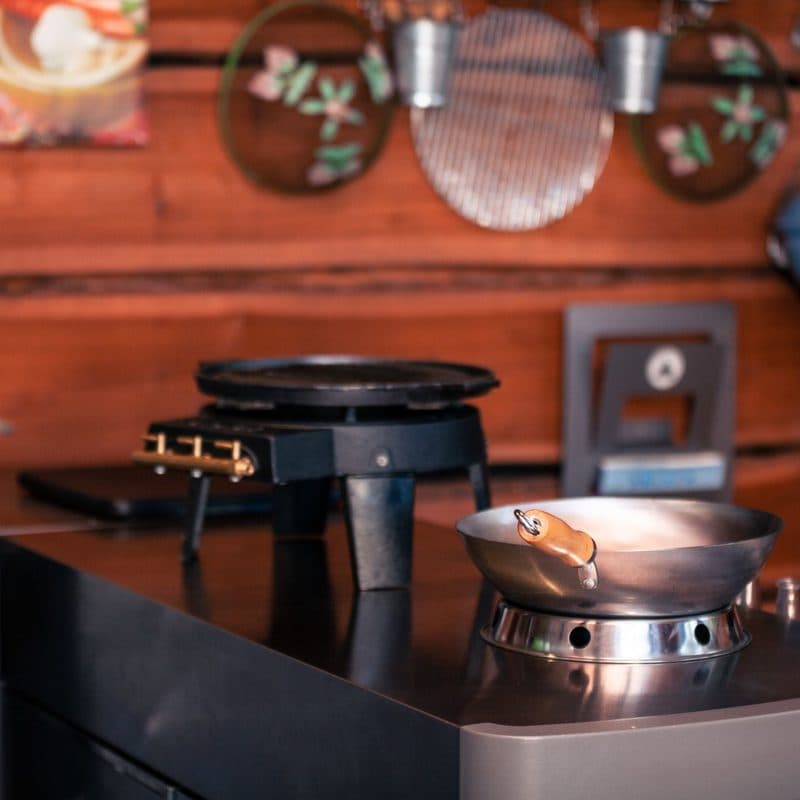 All-Clad D3 Stainless Fry PanAn 18/10 interior with no molybdenum, and the best-evidenced structure in the category. For most kitchens this is the right trade. | Normal cooking, where 18/10 is entirely sufficient | 9.0 | |
| 3 | 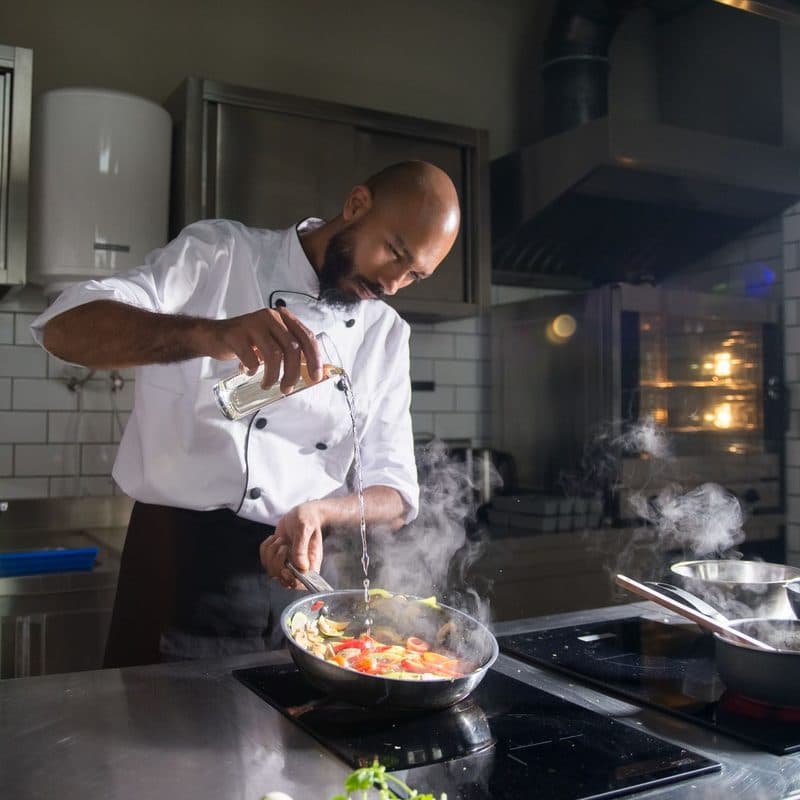 Demeyere Industry 5 Fry PanSilvinox is an electrochemical surface treatment that strips iron from the surface and leaves a more stable passive layer. | Getting most of the corrosion benefit without a 316 alloy | 8.6 |
#ad Buy links are affiliate links. We never print a price — prices change weekly and a printed one is wrong within a month, so every link goes to the live Amazon listing. How we are funded.
The short answer
304 and 316 are both food-grade austenitic stainless steels. The difference is that 316 contains roughly 2 to 3 percent molybdenum and 304 contains none, and molybdenum is what resists pitting corrosion from chlorides — salt. In a kitchen that matters in one specific situation: salty or acidic liquid sitting in a pan for a long time. For food that passes through a pan in minutes, 304 is entirely sufficient, and almost every clad pan sold uses it.
Side by side
| 304 (18/8, 18/10) | 316 | |
|---|---|---|
| Chromium | About 18 percent | About 18 percent |
| Nickel | 8 to 10 percent | About 10 percent |
| Molybdenum | None | 2 to 3 percent |
| Sodium chloride tolerance before pitting begins | As little as 100 ppm | Up to about 2,000 ppm |
| Chlorine tolerance | Signs of corrosion around 2 ppm | Signs of corrosion around 4 ppm |
| Magnetic | No, in the annealed state | No, in the annealed state |
| Food grade | Yes | Yes |
| Cost | Lower | Higher |
| In cookware | The standard: nearly every clad pan | Rare. Heritage Steel's 316Ti is the example on this site |
Those chloride figures come from published engineering reference data, cited below. They describe sustained immersion in solutions of that concentration, which is a continuous-exposure industrial condition rather than a half-hour of salted pasta water — the point is the ratio between the two grades, not a kitchen threshold.
How 304 relates to 18/10, 18/8 and 18/0
Cookware brands rarely print "304" on a pan. They print 18/10 or 18/8, which are the chromium and nickel percentages, and both of those sit inside the 304 family. 18/0 is a different animal: it has chromium and effectively no nickel, which makes it magnetic, cheaper and less corrosion-resistant, and it belongs to the 400 series rather than 304.
So the practical hierarchy on a cooking surface runs: 18/0 at the bottom, 18/8 and 18/10 in the middle as 304-family steels, and 316-series at the top. 18/10 vs 18/8 vs 18/0 works through the first part of that in detail. This page is about the step above it.
One wrinkle worth knowing: 316Ti, which is what Heritage Steel uses, is 316 with titanium added. The titanium stabilises the alloy against a form of attack that happens at weld seams, and it is used in cookware partly for strength and partly for marketing clarity.
What pitting actually is
Stainless steel does not resist corrosion because it is inert. It resists corrosion because chromium reacts with oxygen to form an invisible, self-repairing oxide film on the surface — the passive layer. Scratch it and it reforms; expose it to oxygen and it stays.
Chlorides are the one common household chemical that attacks that film locally rather than generally. A chloride ion finds a weak point, breaks through the passive layer at a single spot, and corrosion then proceeds downward into a tiny pit instead of spreading across the surface. Molybdenum interferes with that process: it slows pit initiation and suppresses pit growth once started.
That is why pitting is the only chemical failure mode that genuinely matters in a stainless pan, and why it looks the way it does — a scatter of tiny dark dots in the base rather than general rust. The mechanism is also behind why stainless cookware can appear to rust, and it is why dishwasher detergent gets a mention: it contains chlorides.
Does it matter in a kitchen?
Usually not, and we would rather say so than sell the upgrade.
Where 304 is fine: searing, frying, boiling pasta, sauces finished in minutes, anything you cook and then wash. Food is in contact with metal briefly, at temperature, and then removed. The overwhelming majority of what a home kitchen does.
Where 316 earns its premium: salt or brine left in a pan, tomato sauce simmered for hours and then left to cool overnight, stock reduced over an afternoon, brining in a stock pot, and undissolved salt sitting on a dry hot base — which is the classic way a pan gets pitted. It also matters more in pots than in pans, because liquid sits in a pot.
The habit that beats the alloy: add salt after the water boils, never leave salted or acidic liquid in a pan to cool overnight, and rinse and dry rather than leaving a pan to soak. Those three habits do more for a 304 pan than upgrading to 316 does for a carelessly used one.
What this means for buying
Do not pay a large premium for 316 unless the way you cook matches the list above. The alloy is a genuine improvement in a narrow condition, not a general upgrade, and a 316 pan with a thin gauge or a low oven rating is still a worse pan than a well-built 304 one.
Do take it as a tiebreaker. Heritage Steel's 316Ti comes attached to five-ply construction, an 800F rating and US manufacturing, so the alloy is one reason among several — which is why it is our top pick in best 5-ply stainless steel cookware and features in buy-it-for-life cookware.
And be cautious about the nickel question, which often arrives attached to this one. Both grades contain nickel at around 10 percent. If nickel is the concern, neither 304 nor 316 solves it — see is stainless steel cookware safe and best non-toxic stainless cookware.
The picks in full
1. The 316 option
Heritage Steel Titanium Series Fry Pan
Heritage Steel
A 316Ti cooking surface — stainless carrying molybdenum and titanium — in a five-ply pan at 800F, made in Tennessee.
- Pitting resistance
- 9.6
- Heat rating
- 9.4
- Durability
- 9.0
- Value
- 7.4
- 316Ti cooking surface: stainless strengthened with titanium and molybdenum
- Five-ply fully clad construction
- Oven safe to 800F and broiler safe (Heritage Steel published spec)
- Induction compatible; handwashing recommended
- Lifetime warranty; manufactured in Clarksville, TN
What it gets right
- 316Ti resists pitting from salt and acid better than the 18/10 everyone else uses
- The 800F oven rating matches Made In and beats All-Clad by 200F
- Made in a family-owned Tennessee factory, not assembled from imported bodies
Who should skip it
- Least-known brand here, so resale and second-hand parts are thin
- Priced against All-Clad without All-Clad's service history
- The clad steel is sourced from South Korea, so made-in-USA means built, not mined
Heritage Steel is the one brand on this site that puts a 316-series alloy where the food is. The Titanium Series cooking surface is 316Ti: stainless strengthened with titanium and carrying molybdenum, which is the element that resists chloride pitting.
The rest of the pan matches: five-ply fully clad, oven safe to 800F and broiler safe, induction compatible, lifetime warranty, manufactured in a family-owned factory in Clarksville, Tennessee. Handwashing is recommended, which is the one convenience cost.
The honest deductions: it is the smallest brand we cover, so parts and lids are thin on the ground; it is priced against All-Clad without All-Clad's service record; and the clad steel is sourced abroad, so made-in-USA means built rather than mined.
2. The 304-family benchmark
All-Clad D3 Stainless Fry Pan
All-Clad
An 18/10 interior with no molybdenum, and the best-evidenced structure in the category. For most kitchens this is the right trade.
- Pitting resistance
- 7.6
- Heat rating
- 7.6
- Durability
- 9.6
- Value
- 7.2
- Tri-ply: stainless interior, aluminum core, magnetic stainless exterior
- Oven and broiler safe to 600F (All-Clad published spec)
- Induction compatible on any stovetop
- Handwash only, per the manufacturer
- Limited lifetime warranty; bonded, engineered and assembled in Canonsburg, PA
What it gets right
- Survived America's Test Kitchen's concrete-strike abuse testing with barely a ding
- Rivets and handle join are the sturdiest in the category
- Decades of parts and service history standing behind the warranty
Who should skip it
- Costs roughly three times a Tramontina that cooks nearly as evenly
- The stick handle is narrow and bites into your palm on a loaded 12-inch pan
- Handwash only, which is a real constraint if you hate washing up
D3 uses the 18/10 interior that almost every clad pan uses, which sits in the 304 family: roughly 18 percent chromium, 10 percent nickel, no molybdenum. It is the standard because for food that spends minutes rather than days in a pan, it is genuinely enough.
What you get instead of alloy upgrades is structural evidence. America's Test Kitchen heated pans to 500F, plunged them into ice water and struck them three times against concrete; the All-Clad came through with barely a ding. Tri-ply bonded, 600F oven and broiler safe, handwash only, limited lifetime warranty, bonded in Canonsburg, Pennsylvania.
The costs: 600F is 200F below Heritage Steel, handwash only, the narrow stick handle is its owners' most common complaint, and it costs roughly three times a Tramontina that cooks nearly as evenly.
3. Best surface treatment on 18/10
Demeyere Industry 5 Fry Pan
Demeyere
Silvinox is an electrochemical surface treatment that strips iron from the surface and leaves a more stable passive layer.
- Pitting resistance
- 8.8
- Heat rating
- 7.6
- Durability
- 9.2
- Value
- 7.0
- Five-ply construction from rim to rim
- Oven safe to 500F (Zwilling published spec)
- Dishwasher safe; induction compatible
- Patented Silvinox surface treatment resists fingerprints and acidic foods
- Lifetime warranty; made in Belgium
What it gets right
- Silvinox is the only surface treatment here that measurably slows cosmetic aging
- Built to a commercial-kitchen spec, and the gauge shows it
- Dishwasher safe despite the price bracket
Who should skip it
- A 500F ceiling is low for the money
- Heaviest pan on this site; genuinely tiring in the larger sizes
- Rare enough in US retail that replacing one piece takes effort
There is a second route to corrosion resistance that has nothing to do with the grade: treat the surface. Silvinox is an electrochemical process that removes iron and impurities from the outer layer of 18/10 steel, leaving a cleaner, more stable passive film behind.
It is the only treatment in this category that measurably slows the cosmetic aging — staining, clouding, fingerprinting — that otherwise marks an older pan. Five-ply from rim to rim, 500F oven rating, dishwasher safe, induction compatible, lifetime warranty, made in Belgium.
A treated surface is not the same as a molybdenum-bearing alloy: it improves the passive layer rather than the metal underneath it. And the deductions are real — a 500F ceiling is low for the money, it is the heaviest pan we cover, and US distribution is thin.
Frequently asked questions
What is the difference between 304 and 316 stainless steel?
316 contains roughly 2 to 3 percent molybdenum and 304 contains none. Molybdenum resists pitting corrosion from chlorides, which is why 316 tolerates far higher salt concentrations before it starts to pit.
Is 316 stainless steel better for cookware?
Marginally, and only in a narrow condition: salty or acidic liquid left in the pan for a long time. For food that passes through in minutes, 304 is entirely sufficient, which is why almost all clad cookware uses it.
Is 18/10 stainless steel the same as 304?
Yes, effectively. 18/10 describes roughly 18 percent chromium and 10 percent nickel, which sits in the 304 family. 18/8 is also 304-family. 18/0 is not — it has effectively no nickel and belongs to the 400 series.
Is 304 stainless steel food safe?
Yes. 304 is the standard food-grade stainless used in kitchen equipment, food processing and nearly every clad pan on the market. 316 is also food safe and is used where chloride exposure is sustained.
What is 316Ti stainless steel?
316 with titanium added. The titanium stabilises the alloy against a form of attack that occurs at weld seams and adds strength. Heritage Steel uses 316Ti as the cooking surface on its Titanium Series.
Will 304 stainless cookware pit from salt?
It can, if undissolved salt sits on a hot dry base or salted liquid is left in the pan to cool overnight. Adding salt after the water boils and not leaving liquid to stand prevents nearly all of it.
Sources
- Boulder Engineering Studio — 304 vs 316 stainless steel: composition and chloride thresholds
- Xometry — 18/8 vs 18/10 vs 18/0 stainless steels compared
- Heritage Steel — Titanium Series 10.5-inch Fry Pan, published specification
- Made In — What is 18/10 stainless steel?
- Klingspor — The passive layer on stainless steel (abrasives technical reference)
- All-Clad — D3 Stainless 12-inch Fry Pan, published specification
- Zwilling — Demeyere Industry 5 11-inch Frying Pan, published specification
- National Institutes of Health — Nickel fact sheet for health professionals