Skillets & Fry Pans
Skillet vs Saute Pan
Two pans that look similar in a listing and do different jobs on a hob. One of them should be your first purchase. It is not the one with the bigger capacity.
Disclosure: Ply & Pan earns a commission on qualifying purchases made through links on this page. We take no free product and no sponsorship, and we never print a price. How we are funded.
Quick picks
The short answer. Tap any row for the full write-up.
| # | Product | Best for | Score | Price |
|---|---|---|---|---|
| 1 | 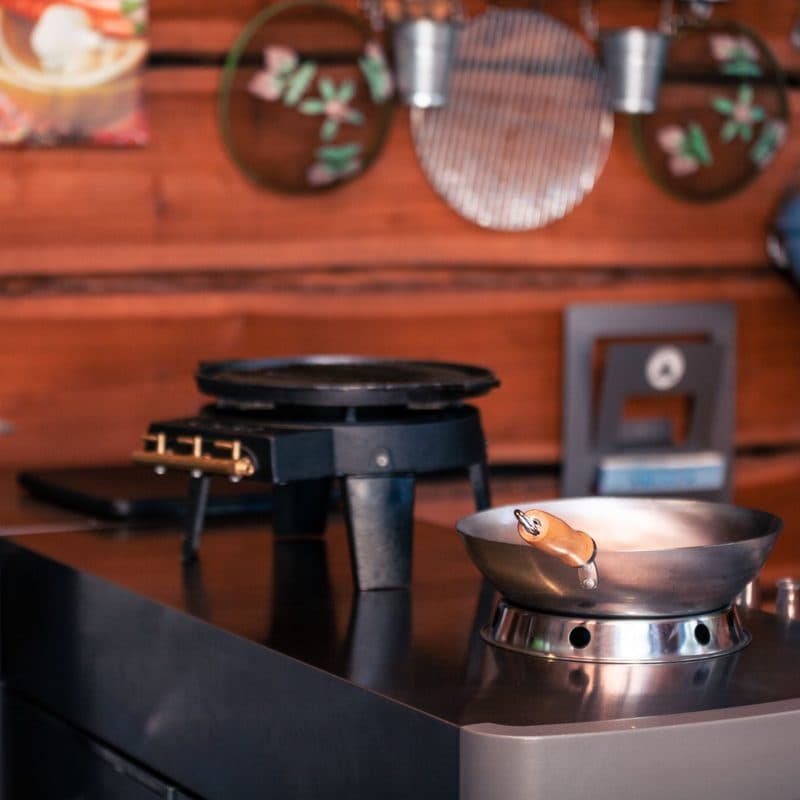 All-Clad D3 Stainless Fry PanThe flared-wall skillet is the higher-utility shape, and this is the reference version of it: 600F, lifetime warranty, best-in-class durability. | Browning, searing, reducing, everything you do most nights | 9.0 | |
| 2 | 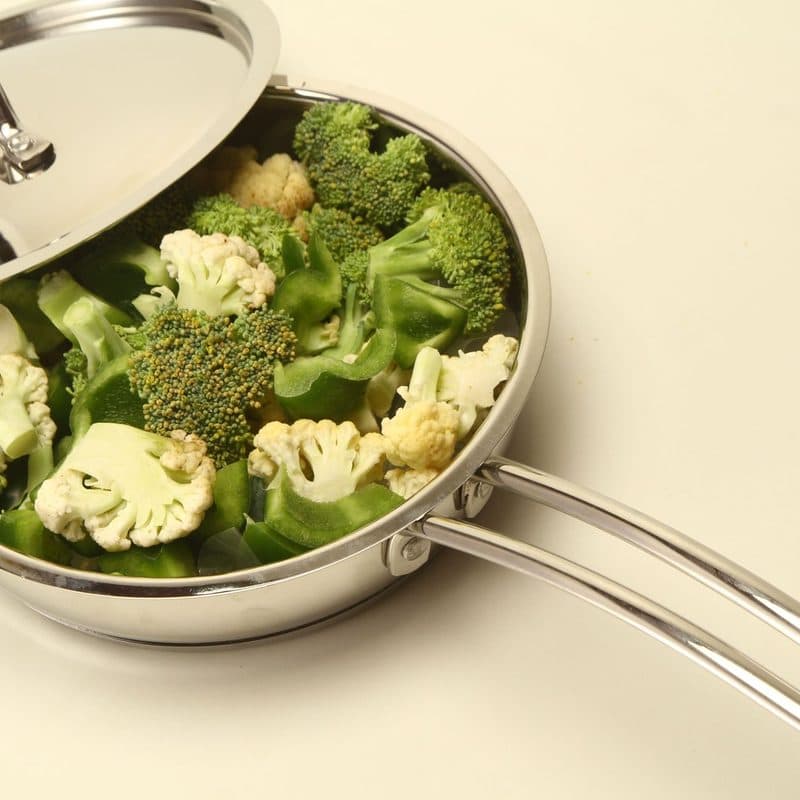 Made In Stainless Clad SaucierIf you want the straight-walled pan for liquid work, a rounded saucier does the same jobs better and leaves no corner for a whisk to miss. | Sauces, risotto, custards and anything you whisk | 8.5 | |
| 3 |  Tramontina Signature Tri-Ply Clad Cookware SetClad through the pots as well as the pans, so you get the skillet, the saucepans and the covered shapes without a disc-bottom compromise. | Furnishing a kitchen rather than buying a single pan | 8.6 |
#ad Buy links are affiliate links. We never print a price — prices change weekly and a printed one is wrong within a month, so every link goes to the live Amazon listing. How we are funded.
The short answer
A skillet has flared, sloping walls and is for browning. A sauté pan has straight, vertical walls and more capacity, and is for cooking with liquid. Buy the skillet first. The skillet covers more of what you cook on a normal weeknight, and the jobs a sauté pan is genuinely better at are mostly done better again by a saucier or a small Dutch oven.
The two shapes compared
| Property | Skillet / fry pan | Sauté pan |
|---|---|---|
| Wall shape | Flared, sloping outward | Straight, vertical |
| Capacity at the same diameter | Lower | Noticeably higher |
| Moisture escape | Fast — browns well | Slower — steams more readily |
| Spatula access | Easy, shallow angle | Awkward against a vertical wall |
| Tossing food | Designed for it | Not really possible |
| Holding liquid | Shallow, spills when full | Its main advantage |
| Usual handle | Long stick handle | Stick handle plus a helper loop |
| Typically sold with a lid | No | Yes |
Why wall shape changes how food browns
Browning requires the surface of the food to get above the boiling point of water, which cannot happen while the food is sitting in its own released moisture. Flared walls give steam a wide, low escape route, so moisture leaves quickly. Straight walls hold a column of humid air over the food, and that humid air is what turns a sear into a braise.
That is the entire functional difference, and it runs both ways. The same property that makes a sauté pan worse at browning makes it better at anything you want to stay moist: a braise, a shallow poach, a simmered sauce with the lid on.
Why the names are a mess
"Sauté" means to jump, which describes tossing food in a flared pan — the thing a sauté pan is structurally unable to do. The name is historically backwards and has stuck, which is why listings are so inconsistent: plenty of retailers list a flared pan as a sauté pan and a straight-walled one as a frying pan.
Ignore the name and look at the photograph in profile. Sloping walls mean skillet behaviour. Vertical walls mean sauté-pan behaviour. The same confusion exists further along the range, which is why saucier vs saucepan and saucepan vs stock pot are worth reading before you buy a second vessel.
Which to buy first, and what to buy second
Buy the skillet. On a normal week it does eggs, chicken thighs, steak, onions, mushrooms, fish, reheating and the beginning of almost every braise. A sauté pan can do many of those but does none of them better, and it does the highest-frequency job — browning — worse.
For the second pan, the honest answer is usually not a sauté pan at all. If you want liquid capacity with a lid, a saucier does sauces, risotto and custards better; a stock pot does volume better; a Dutch oven does long braises better. A sauté pan sits between all three and wins against none of them. This is the argument behind the two-pan kitchen.
The exception is real: if you regularly shallow-fry, or cook one-pan braises for four or more where the food must be covered in liquid, the sauté pan's capacity and its lid are genuinely useful and nothing else in that size range matches it.
What to check on either shape
- Fully clad, not disc-bottomed. On a sauté pan this matters more than on a skillet, because the straight walls are in constant contact with liquid — fully clad vs disc bottom.
- A helper handle on anything over 3 quarts. A full sauté pan is heavy and awkward on a single stick handle.
- A stainless lid rather than glass, because a glass lid caps the whole pan at the lid's oven rating.
- The published oven rating, which ranges from 500F to 800F across the brands we track — oven-safe temperatures by brand.
- Base diameter against your burner, since both shapes suffer the same cool-edge problem on an undersized ring.
The picks in full
1. Buy this shape first
All-Clad D3 Stainless Fry Pan
All-Clad
The flared-wall skillet is the higher-utility shape, and this is the reference version of it: 600F, lifetime warranty, best-in-class durability.
- Browning
- 9.2
- Versatility
- 9.0
- Durability
- 9.8
- Value
- 6.6
- Tri-ply: stainless interior, aluminum core, magnetic stainless exterior
- Oven and broiler safe to 600F (All-Clad published spec)
- Induction compatible on any stovetop
- Handwash only, per the manufacturer
- Limited lifetime warranty; bonded, engineered and assembled in Canonsburg, PA
What it gets right
- Survived America's Test Kitchen's concrete-strike abuse testing with barely a ding
- Rivets and handle join are the sturdiest in the category
- Decades of parts and service history standing behind the warranty
Who should skip it
- Costs roughly three times a Tramontina that cooks nearly as evenly
- The stick handle is narrow and bites into your palm on a loaded 12-inch pan
- Handwash only, which is a real constraint if you hate washing up
If you are choosing one shape, choose the skillet. Flared walls do two things a straight-walled pan cannot: they let moisture escape fast enough to brown rather than steam, and they let you get a spatula or a fish slice under food at a shallow angle.
The D3 is the benchmark. Tri-ply with an aluminum core, oven and broiler safe to 600F, induction compatible, handwash only, limited lifetime warranty, bonded in Canonsburg, Pennsylvania. It came through America's Test Kitchen's concrete-strike abuse testing with barely a ding.
Its weaknesses are well-known and worth saying: three times the price of a Tramontina that browns nearly as well, a narrow stick handle that bites under load, and handwash-only care.
2. Better second pan than a sauté pan
Made In Stainless Clad Saucier
Made In
If you want the straight-walled pan for liquid work, a rounded saucier does the same jobs better and leaves no corner for a whisk to miss.
- Browning
- 6.8
- Versatility
- 8.8
- Durability
- 8.6
- Value
- 8.6
- Five-ply stainless clad construction
- Heat safe to 800F (Made In published spec)
- Induction compatible; handwash preferred
- Rounded walls with no corner for a whisk to miss
- Lifetime warranty on stainless cookware
What it gets right
- Cheapest route into a genuinely good saucier from a fully-clad brand
- The 800F rating makes oven-finishing a braise or a gratin uncomplicated
- Wide mouth reduces sauces faster than a straight-walled saucepan
Who should skip it
- That wide mouth is a liability if you mostly boil small quantities
- Rounded base means less contact area on a small induction ring
- Five plies are slower off the heat than a copper-core saucier
Most people who want a sauté pan want it for liquid: braises, pan sauces, shallow-frying, risotto. A saucier is the better vessel for nearly all of that, because the rounded wall-to-base junction means a whisk reaches everywhere and nothing seizes in a square corner.
Made In's version is five-ply, heat safe to 800F by published specification, induction compatible, lifetime warranty on stainless. The wide mouth also reduces a sauce faster than a straight-walled pan of the same volume.
The trade-offs: the wide mouth is a liability if you mostly boil small quantities, the rounded base gives less contact area on a small induction ring, and five plies respond slower than tri-ply off the heat.
3. Cheapest way to own both shapes
Tramontina Signature Tri-Ply Clad Cookware Set
Tramontina
Clad through the pots as well as the pans, so you get the skillet, the saucepans and the covered shapes without a disc-bottom compromise.
- Browning
- 8.2
- Versatility
- 9.2
- Durability
- 7.8
- Value
- 9.6
- Tri-ply clad throughout, not disc-bottomed on the pots
- 18/10 stainless interior over an aluminum core
- Oven safe to 500F; dishwasher safe; NSF-certified
- Induction compatible across the set
- Tramontina lifetime warranty
What it gets right
- Fully clad at a price where most sets quietly switch to disc bottoms
- The one set we would hand to someone furnishing a first kitchen
- The dishwasher-safe rating applies across the set, not just the skillets
Who should skip it
- Sets always include a piece or two you will never reach for
- The 500F ceiling limits oven work compared with buying pieces individually
- Lids are the weakest component; treat their rating as lower than the pans'
If this question is really "what do I buy to cover everything", the answer is usually not one more pan shape. A fully-clad set gets you a skillet, saucepans and a covered pot for less than two premium pieces.
Tramontina clads the pots as well as the fry pans, which is the specification most sets quietly skip. 18/10 interior over an aluminum core, 500F oven rating, dishwasher safe, NSF-certified, induction compatible, lifetime warranty.
Sets always include a piece you will not use, the 500F ceiling limits oven work, and the lids are the weakest component. Our general view on sets is in set vs buying piece by piece.
Frequently asked questions
What is the difference between a skillet and a saute pan?
Wall shape. A skillet has flared, sloping walls that let moisture escape so food browns. A sauté pan has straight vertical walls, more capacity and usually a lid, which suits cooking with liquid.
Should I buy a skillet or a saute pan first?
A skillet. It handles the highest-frequency jobs — searing, browning, eggs, reheating — and a sauté pan does none of those better. Buy the second shape once you know what you are missing.
Can you use a saute pan as a frying pan?
Yes, but food browns less well because the straight walls trap steam over it, and getting a spatula under anything is awkward against a vertical wall.
Is a saute pan the same as a saucier?
No. A sauté pan has straight walls and a flat base; a saucier has rounded walls that meet the base in a curve, so a whisk reaches everywhere. For sauces and risotto the saucier is the better vessel.
Why is it called a saute pan if you cannot saute in it?
Sauté means to jump, describing food tossed in a flared pan. The naming is historically backwards and retailers use both terms loosely, so judge the pan by its profile rather than its label.
What size saute pan is most useful?
Three to four quarts, which is roughly an 11-inch diameter. Below that the capacity advantage over a skillet disappears; above it the pan is heavy enough to need two hands when full.
Sources
- All-Clad — D3 Stainless 12-inch Fry Pan, published specification
- Made In — Stainless Clad Frying Pan, published specification
- Tramontina — Signature Tri-Ply Clad Stainless Steel Fry Pan, published specification
- America's Test Kitchen — The Best Stainless-Steel Skillets
- All-Clad — Care and use instructions for stainless cookware