Saucepans & Sauciers
How to Use a Saucier
The pan rewards a different stirring motion than a saucepan does. Once you use it, the shape makes sense.
Disclosure: Ply & Pan earns a commission on qualifying purchases made through links on this page. We take no free product and no sponsorship, and we never print a price. How we are funded.
Quick picks
The short answer. Tap any row for the full write-up.
| # | Product | Best for | Score | Price |
|---|---|---|---|---|
| 1 |  Made In Stainless Clad SaucierFive-ply, 800F and a comfortable handle. Nothing here will hold back your technique. | A first saucier that will not limit you later | 8.9 |
#ad Buy links are affiliate links. We never print a price — prices change weekly and a printed one is wrong within a month, so every link goes to the live Amazon listing. How we are funded.
The sweeping stir
The first thing to change is how you hold the spoon. In a saucepan you stir in a circle in the middle and periodically go and deal with the corner. In a saucier you do one continuous motion: keep the spoon or whisk in contact with the metal and sweep from the center of the base up the curved wall and back down, rotating the pan or your wrist as you go.
That motion touches every part of the cooking surface on every pass, which is the entire reason the shape exists. It is also why people who buy a saucier and keep stirring the way they always did conclude the pan is nothing special.
Reductions
A saucier reduces faster than a saucepan of the same volume because its mouth is wider and evaporation scales with exposed surface. Two practical consequences.
- Recipe timings written for a saucepan will overshoot. Start checking early.
- You can reduce at a lower heat for the same speed, which means less scorching risk on the base.
For a pan sauce: sear in a skillet, transfer the meat out, deglaze the skillet, then pour into the saucier to reduce and mount with butter. Two pans, but you get the skillet's fond and the saucier's control.
Emulsified sauces
Hollandaise, beurre blanc, and butter-mounted pan sauces all live in a narrow temperature band: too cool and they will not come together, too hot and they split. The saucier helps in two ways — complete whisk contact, so no pocket of sauce sits still and overheats, and a curved base that keeps the volume moving.
Work off the heat more than you think. Bring the base up to temperature, then pull the pan and let residual heat do the work while you whisk. This is where a copper core genuinely helps, because the pan stops delivering heat sooner.
Risotto, polenta and grains
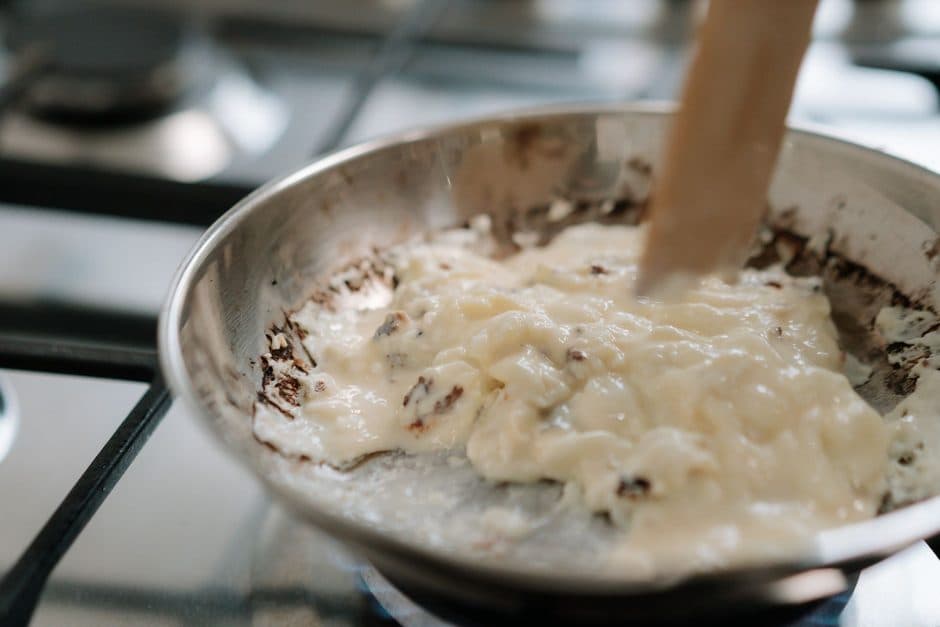
These are the dishes that convert people. All three release starch that sticks to whatever it touches and scorches where it sits. In a saucepan that means a ring of burnt starch in the corner; in a saucier there is no corner and your normal stirring reaches it all.
Practical notes: keep the heat at a genuine medium rather than low, since risotto wants an active simmer; add liquid in stages and let each be absorbed; and resist covering the pan, because the wide mouth is doing useful evaporation work. More in best pan for rice and risotto.
What the saucier is bad at
Long simmers. That wide mouth loses liquid. A two-hour stock will reduce more than you want. Use a straight-walled saucepan.
Boiling large volumes. More exposed surface means more energy to reach and hold a boil.
Deep frying. The wide mouth means a large volume of oil for a given depth, and the curved walls make the level rise unpredictably when food goes in.
Technique that protects the pan
Three habits, all cheap, that decide whether your saucier lasts decades.
Never heat it empty for long. Sauciers are usually filled before heating, which is why they outlast skillets. Keep it that way. Empty high heat is the leading cause of warping, and it is excluded from every warranty in this category.
Add salt to moving liquid. Salt dumped into still water settles and concentrates against the base, and concentrated chloride is the one thing that genuinely pits stainless over years.
Let it cool before it meets water. Thermal shock warps bases, and a warped base on a glass or induction hob is effectively a retired pan. Deglazing with a splash of liquid while cooking is fine; a hot empty pan under a cold tap is not.
The picks in full
1. The pan we would learn on
Made In Stainless Clad Saucier
Made In
Five-ply, 800F and a comfortable handle. Nothing here will hold back your technique.
- Shape
- 9.2
- Heat
- 9.0
- Durability
- 8.6
- Value
- 8.8
- Five-ply stainless clad construction
- Heat safe to 800F (Made In published spec)
- Induction compatible; handwash preferred
- Rounded walls with no corner for a whisk to miss
- Lifetime warranty on stainless cookware
What it gets right
- Cheapest route into a genuinely good saucier from a fully-clad brand
- The 800F rating makes oven-finishing a braise or a gratin uncomplicated
- Wide mouth reduces sauces faster than a straight-walled saucepan
Who should skip it
- That wide mouth is a liability if you mostly boil small quantities
- Rounded base means less contact area on a small induction ring
- Five plies are slower off the heat than a copper-core saucier
Everything on this page works in any fully-clad saucier. This is the one we would buy to learn in, because the handle is comfortable for the long stirring these techniques involve.
Frequently asked questions
How do you stir in a saucier?
One continuous sweep rather than a circle in the middle. Keep the spoon or whisk in contact with the metal and move from the center of the base up the curved wall and back, so every pass touches the whole surface.
What can you cook in a saucier that you cannot in a saucepan?
Nothing exclusively, but risotto, polenta, custard, grits and emulsified sauces all come out better because there is no right-angled corner where starch and protein collect and scorch.
Should you cover a saucier when making risotto?
No. The wide mouth is doing useful evaporation work, and covering it traps steam and makes the rice gluey. Keep it uncovered and at an active simmer.
Can you deep fry in a saucier?
It is a poor choice. The wide mouth needs a lot of oil for a given depth and the curved walls make the level rise unpredictably when food goes in. Use a straight-walled pot.
Why do recipe timings run short in a saucier?
Because a saucier's wider mouth evaporates faster than a saucepan of the same volume. Recipes written for straight-walled pans will over-reduce. Start checking earlier than the stated time.
How do I stop a saucier pitting?
Add salt to moving liquid rather than to still cold water. Salt that settles on the base concentrates, and concentrated chloride is what causes the small dark pits that will not polish out.