Care & Technique
How to Store Stainless Steel Cookware
Clad stainless does not wear out in use. It gets scratched, spotted and dented in the cupboard — which is the one part of owning it that nobody plans for.
Disclosure: Ply & Pan earns a commission on qualifying purchases made through links on this page. We take no free product and no sponsorship, and every price here is read from Amazon on the date shown. How we are funded.
Quick picks
The short answer. Tap any row for the full write-up.
| # | Product | Best for | Score | Price |
|---|---|---|---|---|
| 1 | 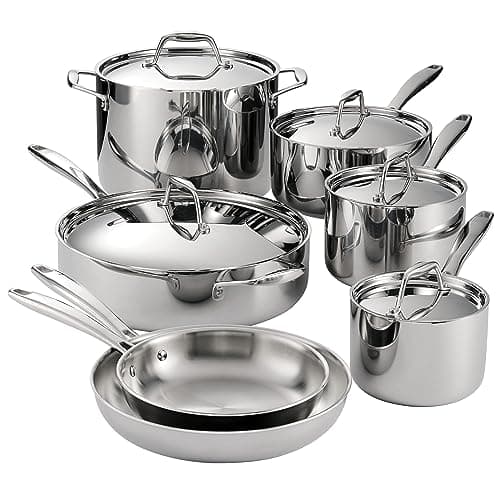 Tramontina Signature Tri-Ply Clad Cookware SetFully clad tri-ply with stainless lids, dishwasher safe across the set — and pots that nest into one cabinet if you store the lids flat and separately. | Pots that nest properly when the lids come off | 8.4 | $299.95 · View on Amazon $399.95 · 25% off |
| 2 | 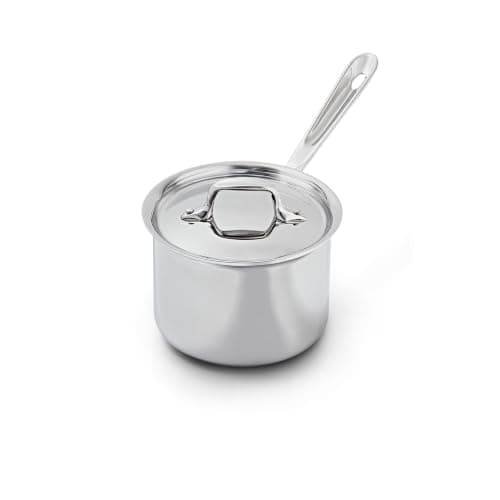 All-Clad D3 Stainless SaucepanA steel lid rather than glass: it stacks flat in a drawer, it does not break, and it shares the pan's 600F rating instead of capping it. | A stainless lid that stacks flat and shares the pan's rating | 8.4 | $159.95 · View on Amazon $179.99 · 11% off |
| 3 | 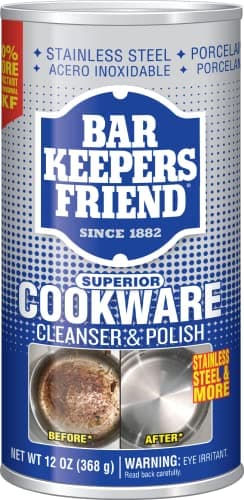 Bar Keepers Friend Cookware CleanserOxalic acid removes the water spotting and dull film that build up on stored pans, and restores the surface rather than polishing metal away. | Removing water spots and stacking marks | 8.0 |
#ad Buy links are affiliate links. Prices come straight from Amazon, are stamped with the date they were read, and disappear rather than go stale if the feed stops. How we are funded.
What storage actually does to clad pans
Fully-clad stainless has no coating to fail, so it does not wear out in use. It accumulates damage in the cupboard, and there are only three kinds.
Scratches, from stacking. A pan's own base dragged across the interior of the pan below it is the commonest source of interior scratching on steel cookware. It is cosmetic — there is no coating to breach — but scratches hold residue and make a pan look finished long before it is.
Spotting and pitting, from trapped moisture. Clad stainless resists corrosion because of a passive chromium-oxide layer that needs oxygen to maintain itself. A damp pan nested inside another, in a closed cupboard, is one of the few realistic ways to deprive it of that and get pitting. The mechanism is in does stainless steel cookware rust.
Dents and rim damage, from falls. Rarer, and usually from a stack that was one pan too tall or a hanging hook that let go. A dented rim means a lid that no longer seals.
How to stack without scratching
Put something between each pan. That is the whole technique, and almost anything works: a folded dishcloth, a paper plate, a sheet of kitchen paper, a cheap felt pan protector. Dedicated protectors are tidier; a dishcloth you already own costs nothing and works as well.
Stack heaviest at the bottom, and keep stacks to three or four pans. Beyond that the stack gets unstable and the pan at the bottom takes the full weight of everything above it every time you lift one off.
Nest by diameter where you can — a 10-inch skillet inside a 12-inch wastes no space at all. Shapes that nest with nothing, like a wide straight-sided sauté pan, are better stored alone on a shelf than at the bottom of a stack.
Lids are the real problem
A stack of three pans with their lids on takes more vertical space than five pans nested without them. Lids are also the component most likely to break, chip or warp.
Store lids separately and flat, in a drawer, or upright in a lid rack or a plate stand. Both are better than leaving them on the pans.
Steel lids stack; glass lids do not. A stainless lid goes flat under another stainless lid and nothing happens. Glass lids need space around the handle and they break. That is a point in favour of steel lids beyond the oven rating.
Never store a pan with the lid sealed on. A closed pan traps whatever moisture was left inside it, which is the single most reliable way to produce spotting and, eventually, pitting.
Dry it properly first — this is the important one
Everything else on this page is cosmetic. This one is not.
Towel-dry every pan before it goes away, including the rim and the underside of the base where water collects at the edge of the cladding. Air-drying leaves hard-water minerals behind as chalky white spots — the problem we deal with in white spots on a stainless steel pan — and leaves a genuinely damp pan if you put it away too soon.
If a pan comes out of the dishwasher still wet, do not stack it. Leave it on the rack. Five minutes of air and it is fine; an hour nested inside another pan in a closed cupboard and it is spotted.
Where to store cookware, ranked
Hanging, on a rack or rail. The best option by a clear margin: no stacking contact, no trapped moisture, nothing to lift off another pan. The constraint is wall space and the weight rating of the fixing — a heavy clad pot needs a proper fixing into a stud, not a hook in plasterboard.
A deep drawer with dividers. Excellent for pans stored flat with protectors, and far easier to use than a low cabinet because you can see what you have.
A standard base cabinet. The default. Works fine with protectors between pans and lids kept elsewhere. Watch the depth: a 12-inch skillet with its handle is about 22 inches long, and the usable depth of a standard cabinet is closer to 20.
On the stovetop. Legitimate for the pan you use daily, and it is what most people actually do. Just do not leave a pan sitting on a burner you then use for something else, and do not store a pan on a glass cooktop, where grit underneath it is the main cause of surface marks — see will stainless steel scratch a glass top stove.
In the oven. The classic small-kitchen move, and it is fine for oven-safe steel pans with no plastic or wooden components — until you preheat the oven without checking. If you do this, make it a habit to look first.
If you have no room at all
The real answer to a storage problem is usually fewer pans rather than better shelving. Four good pieces cover a kitchen for one or two people: a 10-inch skillet, a saucier or saucepan, a pot and one shared lid. The argument is in the two-pan kitchen, and the shopping version of it is the best stainless steel cookware for small kitchens.
The bottom line
Towel-dry everything, put a cloth between stacked pans, store lids flat and separately, and keep stacks to three or four. That is the entire method, it costs nothing, and it is the difference between cookware that looks a decade old and cookware that looks like it has been used for a decade.
The picks in full
1. Best set for stacking
Tramontina Signature Tri-Ply Clad Cookware Set
Tramontina
Fully clad tri-ply with stainless lids, dishwasher safe across the set — and pots that nest into one cabinet if you store the lids flat and separately.
- Nesting
- 8.6
- Finish durability
- 7.0
- Build
- 8.2
- Value
- 9.6
- Tri-ply clad throughout, not disc-bottomed on the pots
- 18/10 stainless interior over an aluminum core
- Oven safe to 500F; dishwasher safe; NSF-certified
- Induction compatible across the set
- Tramontina lifetime warranty
What it gets right
- Fully clad at a price where most sets quietly switch to disc bottoms
- The one set we would hand to someone furnishing a first kitchen
- The dishwasher-safe rating applies across the set, not just the skillets
Who should skip it
- Sets always include a piece or two you will never reach for
- The 500F ceiling limits oven work compared with buying pieces individually
- Lids are the weakest component; treat their rating as lower than the pans'
A set is the storage problem and the storage solution at once: more pieces to put away, but pieces designed to nest. Tramontina's pots stack cleanly with the lids removed, which is the single biggest space saving available in any cupboard.
The mirror-polished exterior is the catch for storage specifically — it displays every scuff that stacking causes, where a brushed finish hides it. Worth protecting with a cloth between pans. See brushed vs polished stainless steel.
The 500F ceiling, the lighter gauge base and the pieces you will not use are the usual trade-offs.
2. Best lid design for storage
All-Clad D3 Stainless Saucepan
All-Clad
A steel lid rather than glass: it stacks flat in a drawer, it does not break, and it shares the pan's 600F rating instead of capping it.
- Nesting
- 9.0
- Finish durability
- 8.4
- Build
- 9.4
- Value
- 6.8
- Tri-ply bonded construction with an aluminum core
- Oven and broiler safe to 600F
- Induction compatible; handwash only
- Straight walls and a tight-fitting stainless lid
- Limited lifetime warranty; made in Canonsburg, PA
What it gets right
- Straight walls and a narrow mouth hold a simmer with very little evaporation
- The same rivet and handle construction that survives ATK's abuse testing
- A stainless lid rather than glass, so the lid shares the 600F rating
Who should skip it
- A saucier does most of what this does, and does sauces better
- Handwash only, on a pan you will use several times a week
- Priced well above a Tramontina saucepan that boils water identically
Lids are the real storage problem, and a steel lid solves most of it. It stacks flat with other lids in a drawer, it survives being stacked under something heavy, and it shares the pan's 600F oven rating rather than capping the whole pan at whatever the glass tolerates.
Straight walls and a narrow mouth also make it a good simmering pan rather than a storage compromise.
Handwash only, priced above a Tramontina that boils water identically, and a saucier does most of what it does while doing sauces better.
3. For the marks storage leaves
Bar Keepers Friend Cookware Cleanser
Bar Keepers Friend
Oxalic acid removes the water spotting and dull film that build up on stored pans, and restores the surface rather than polishing metal away.
- Nesting
- 0.0
- Finish durability
- 8.0
- Build
- 8.0
- Value
- 9.6
- Oxalic acid based: dissolves heat tint rather than grinding it off
- Powder and liquid formulations; the liquid is gentler on polished finishes
- Safe on stainless, not on anodized aluminum or nonstick coatings
- Rinse thoroughly and never leave it sitting on the surface
- Sold nearly everywhere, which matters more than it sounds
What it gets right
- The only product that reliably removes rainbow heat tint
- Cheap enough that there is no reason to tolerate a stained pan
- Restores the surface rather than polishing metal away
Who should skip it
- The abrasive powder will dull a mirror-polished exterior over time
- Does nothing for warping, which is the failure that actually matters
- Needs a thorough rinse; residue left on steel can pit it
Two storage problems are chemical rather than mechanical: the chalky white spotting that hard water leaves on a pan dried in the air, and the dull grey film that builds on a pan stored in a damp cupboard. An oxalic-acid cleanser clears both.
Cheap enough that there is no reason to tolerate a stained pan, and it restores the surface rather than grinding metal off.
The powder will dull a mirror-polished exterior over time, so use the liquid on exteriors you care about, and rinse thoroughly.
#ad Price as of October 10, 2026. How we are funded
Frequently asked questions
How do you store stainless steel pans without scratching them?
Put something soft between each pan — a folded dishcloth, a paper plate or a felt pan protector — stack heaviest at the bottom, and keep stacks to three or four pans. Scratches in stainless are cosmetic rather than structural, because there is no coating to breach, but they trap residue and age a pan's appearance quickly.
Should you store pans with the lids on?
No. A sealed pan traps whatever moisture is left inside, which is the most reliable way to cause spotting and eventually pitting. Store lids separately and flat in a drawer or upright in a lid rack — a stack of pans with lids on also takes more vertical space than the same pans nested without them.
Does stainless steel cookware rust in storage?
It can pit if it is stored damp. Stainless resists corrosion thanks to a passive chromium-oxide layer that needs oxygen to maintain itself, and a wet pan nested inside another in a closed cupboard is one of the few realistic ways to deprive it of that. Towel-dry everything, including the rim and the underside of the base.
What is the best way to store cookware in a small kitchen?
Hanging on a rack or rail is best — no stacking contact and no trapped moisture — provided the fixing goes into a stud rather than plasterboard. A deep drawer with dividers is next. In a standard base cabinet, use protectors between pans and store lids elsewhere, and remember a 12-inch skillet with its handle is about 22 inches long against roughly 20 inches of usable cabinet depth.
Is it bad to store pans in the oven?
Not for all-steel oven-safe pans with no plastic or wooden parts — it is a standard small-kitchen solution. The risk is preheating the oven without checking what is inside it, so make looking first a habit.