Care & Technique
How to Clean Stainless Steel Cookware
Stainless is the most abuse-tolerant surface in your kitchen. Almost nothing you do in a sink can hurt it — but two habits genuinely can.
Disclosure: Ply & Pan earns a commission on qualifying purchases made through links on this page. We take no free product and no sponsorship, and we never print a price. How we are funded.
Quick picks
The short answer. Tap any row for the full write-up.
| # | Product | Best for | Score | Price |
|---|---|---|---|---|
| 1 |  Bar Keepers Friend Cookware CleanserOxalic acid dissolves the discolouration rather than grinding it off, which is why it restores the surface instead of polishing metal away. | Heat tint, fond staining and the weekly reset | 9.3 | |
| 2 |  Tramontina Signature Tri-Ply Clad Cookware SetFully clad and dishwasher safe across the set, which is the single feature that most reliably keeps stainless cookware in use. | Anyone who will not handwash, honestly | 8.9 |
#ad Buy links are affiliate links. We never print a price — prices change weekly and a printed one is wrong within a month, so every link goes to the live Amazon listing. How we are funded.
The short answer
Let the pan cool, wash it with hot water, dish soap and a normal sponge, and dry it. When a film or a rainbow tint builds up, scrub it once with Bar Keepers Friend and rinse thoroughly. That is the entire routine. Stainless does not need protecting, and nothing in a sink will harm it — the only two habits that genuinely shorten a clad pan's life are cold water into a hot pan, and leaving salted water or cleanser sitting in it.
The everyday routine
- Let the pan cool first. Not to room temperature — just off the heat and no longer hissing. This is the one rule that matters, and the reason is in the next section.
- Deglaze while it is still warm if there is fond. A splash of water, wine or stock in a warm pan lifts the browned residue in seconds, and that residue is a sauce rather than a cleaning problem.
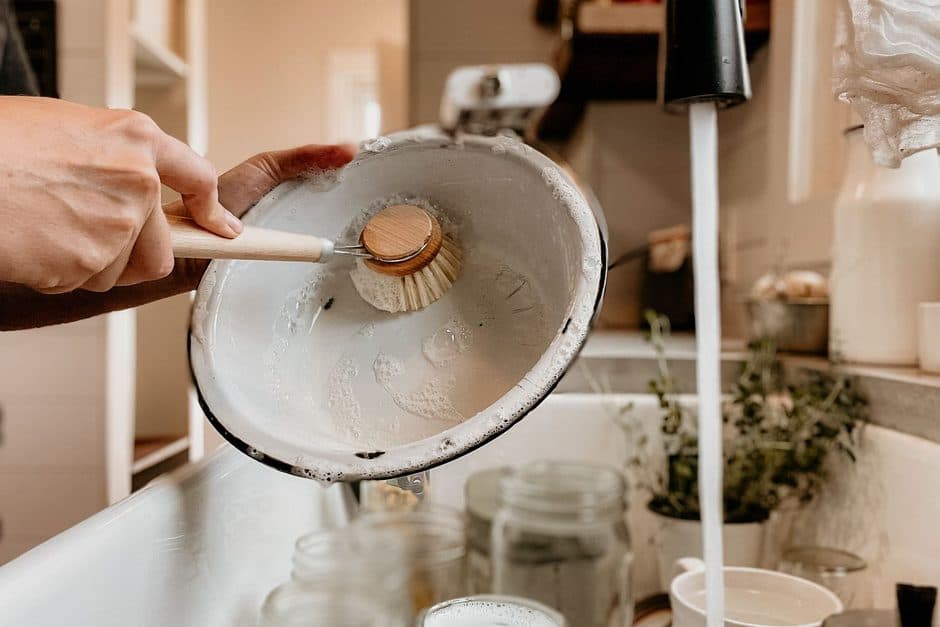
- Hot water, dish soap, ordinary sponge. A green scouring pad is fine on the cooking surface. So is steel wool, if you want it. Bare stainless has nothing to scratch through.
- Dry it. Air drying is what leaves the water spots covered further down this page, particularly in a hard-water area.
The one habit that actually damages pans
Running a hot pan under a cold tap is the single most destructive thing most people do to clad cookware. The interior and exterior layers contract at different rates, the base loses its flatness, and the pan develops a slight convex curve that makes it rock on a flat induction hob or glass top.
That is permanent, it is excluded from essentially every manufacturer's warranty, and it is the failure that actually retires clad pans — not stains, not scratches. Warped stainless steel pans covers what can be salvaged, and when to replace stainless steel cookware covers the point of no return.
The second habit is leaving things sitting: salted water, acidic sauce or cleanser residue left in a pan overnight can pit the passive layer. Pitting is one of the few forms of damage to stainless that is genuinely irreversible.
Burnt-on food, without scrubbing
Scrubbing a carbonised pan is a waste of effort. Simmer instead: cover the burnt area with water, add a tablespoon of baking soda, bring it to a simmer for ten minutes, then turn it off and let it sit. The residue lifts with a wooden spoon.
For anything that survives that, a paste of Bar Keepers Friend left on the spot for a minute will usually finish it. The detailed version, including what to do with a pan that has been properly cremated, is in how to clean a burnt stainless steel pan.
The three stains and what each one is
| What you see | What it is | Fix |
|---|---|---|
| Blue and gold rainbow | Heat tint — a thickened chromium oxide layer from running the pan hot | Bar Keepers Friend, or white vinegar for a light tint |
| Chalky white spots or streaks | Calcium from hard water, or salt added before the water boiled | White vinegar, left a few minutes — see white spots on a stainless steel pan |
| Brown or amber film | Polymerised oil and protein, baked on by repeated heating | Bar Keepers Friend and a non-scratch pad |
None of the three affects how the pan cooks. They are all cosmetic, and the full diagnostic walk-through is in stainless steel pan discoloration.
Should you use the dishwasher?
It depends on the brand, and the answer is published. Tramontina, Cuisinart, Misen and Demeyere state dishwasher safe. All-Clad specifies handwash only. Made In and Heritage Steel both recommend handwashing.
Those are not arbitrary. Dishwasher detergents are strongly alkaline and, over hundreds of cycles, will dull a polished exterior and can discolour riveted joins where water sits. On a pan rated for it that is a cosmetic cost. On a pan not rated for it, you are also outside the warranty. Is stainless steel dishwasher safe has the brand-by-brand picture.
What not to do
- Do not use bleach or chlorine cleaners. Chloride is the one chemical that reliably pits stainless steel, and the damage is permanent.
- Do not leave cleanser sitting on the surface. Rinse Bar Keepers Friend off thoroughly rather than letting it dry in place.
- Do not use oven cleaner. It is caustic enough to attack the finish and the rivets.
- Do not scrub the exterior with an abrasive powder if you care how it looks. The cooking surface is fair game; the mirror polish on the outside is not.
- Do not salt water before it boils. Undissolved salt sitting on the base is the most common cause of the small permanent pits people mistake for stains.
If cleaning is the whole problem, buy differently
There is a legitimate shortcut here. If you already know you will not handwash, buy cookware that is rated for the dishwasher rather than buying a premium handwash-only pan and resenting it. Best dishwasher-safe stainless steel cookware is the shortlist, and the best cookware cleaners covers what to keep under the sink.
The picks in full
1. The one cleaner worth owning
Bar Keepers Friend Cookware Cleanser
Bar Keepers Friend
Oxalic acid dissolves the discolouration rather than grinding it off, which is why it restores the surface instead of polishing metal away.
- Effectiveness
- 9.4
- Gentleness
- 8.4
- Availability
- 9.8
- Value
- 9.6
- Oxalic acid based: dissolves heat tint rather than grinding it off
- Powder and liquid formulations; the liquid is gentler on polished finishes
- Safe on stainless, not on anodized aluminum or nonstick coatings
- Rinse thoroughly and never leave it sitting on the surface
- Sold nearly everywhere, which matters more than it sounds
What it gets right
- The only product that reliably removes rainbow heat tint
- Cheap enough that there is no reason to tolerate a stained pan
- Restores the surface rather than polishing metal away
Who should skip it
- The abrasive powder will dull a mirror-polished exterior over time
- Does nothing for warping, which is the failure that actually matters
- Needs a thorough rinse; residue left on steel can pit it
Most cookware stains are not dirt. Heat tint — the blue and gold rainbow that appears on a pan that has been run hot — is a thickened chromium oxide layer, and the brown film left after searing is polymerised fat and protein. Neither comes off with detergent, and both come off with an acid.
Bar Keepers Friend is oxalic acid based, so it dissolves the oxide and lifts the film rather than abrading the steel. That is the important distinction: it restores the original surface instead of sanding a new one. It is sold nearly everywhere, which matters more than it sounds when you want it on a Sunday.
Use the liquid on polished exteriors — the powder is mildly abrasive and will dull a mirror finish over years. Rinse thoroughly: residue left sitting on steel can pit it. And it does nothing for warping, which is the failure that actually ends pans.
2. The easiest clad cookware to keep clean
Tramontina Signature Tri-Ply Clad Cookware Set
Tramontina
Fully clad and dishwasher safe across the set, which is the single feature that most reliably keeps stainless cookware in use.
- Effectiveness
- 8.2
- Gentleness
- 9.0
- Availability
- 9.2
- Value
- 9.7
- Tri-ply clad throughout, not disc-bottomed on the pots
- 18/10 stainless interior over an aluminum core
- Oven safe to 500F; dishwasher safe; NSF-certified
- Induction compatible across the set
- Tramontina lifetime warranty
What it gets right
- Fully clad at a price where most sets quietly switch to disc bottoms
- The one set we would hand to someone furnishing a first kitchen
- The dishwasher-safe rating applies across the set, not just the skillets
Who should skip it
- Sets always include a piece or two you will never reach for
- The 500F ceiling limits oven work compared with buying pieces individually
- Lids are the weakest component; treat their rating as lower than the pans'
The most common reason people abandon stainless is not sticking. It is the washing-up. A pan you have to handwash after every meal gets used less than a pan you can put in the machine, and a pan that gets used less was a worse purchase.
Tramontina Signature publishes a dishwasher-safe rating across the whole set, and it is genuinely fully clad rather than disc-bottomed — 18/10 over an aluminum core, 500F oven rating, NSF-certified, induction compatible, lifetime warranty.
Dishwasher safe is not dishwasher indifferent. Alkaline detergents will dull a polished exterior over years, and that is cosmetic. Sets also always include a piece you will not use, and the lids are the weakest component.
Frequently asked questions
How do you clean stainless steel cookware without scratching it?
You largely cannot scratch it in a way that matters. Bare clad stainless has no coating, so a scouring pad or even steel wool on the cooking surface is fine. Save the gentle treatment for the polished exterior.
What is the best cleaner for stainless steel pans?
Bar Keepers Friend. It is oxalic acid based, so it dissolves heat tint and baked-on film rather than abrading the steel. Use the liquid version on polished exteriors and rinse thoroughly.
Can you put hot stainless steel pans in cold water?
No. Thermal shock is the most common cause of a warped base, it is permanent, and it is excluded from essentially every warranty. Let the pan stop hissing before it meets water.
How do you get the rainbow discolouration off a stainless pan?
That is heat tint, a thickened oxide layer. White vinegar removes a light tint; Bar Keepers Friend removes the rest. It is cosmetic and does not affect cooking.
Is it safe to use steel wool on stainless cookware?
On the cooking surface, yes. It will leave fine marks that even out with use and it cannot reach anything underneath. On a mirror-polished exterior it will dull the finish permanently.
Why should you not salt water before it boils?
Undissolved salt sinks and sits on the base, where it can pit the passive layer. Those small permanent marks are often mistaken for stains. Add salt once the water is boiling.
Sources
- All-Clad — Care and use instructions for stainless cookware
- Tramontina — Signature Tri-Ply Clad Stainless Steel Fry Pan, published specification
- Klingspor — The passive layer on stainless steel (abrasives technical reference)
- Made In — What is 18/10 stainless steel?
- Boulder Engineering Studio — 304 vs 316 stainless steel: composition and chloride thresholds