Care & Technique
When to Replace Stainless Steel Cookware
Nonstick has a lifespan. Clad stainless has failure modes. Knowing which is which saves you from replacing a perfectly good pan.
Disclosure: Ply & Pan earns a commission on qualifying purchases made through links on this page. We take no free product and no sponsorship, and we never print a price. How we are funded.
Quick picks
The short answer. Tap any row for the full write-up.
| # | Product | Best for | Score | Price |
|---|---|---|---|---|
| 1 | 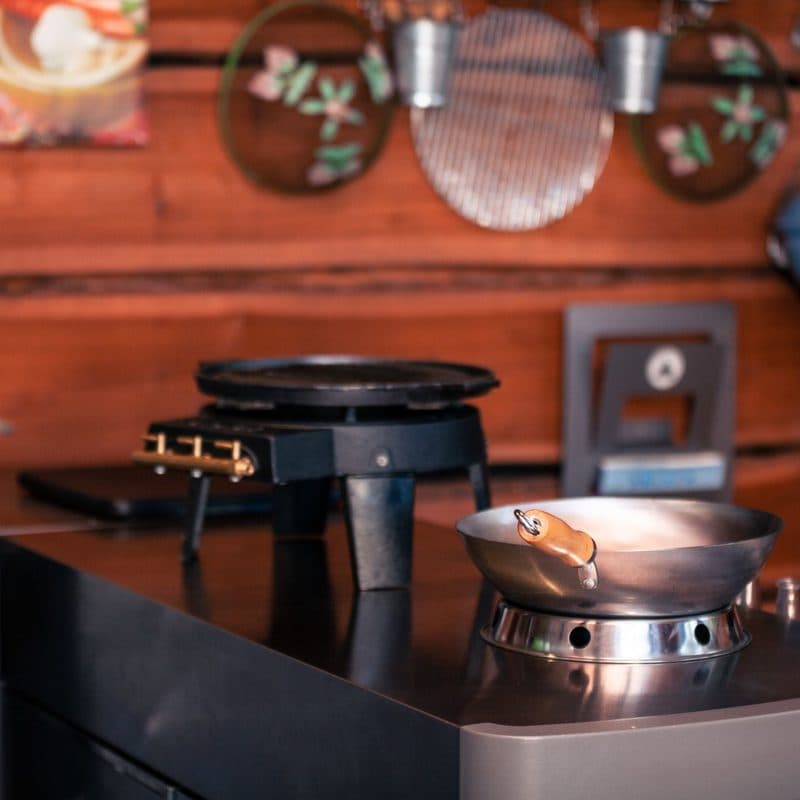 All-Clad D3 Stainless Fry PanThe only pan here with published abuse-test results, and the structure is what actually fails in clad cookware. | A pan bought once, with evidence behind the claim | 9.0 | |
| 2 |  Tramontina Signature Tri-Ply Clad Cookware SetFully clad throughout, NSF-certified, dishwasher safe, and cheap enough that replacing a warped piece is an errand. | Accepting that one piece will go and not caring much | 8.8 | |
| 3 |  Heritage Steel Titanium Series Fry PanA 316Ti cooking surface resists the salt pitting that erodes a stainless interior over decades, plus 800F and US manufacture. | The pan that outlasts the pitting that ends old pots | 8.8 |
#ad Buy links are affiliate links. We never print a price — prices change weekly and a printed one is wrong within a month, so every link goes to the live Amazon listing. How we are funded.
The short answer
Clad stainless steel cookware has no replacement schedule. Replace a pan for exactly three reasons: a base warped enough that it no longer makes contact with your hob, a loose or cracked handle join that cannot be re-tightened, or visible delamination where the clad layers have separated. Everything else — discoloration, scratches, heat tint, stuck-on residue, a cloudy finish — is cosmetic and does not justify a new pan.
This is the main practical difference between stainless and coated cookware. Nonstick has a lifespan measured in years because the coating wears out. Bare steel has no coating to wear out, so a clad pan either fails structurally or lasts for decades.
Replace, or keep?
| What you are seeing | What it is | Verdict |
|---|---|---|
| Base rocks or spins on a flat hob | Warping, usually from thermal shock | Replace if it affects cooking |
| Handle wobbles, rivets weeping | Failed handle join | Replace — and it is a safety issue |
| Layers visibly separating at the rim or base | Delamination of the clad bond | Replace, and claim it — this is a defect |
| Rainbow or blue-brown tint | Heat tint on the passive layer | Keep. It cleans off |
| Cloudy, dull or chalky white film | Mineral deposits or detergent film | Keep. It cleans off |
| Fine scratches and a hazy finish | Normal utensil and cleaning wear | Keep. Cosmetic only |
| Scatter of tiny dark pits in the base | Chloride pitting from salt | Keep unless severe. Change the salt habit |
| Orange specks that wipe away | Surface iron contamination, not rust of the pan | Keep. It cleans off |
| Broken or cracked lid | The commonest failure in any set | Replace the lid, not the pan |
The three that actually matter
Warping. A clad base bows when one layer expands faster than another, which happens when a hot pan meets cold water or an empty pan is run hard on a high flame. A slight bow is survivable on gas and fatal on induction or a glass top, because those heat by contact. The test is to set the pan on a flat worktop and see whether it rocks or spins. Full diagnosis and the one partial fix are in warped stainless steel pan.
Handle failure. Riveted handles can usually be re-tightened once; a rivet that keeps loosening has enlarged its hole and will not hold. A hot pan with a wobbling handle is a burn waiting to happen, and this is the one failure where replacement is not optional. Welded handles cannot be re-tightened at all, though they also have no rivets to loosen.
Delamination. Rare, and the one failure that is unambiguously a manufacturing defect rather than something you did. Layers separating at the rim or a base that has visibly puffed or blistered is exactly what a lifetime warranty exists to cover. Claim it.
What is not a reason to replace
Nearly everything people actually throw pans out for.
Heat tint — the rainbow sheen — is an optical effect in a slightly thickened passive layer, and it comes off with an oxalic-acid cleanser. So does the white chalky film, which is mineral deposit from hard water, and the brown staining that accumulates on an exterior. Stainless steel pan discoloration and how to clean a burnt stainless pan cover both, and our cleaner ranking covers what to use.
Scratches are cosmetic on bare steel, because there is no coating to breach — metal utensils on stainless steel. Orange specks that wipe off are iron contamination sitting on the surface rather than the pan rusting; does stainless cookware rust separates the two. And food starting to stick is almost always a preheat problem rather than a worn pan — why food sticks to stainless steel.
How a set degrades
Cookware does not fail as a set. It fails one piece at a time, in a fairly predictable order, which is worth knowing before you replace anything.
Lids go first. Glass cracks from thermal shock and knobs work loose, and replacement lids are frequently unavailable or priced absurdly. A good pan with no lid is a partially retired pan, and this is the most common way a set quietly degrades.
The most-used skillet goes second, usually to warping, because it is the piece run hottest and washed soonest.
Everything else outlives you. Stockpots and saucepans are rarely run empty at high heat, so they mostly accumulate cosmetic marks and nothing more.
Which means replacement-part availability matters more than prestige does. More on that reasoning in what cookware lasts the longest.
Try the warranty before you buy
Before replacing anything, check whether what failed is covered. The pattern across brands is consistent: defects in material, construction or workmanship are covered for a lifetime, and normal wear, discoloration, warping from high heat or thermal shock, misuse and commercial use are excluded.
Read that honestly. Delamination and a defective handle join are covered. Warping, which is the most likely failure, is not — because it is caused by use. Every brand's exact terms are side by side in cookware lifetime warranties compared, and if you are replacing a pan anyway, the buy-once case is in buy-it-for-life cookware.
How to not need this page
Three habits prevent almost every real failure. Never put a hot pan into water or under a cold tap — let it cool on the hob, because thermal shock is what warps bases. Never heat an empty pan hard, and never leave one unattended on a high flame. And add salt after water boils, and never leave salted or acidic liquid in a pan to cool overnight, which is what pits a base.
The picks in full
1. Least likely to need replacing
All-Clad D3 Stainless Fry Pan
All-Clad
The only pan here with published abuse-test results, and the structure is what actually fails in clad cookware.
- Structure
- 9.6
- Parts support
- 9.0
- Warranty record
- 9.8
- Value
- 7.2
- Tri-ply: stainless interior, aluminum core, magnetic stainless exterior
- Oven and broiler safe to 600F (All-Clad published spec)
- Induction compatible on any stovetop
- Handwash only, per the manufacturer
- Limited lifetime warranty; bonded, engineered and assembled in Canonsburg, PA
What it gets right
- Survived America's Test Kitchen's concrete-strike abuse testing with barely a ding
- Rivets and handle join are the sturdiest in the category
- Decades of parts and service history standing behind the warranty
Who should skip it
- Costs roughly three times a Tramontina that cooks nearly as evenly
- The stick handle is narrow and bites into your palm on a loaded 12-inch pan
- Handwash only, which is a real constraint if you hate washing up
If the question is which pan you will not have to replace, the answer turns on structure rather than surface. America's Test Kitchen heated pans to 500F, plunged them into ice water and struck them three times against concrete; the All-Clad came through with barely a ding while competitors dented and one handle nearly detached.
That matters because the handle join and the flatness of the base are the two things that end a clad pan's life. Tri-ply bonded, 600F oven and broiler safe, induction compatible, handwash only, limited lifetime warranty, bonded in Canonsburg since 1971 — which also means decades of parts and service history behind the warranty.
The costs: handwash only, a 600F ceiling below Made In and Heritage Steel, a narrow stick handle that is its owners' most common complaint, and roughly three times the price of a Tramontina that cooks nearly as evenly.
2. Cheapest to replace when something does fail
Tramontina Signature Tri-Ply Clad Cookware Set
Tramontina
Fully clad throughout, NSF-certified, dishwasher safe, and cheap enough that replacing a warped piece is an errand.
- Structure
- 7.8
- Parts support
- 8.0
- Warranty record
- 8.0
- Value
- 9.7
- Tri-ply clad throughout, not disc-bottomed on the pots
- 18/10 stainless interior over an aluminum core
- Oven safe to 500F; dishwasher safe; NSF-certified
- Induction compatible across the set
- Tramontina lifetime warranty
What it gets right
- Fully clad at a price where most sets quietly switch to disc bottoms
- The one set we would hand to someone furnishing a first kitchen
- The dishwasher-safe rating applies across the set, not just the skillets
Who should skip it
- Sets always include a piece or two you will never reach for
- The 500F ceiling limits oven work compared with buying pieces individually
- Lids are the weakest component; treat their rating as lower than the pans'
There are two coherent strategies with cookware, and this is the other one: buy construction that is genuinely good, pay little enough that replacement is not an event, and replace the one piece that fails rather than nursing it.
Tri-ply clad throughout — the pots as well as the pans, which is where sets usually cut corners — 18/10 interior over an aluminum core, 500F oven rating, dishwasher safe, NSF-certified, induction compatible, lifetime warranty.
The compromises matter for this page specifically: the lighter gauge is more prone to warping under thermal shock, which is the single most common reason a clad pan gets retired. And the lids are the weakest component in the set.
3. Best surface for a very long life
Heritage Steel Titanium Series Fry Pan
Heritage Steel
A 316Ti cooking surface resists the salt pitting that erodes a stainless interior over decades, plus 800F and US manufacture.
- Structure
- 9.0
- Parts support
- 7.4
- Warranty record
- 8.0
- Value
- 7.4
- 316Ti cooking surface: stainless strengthened with titanium and molybdenum
- Five-ply fully clad construction
- Oven safe to 800F and broiler safe (Heritage Steel published spec)
- Induction compatible; handwashing recommended
- Lifetime warranty; manufactured in Clarksville, TN
What it gets right
- 316Ti resists pitting from salt and acid better than the 18/10 everyone else uses
- The 800F oven rating matches Made In and beats All-Clad by 200F
- Made in a family-owned Tennessee factory, not assembled from imported bodies
Who should skip it
- Least-known brand here, so resale and second-hand parts are thin
- Priced against All-Clad without All-Clad's service history
- The clad steel is sourced from South Korea, so made-in-USA means built, not mined
Over a genuinely long life there is one chemical failure that matters, and it is chloride pitting: a scatter of tiny pits in the base, usually from salt left sitting on hot dry metal or brine left to cool overnight.
Heritage Steel's 316Ti cooking surface carries molybdenum, which resists that mechanism substantially better than the 18/10 everyone else uses. Five-ply fully clad, oven safe to 800F and broiler safe, induction compatible, lifetime warranty, made in Clarksville, Tennessee. Handwashing recommended.
The deductions: smallest brand we cover, so replacement lids and second-hand parts are thin; priced against All-Clad without All-Clad's service record; and the clad steel is sourced abroad.
Frequently asked questions
How often should you replace stainless steel cookware?
There is no schedule. Clad stainless has no coating to wear out, so it either fails structurally or lasts decades. Replace it for a warped base, a failed handle join or visible delamination, and for nothing else.
How do you know when a stainless steel pan is worn out?
Set it on a flat worktop. If it rocks or spins, the base has warped. Check the handle for wobble and weeping rivets, and the rim and base for layers separating. Discoloration and scratches are not wear.
Should I throw out a discolored stainless steel pan?
No. Rainbow heat tint, white mineral film and brown staining are all cosmetic and come off with an oxalic-acid cleanser. None of them affect how the pan cooks or whether it is safe.
Is a scratched stainless steel pan still safe to use?
Yes. The corrosion protection comes from a self-repairing chromium oxide layer rather than an intact finish, so a scratch exposes more of the same alloy and it re-passivates in air.
Can a warped stainless steel pan be fixed?
Rarely, and only partially. A slight bow may be tolerable on gas but not on induction or a glass top, which heat by contact. If the pan rocks on a flat surface and it affects cooking, replace it.
Does a lifetime warranty cover a warped pan?
No. Every lifetime warranty in this category excludes warping from high heat or thermal shock, because it is caused by use. Delamination and defective handle joins are covered.
What fails first in a cookware set?
The lids, almost always. Glass cracks from thermal shock, knobs loosen, and replacement lids are often unavailable. Replace the lid rather than the pan if you can source one.
Sources
- All-Clad — Cookware Limited Lifetime Warranty (PDF)
- All-Clad — Care and use instructions for stainless cookware
- Made In — Warranty policy
- All-Clad — D3 Stainless 12-inch Fry Pan, published specification
- Tramontina — Signature Tri-Ply Clad Stainless Steel Fry Pan, published specification
- Heritage Steel — Titanium Series 10.5-inch Fry Pan, published specification
- Klingspor — The passive layer on stainless steel (abrasives technical reference)
- America's Test Kitchen — Getting Whacked (how the abuse testing works)