Cookware Sets & Buy-It-For-Life
The Best Cookware for Gas Stoves
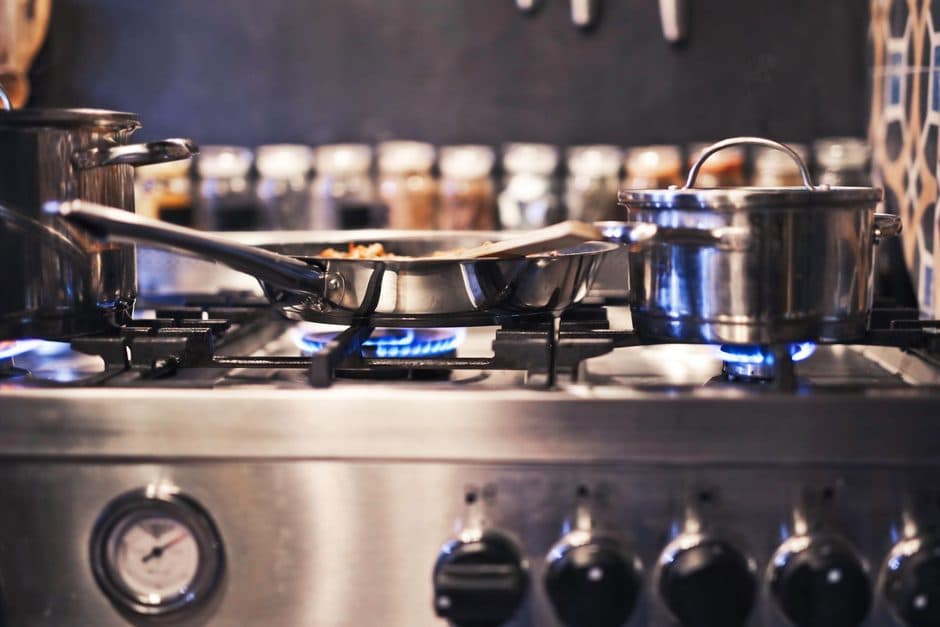
Gas is forgiving about flatness and unforgiving about handles. That reverses most induction advice.
Disclosure: Ply & Pan earns a commission on qualifying purchases made through links on this page. We take no free product and no sponsorship, and we never print a price. How we are funded.
Quick picks
The short answer. Tap any row for the full write-up.
| # | Product | Best for | Score | Price |
|---|---|---|---|---|
| 1 |  All-Clad D3 Stainless Fry PanGas rewards responsiveness, and tri-ply reacts faster than five plies. This is the right construction for a flame. | Fast response on a burner you control directly | 9.1 | |
| 2 |  Made In Stainless Clad Frying PanAn 800F rating is worth more on gas than anywhere else, because gas can genuinely get there. | Powerful gas ranges and broiler finishing | 8.8 | |
| 3 |  Tramontina Signature Tri-Ply Clad Fry PanGas forgives a lot, including a lighter pan. Just watch the 500F ceiling on a powerful range. | Moderate burners and everyday cooking | 8.6 |
#ad Buy links are affiliate links. We never print a price — prices change weekly and a printed one is wrong within a month, so every link goes to the live Amazon listing. How we are funded.
How gas heat behaves
A gas burner delivers heat as a ring of flame that contacts the base in a circle and licks up the lower sides. Three consequences follow, and they are close to the opposite of induction's.
Flatness matters less. Hot combustion gases wrap around a slightly convex base. A pan that would cook in a visible ring on induction may be entirely acceptable on gas, which is why people switching to induction suddenly discover their pans are warped.
The heat is annular, not uniform. A burner significantly smaller than the pan produces a hot ring and a cooler center-and-edge. Clad construction spreads that, which is the main argument for fully-clad pans on gas.
Flames climb the sides. This is the one nobody mentions, and it is the most consequential for how long your cookware lasts.
The handle problem
On induction or a smooth electric hob, the handle stays comparatively cool because heat reaches it only by conduction through the metal. On gas, flame licking up the side of an oversized pan heats the handle directly, and it will get hot enough to need a cloth.
Two practical responses. Match pan size to burner so the flame stays under the base rather than wrapping up the sides — which is good practice anyway. And prefer hollow stainless handles over solid ones; they conduct less and stay usable longer.
It also means handles with plastic or silicone components are a worse idea on gas than elsewhere. Direct flame contact degrades them, and the composite sets the oven ceiling regardless of what the metal could take.
What to look for
Fully clad, so the ring of heat spreads. This matters more on gas than most people assume, because the annular heat pattern is what produces the classic burnt ring in a disc-bottom pan.
An oven rating with headroom. A powerful gas ring can drive an empty pan past 500F. If your range is high-output, the 800F brands are worth the money for that reason alone.
Responsiveness over mass. Gas lets you change heat instantly, so a pan that reacts quickly rewards you. This is the one hob type where tri-ply is arguably better than five-ply — see tri-ply vs 5-ply.
A base roughly matched to your burner. Within an inch or so in either direction.
What gas does to cookware over time
Gas is easier on pans than induction in one respect and harder in another.
Easier: the heat is less concentrated in the base, so the thermal gradient between base and walls is smaller and there is less stress on the bond. Warping is somewhat less likely, and a slightly warped pan remains usable.
Harder: flames climbing the sides produce heat tint on the exterior walls — the rainbow and straw-colored marks that appear on the outside of pans used on gas. That is cosmetic oxide, it is harmless, and an oxalic cleanser removes it. See pan discoloration explained. Gas also produces soot on the exterior of pans used over a poorly- adjusted or yellow-tipped flame, which is a burner problem worth fixing rather than a pan problem.
The one real risk specific to gas is the empty pan left on a high burner. Gas ranges have no automatic cutoff and a high-output ring will take an empty clad pan past its rating quickly. That is exactly the scenario All-Clad's warranty names when it excludes discoloration, warping and metal separation from prolonged heat exposure when empty.
The picks in full
1. Best for gas
All-Clad D3 Stainless Fry Pan
All-Clad
Gas rewards responsiveness, and tri-ply reacts faster than five plies. This is the right construction for a flame.
- Response
- 9.2
- Evenness
- 8.8
- Durability
- 9.6
- Value
- 7.2
- Tri-ply: stainless interior, aluminum core, magnetic stainless exterior
- Oven and broiler safe to 600F (All-Clad published spec)
- Induction compatible on any stovetop
- Handwash only, per the manufacturer
- Limited lifetime warranty; bonded, engineered and assembled in Canonsburg, PA
What it gets right
- Survived America's Test Kitchen's concrete-strike abuse testing with barely a ding
- Rivets and handle join are the sturdiest in the category
- Decades of parts and service history standing behind the warranty
Who should skip it
- Costs roughly three times a Tramontina that cooks nearly as evenly
- The stick handle is narrow and bites into your palm on a loaded 12-inch pan
- Handwash only, which is a real constraint if you hate washing up
On gas you change heat by turning a knob and the flame responds instantly — the limiting factor is the pan. Three plies react faster than five, which makes tri-ply the better match for a hob you control directly. The 600F rating also covers the higher temperatures a powerful gas ring can produce.
2. Best for high-output burners
Made In Stainless Clad Frying Pan
Made In
An 800F rating is worth more on gas than anywhere else, because gas can genuinely get there.
- Response
- 8.4
- Evenness
- 9.2
- Durability
- 8.6
- Value
- 8.4
- Five-ply construction, 2.7mm thick (Made In published spec)
- Heat safe to 800F / 430C, 200F above All-Clad's rating
- Gas, electric and induction; handwash preferred
- Lifetime warranty on stainless; the frying pans are made in Italy
- Flared rim pours cleanly, which sounds trivial until you deglaze
What it gets right
- The 800F rating puts broiler work and hard oven finishes in spec rather than in hope
- Longer, flatter handle is more comfortable than All-Clad's stick handle
- Direct-to-consumer pricing undercuts All-Clad at an equivalent ply count
Who should skip it
- No decades-long warranty service record yet; the company is young
- Five plies make it slower to respond than a tri-ply of the same size
- Warranty excludes warping from thermal shock, same as everyone else's
A high-BTU gas burner with a pan left on it can exceed 500F comfortably, which puts a Tramontina or Zwilling outside its published rating. Made In's 800F ceiling gives you genuine headroom, and heat damage is excluded from every warranty in the category.
3. Best value for gas
Tramontina Signature Tri-Ply Clad Fry Pan
Tramontina
Gas forgives a lot, including a lighter pan. Just watch the 500F ceiling on a powerful range.
- Response
- 8.8
- Evenness
- 8.2
- Durability
- 7.8
- Value
- 9.7
- Tri-ply: aluminum core between two layers of 18/10 stainless
- Oven safe to 500F (Tramontina published spec)
- Dishwasher safe; works on gas, electric, ceramic glass and induction
- NSF-certified for commercial kitchens
- Mirror-polished exterior, riveted stainless handle
What it gets right
- Cooks close enough to All-Clad that most people could not pick them apart blind
- Dishwasher safe and NSF-certified, neither of which All-Clad's tri-ply is
- Cheap enough that replacing it in fifteen years still costs less than one D3
Who should skip it
- The 500F oven rating is 100F below All-Clad and 300F below Made In
- Handle is less comfortable and the polished finish scuffs faster
- Lighter gauge base is more prone to warping under thermal shock
Gas is the most forgiving hob type for inexpensive cookware, because the flame spreads around the base and compensates for a less even pan. On a moderate burner this is all the pan most people need.
Frequently asked questions
What cookware is best for a gas stove?
Fully-clad stainless, ideally tri-ply. Gas delivers heat as a ring, so the cladding spreads it; and because gas responds instantly, a pan that reacts quickly is more useful than a heavy one.
Why do my pan handles get so hot on gas?
Flame licking up the sides of a pan larger than the burner heats the handle directly. Match pan size to burner and prefer hollow stainless handles, which conduct less than solid ones.
Does gas warp pans less than induction?
Somewhat. Gas heats less concentrated into the base, so the gradient between base and walls is smaller. A slightly warped pan also remains usable on gas, where on induction it does not.
Why is the outside of my pan discolored on gas?
Flames climbing the sides produce heat tint, a thin oxide layer that shows as rainbow or straw colors. It is cosmetic and an oxalic-acid cleanser removes it.
Does gas leave soot on pans?
It can, if the flame is yellow-tipped rather than blue. That indicates a burner needing adjustment or cleaning, and it is a stove problem rather than a cookware problem.
Should the pan be bigger or smaller than the gas burner?
Roughly matched, within an inch. A pan much larger than the burner heats as a ring with cool edges; a pan much smaller lets flames wrap up the sides and cook the handle.
Sources
- All-Clad — D3 Stainless 12-inch Fry Pan, published specification
- Made In — Stainless Clad Frying Pan, published specification
- Tramontina — Signature Tri-Ply Clad Stainless Steel Fry Pan, published specification
- All-Clad — Cookware Limited Lifetime Warranty (PDF)
- All-Clad — Cooking on stainless steel for beginners (brand blog)