Care & Technique
Stainless Steel Pan: First Use
Wash it, dry it, and cook something forgiving in it. There is no seasoning step, no breaking-in period and no ritual - but the first wash does matter, and the first dish you choose decides whether you end up liking the pan.
Disclosure: Ply & Pan earns a commission on qualifying purchases made through links on this page. We take no free product and no sponsorship, and every price here is read from Amazon on the date shown. How we are funded.
Quick picks
The short answer. Tap any row for the full write-up.
| # | Product | Best for | Score | Price |
|---|---|---|---|---|
| 1 | 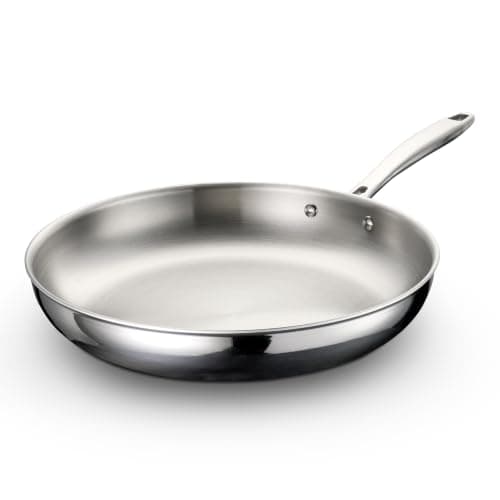 Tramontina Signature Tri-Ply Clad Fry PanDishwasher safe and NSF-certified, so the first wash and every wash after it is simple. Fully clad tri-ply at a price that makes learning on it painless. | A first steel pan you will not be precious about | 8.6 | |
| 2 | 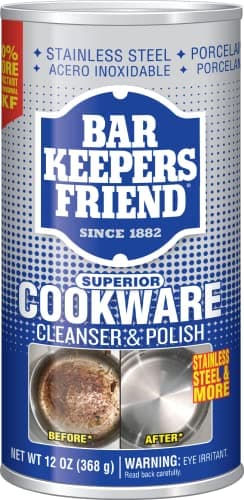 Bar Keepers Friend Cookware CleanserAn oxalic-acid cleanser removes heat tint and polymerised residue by dissolving them. Owning it from day one is what stops a new pan looking permanently marked. | The first stain, the first heat tint and the first burnt-on fond | 9.0 | $3.89 · View on Amazon $8.08 · 52% off |
| 3 | 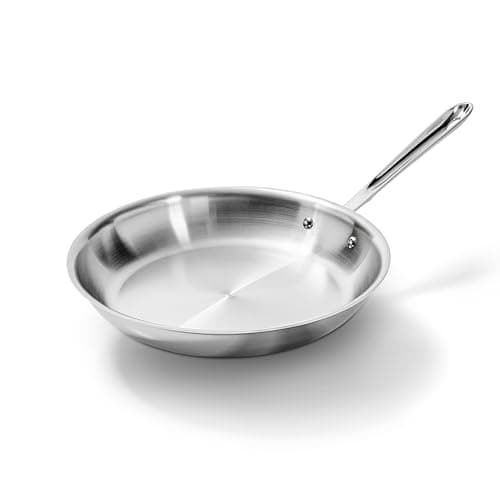 All-Clad D3 Stainless Fry Pan600F and broiler safe, bonded in Pennsylvania, with a warranty honored since 1971. Handwash only - which is a commitment you should make deliberately on day one, not discover later. | Someone buying once and prepared to handwash from day one | 8.8 |
#ad Buy links are affiliate links. Prices come straight from Amazon, are stamped with the date they were read, and disappear rather than go stale if the feed stops. How we are funded.
1. Wash it before you cook in it
A new pan has been machined, polished, handled and packed. It carries manufacturing oils, traces of polishing compound and whatever came off the packaging. None of it is dangerous and all of it tastes bad and smokes.
Hot water, dish soap, a normal sponge or cloth. Get the inside, the rim and the outside of the base. Rinse and dry it with a towel rather than leaving it to air dry, because air-drying is what leaves water spots on polished steel. That is the whole step.
If the pan is published dishwasher safe, a cycle in the machine is also fine for the first wash. If it is handwash only — All-Clad's bonded lines and Made In's stainless are — start that habit now.
2. Do not season it
Stainless steel does not take seasoning. Cast iron and carbon steel are porous enough for polymerised oil to bond into the surface and build up over years; stainless is not. You can heat oil to its smoke point in a steel pan and create a thin slick film that behaves slightly like seasoning for one cook, and it comes straight off with detergent or anything acidic.
This is good news rather than a limitation. It means there is nothing to maintain, nothing to ruin, no rule against washing it properly, and no reason to be careful what you cook in it. Every cook starts from bare steel. The full explanation is in how to season a stainless steel pan.
3. Expect a smell on the first heat
Even a washed pan usually gives off a sharp metallic or oily smell the first time it gets properly hot, as the last of the manufacturing residue burns off. A little smoke with it is normal. It passes within the first couple of uses.
What is not normal is a pan that keeps smoking dry after several uses — that is polymerised residue from your own cooking and needs cleaning rather than patience. The diagnosis is in why does my stainless steel pan smoke.
4. Choose the first dish deliberately
This is the step that decides whether you like the pan. People take a new steel skillet and immediately try scrambled eggs, which is the single hardest thing to do in it, and conclude that steel is bad.
Start with something that wants to stick and then release on its own:
Chicken thighs, skin down. Forgiving, hard to overcook, and they release themselves when the skin crisps. You get fond for a sauce as a bonus.
Mushrooms. They release water, which keeps the pan from overheating while you learn what medium heat looks like, and they brown beautifully.
Onions and peppers. Nearly impossible to get wrong and a good way to learn how the pan responds when you move it off the heat.
A steak, if you want the point made quickly. Nothing demonstrates what steel is for faster than a seared steak and a pan sauce made in the same pan. The method is in best skillet for searing steak.
Save eggs and delicate fish for week two, after you have used the water test enough times to know what a ready pan looks like.
5. Learn the water test on day one
One technique accounts for almost all the difference between people who get on with steel and people who do not. Heat the dry pan on medium for two to four minutes, then flick in a few drops of water. If they sizzle and evaporate, the pan is not ready. If they form a ball that skates across the surface, it is — add the oil, then the food.
That is the Leidenfrost effect, and it is a direct read of surface temperature rather than a guess. Learn it in the first week and the pan stops being temperamental: the stainless steel water test.
What will happen in the first month, and is fine
It will discolor. Amber, gold, blue or rainbow patches are heat tint in the surface oxide layer. Harmless, and removable with an oxalic-acid cleanser: stainless steel pan discoloration.
You will get white chalky spots. Mineral deposits from hard water or salt added to cold water. A splash of vinegar removes them: white spots on a stainless steel pan.
Something will weld on. Everybody's first pan does this. Deglaze while it is still warm, or soak and use a cleanser: how to clean a burnt stainless steel pan.
It will get scratched. Metal utensils are fine on steel and scratches do not affect performance: can you use metal utensils on stainless steel.
Three things to avoid from day one
Never run a hot pan under a cold tap. Thermal shock is what warps bases, and a warped base is the one damage that cannot be undone — it rocks on a glass hob and will not couple properly with an induction ring. Let the pan cool first: warped stainless steel pan.
Do not salt cold water in the pan. Undissolved salt sitting on the base pits the steel. Salt the water once it is boiling.
Do not store food in it. Salty and acidic leftovers left sitting cause pitting: does stainless steel cookware rust.
The bottom line
Wash it in hot soapy water, dry it with a towel, and do not season it — there is nothing to season. Expect a smell and a little smoke on the first heat. Then cook chicken thighs or mushrooms rather than eggs, learn the water test in the first week, and never put the hot pan under a cold tap. A steel pan has no break-in period; what it has is one technique, and the sooner you learn it the sooner the pan stops being difficult.
The picks in full
1. Easiest new pan to live with
Tramontina Signature Tri-Ply Clad Fry Pan
Tramontina
Dishwasher safe and NSF-certified, so the first wash and every wash after it is simple. Fully clad tri-ply at a price that makes learning on it painless.
- Ease of care
- 9.4
- Forgiveness
- 8.2
- Build
- 7.6
- Value
- 9.6
- Tri-ply: aluminum core between two layers of 18/10 stainless
- Oven safe to 500F (Tramontina published spec)
- Dishwasher safe; works on gas, electric, ceramic glass and induction
- NSF-certified for commercial kitchens
- Mirror-polished exterior, riveted stainless handle
What it gets right
- Cooks close enough to All-Clad that most people could not pick them apart blind
- Dishwasher safe and NSF-certified, neither of which All-Clad's tri-ply is
- Cheap enough that replacing it in fifteen years still costs less than one D3
Who should skip it
- The 500F oven rating is 100F below All-Clad and 300F below Made In
- Handle is less comfortable and the polished finish scuffs faster
- Lighter gauge base is more prone to warping under thermal shock
The best first steel pan is one you are not frightened of. This one is dishwasher safe, which removes the main reason people resent bare steel, and NSF-certified for commercial kitchens, which is a cleanability standard as much as a construction one. Fully clad tri-ply with an 18/10 interior, so it behaves like a good pan while you learn.
Price is part of the argument. The first few weeks with a steel pan involve at least one welded-on egg and one over-browned fond, and doing that to an inexpensive pan is a cheaper education than doing it to a premium one.
Against it: 500F is the lowest ceiling among the skillets on this site, which rules out broiler finishing. The mirror-polished exterior scuffs sooner than brushed. And the lighter gauge base is the most prone here to warping under thermal shock — which is precisely the beginner mistake of running a hot pan under a cold tap.
#ad Price as of October 17, 2026. How we are funded
2. Buy it at the same time as the pan
Bar Keepers Friend Cookware Cleanser
Bar Keepers Friend
An oxalic-acid cleanser removes heat tint and polymerised residue by dissolving them. Owning it from day one is what stops a new pan looking permanently marked.
- Ease of care
- 9.6
- Forgiveness
- 9.4
- Build
- 8.0
- Value
- 9.4
- Oxalic acid based: dissolves heat tint rather than grinding it off
- Powder and liquid formulations; the liquid is gentler on polished finishes
- Safe on stainless, not on anodized aluminum or nonstick coatings
- Rinse thoroughly and never leave it sitting on the surface
- Sold nearly everywhere, which matters more than it sounds
What it gets right
- The only product that reliably removes rainbow heat tint
- Cheap enough that there is no reason to tolerate a stained pan
- Restores the surface rather than polishing metal away
Who should skip it
- The abrasive powder will dull a mirror-polished exterior over time
- Does nothing for warping, which is the failure that actually matters
- Needs a thorough rinse; residue left on steel can pit it
The first thing that happens to a new steel pan is a stain, and the first reaction is usually to assume it is ruined. It is not. Amber, blue and rainbow patches are heat tint in the surface of the steel, and brown varnish is polymerised oil. Both come off with oxalic acid, and almost nothing else removes either.
Having it in the cupboard before you need it changes how you treat the pan: you stop over-protecting it and start cooking properly, which is the point. Cheap, sold nearly everywhere, and it restores the surface rather than polishing metal away.
Against it: the abrasive powder will dull a mirror-polished exterior over time, so use the liquid formulation outside. Rinse thoroughly, as residue left on steel can pit it. And it does nothing for warping, which is the one failure that genuinely matters.
3. If you are starting with a pan for life
All-Clad D3 Stainless Fry Pan
All-Clad
600F and broiler safe, bonded in Pennsylvania, with a warranty honored since 1971. Handwash only - which is a commitment you should make deliberately on day one, not discover later.
- Ease of care
- 6.0
- Forgiveness
- 8.8
- Build
- 9.6
- Value
- 7.6
- Tri-ply: stainless interior, aluminum core, magnetic stainless exterior
- Oven and broiler safe to 600F (All-Clad published spec)
- Induction compatible on any stovetop
- Handwash only, per the manufacturer
- Limited lifetime warranty; bonded, engineered and assembled in Canonsburg, PA
What it gets right
- Survived America's Test Kitchen's concrete-strike abuse testing with barely a ding
- Rivets and handle join are the sturdiest in the category
- Decades of parts and service history standing behind the warranty
Who should skip it
- Costs roughly three times a Tramontina that cooks nearly as evenly
- The stick handle is narrow and bites into your palm on a loaded 12-inch pan
- Handwash only, which is a real constraint if you hate washing up
If this is the pan you intend to keep for forty years, the first-use question is really a habit question. All-Clad publishes its bonded cookware as handwash only, and that instruction starts with the first wash. Deciding on day one that this pan never goes in the machine is far easier than retrofitting the rule after six months of convenience.
The pan itself is the most forgiving premium option for a new steel cook. Three plies respond quickly, so you can correct an overheated pan by lifting it; the build came through America's Test Kitchen's concrete-strike abuse testing with barely a ding; and 600F plus broiler safe means you will not outgrow it.
Against it: handwash only, which on a daily pan is a real tax. It costs roughly three times a Tramontina that cooks nearly as evenly. And the narrow stick handle bites into your palm on a loaded 12-inch.
#ad Price as of October 17, 2026. How we are funded
Frequently asked questions
What should I do before using a new stainless steel pan?
Wash it in hot soapy water with a normal sponge, rinse it, and dry it with a towel rather than letting it air dry. That removes the manufacturing oils, polishing compound and packing residue that otherwise smoke and taste bad on the first heat. If the pan is published dishwasher safe, a cycle in the machine works equally well.
Do you need to season a stainless steel pan?
No. Stainless is not porous the way cast iron and carbon steel are, so polymerised oil will not bond into it. You can heat oil to its smoke point to create a thin slick film that lasts one cook, but it washes off with detergent. There is nothing to build and nothing to ruin, which is one of the advantages of steel.
Why does my new stainless steel pan smell?
Manufacturing oils and polishing residue burning off on the first proper heat. A sharp metallic or oily smell with a little smoke is normal and passes within the first couple of uses. Washing the pan before you cook in it removes most of it in advance. A pan that still smokes dry after several uses has polymerised residue from your own cooking and needs an oxalic-acid cleanser.
What should I cook first in a new stainless steel pan?
Something forgiving that releases itself: chicken thighs skin-down, mushrooms, or onions and peppers. Avoid eggs and delicate fish for the first week - they are the hardest things to do in steel and they are why people give up on it. A seared steak with a pan sauce is the fastest way to see what the pan is for.
Is there a break-in period for stainless steel cookware?
No. Unlike cast iron, a stainless pan performs the same on day one as on day one thousand. What changes is the cook: once you have learned to preheat the pan properly and read the water test, food stops sticking. There is no process happening to the pan itself.
Sources
- All-Clad — Care and use instructions for stainless cookware
- Encyclopaedia Britannica — Leidenfrost effect
- Tramontina — Signature Tri-Ply Clad Stainless Steel Fry Pan, published specification
- All-Clad — D3 Stainless 12-inch Fry Pan, published specification
- Klingspor — The passive layer on stainless steel (abrasives technical reference)