Care & Technique
Will Stainless Steel Scratch a Glass Top Stove?
Steel is softer than ceramic glass, so the pan itself is not the problem. What scratches a cooktop is what gets trapped between the two, plus the habit of sliding pans instead of lifting them.
Disclosure: Ply & Pan earns a commission on qualifying purchases made through links on this page. We take no free product and no sponsorship, and every price here is read from Amazon on the date shown. How we are funded.
Quick picks
The short answer. Tap any row for the full write-up.
| # | Product | Best for | Score | Price |
|---|---|---|---|---|
| 1 | 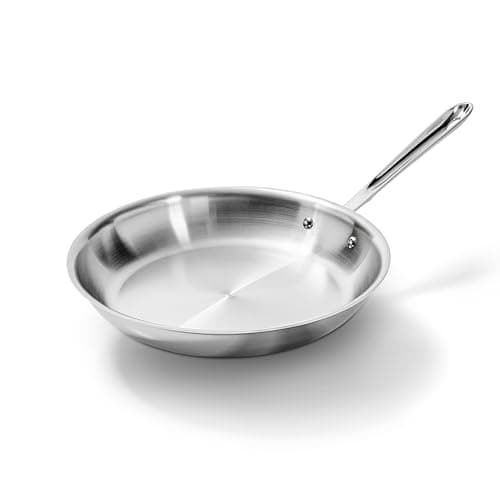 All-Clad D3 Stainless Fry PanThe specification that protects a glass cooktop is a flat, heavy base that does not warp. All-Clad's is the flattest in the category and the least likely to start rocking. | A dead-flat base that stays flat for decades | 9.0 | |
| 2 | 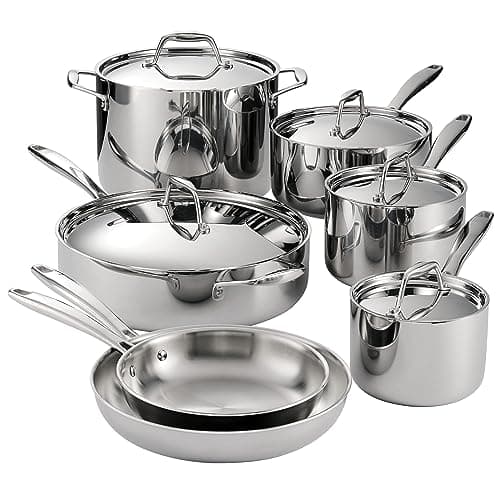 Tramontina Signature Tri-Ply Clad Cookware SetTramontina publishes ceramic glass compatibility across the Signature line, it is fully clad, NSF-certified and dishwasher safe. | A whole clad set that is dishwasher safe and glass-top rated | 8.4 | $299.95 · View on Amazon $399.95 · 25% off |
| 3 | 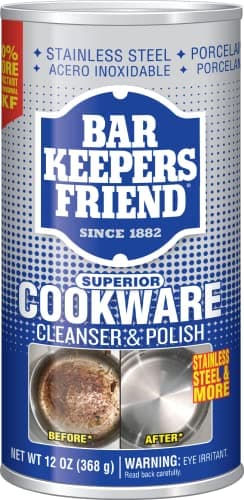 Bar Keepers Friend Cookware CleanserMost grey streaks on a cooktop are aluminum or steel transferred from a pan base, not scratches. An oxalic-acid cleanser lifts them off. | Removing metal transfer and residue from the glass | 8.0 |
#ad Buy links are affiliate links. Prices come straight from Amazon, are stamped with the date they were read, and disappear rather than go stale if the feed stops. How we are funded.
The direct answer
No, not on its own. Glass-ceramic cooktop surfaces are harder than stainless steel, so a clean, flat steel base slid across a clean glass surface does not cut it. Cookware manufacturers routinely list ceramic glass as a compatible cooktop — Tramontina does across the Signature line — and they would not if the pans scratched it.
Yes, in three specific situations. Grit trapped between the pan and the glass. A warped or rough-finished base. And dragging a loaded pan rather than lifting it. All three are about what is between the surfaces or how the pan sits, not about the steel.
What actually marks a glass cooktop
Grit. A grain of salt, a crumb, a speck of sand from unwashed vegetables. These are harder than both the pan and the glass, and dragging a heavy pan over one grinds it across the surface like a cutting tool. This is the number one cause, by a wide margin, and it is entirely preventable: wipe the cooktop before you put a pan on it.
A warped base. A base that rocks concentrates the pan's whole weight onto a small area, and it pivots every time you stir. That is a grinding action with the full weight of the pan behind it. Warping comes from thermal shock — a hot pan into cold water, or an empty pan left over a high flame — and it is the one failure no lifetime warranty covers. See warped stainless steel pan.
Dragging instead of lifting. Sliding a pan from one zone to another is the habit that turns the two problems above into visible damage. Lift it. On a heavy loaded pot, lift it with two hands.
Rough base finishes. Some cheap cookware has a base with a coarse machined or sandblasted finish, sometimes deliberately for grip on induction. Run a fingertip over the base of a pan before it goes on glass; if it feels like fine sandpaper, keep it off the cooktop.
Most "scratches" are not scratches
Grey lines and smudges on a glass cooktop are very often metal transfer: a trace of aluminum or steel deposited from the pan base onto the glass. It looks exactly like a scratch and it is not one.
The test is simple. Clean the mark with a cooktop cleaner or an oxalic-acid cleanser such as Bar Keepers Friend liquid, and if it disappears it was transfer. A real scratch is a channel in the glass and nothing will remove it.
Aluminum-based deposits are the most common, which is why bare-aluminum and some disc-bottom pans mark glass more than clad stainless does — the exposed metal on the base is softer and more likely to leave material behind. A clad stainless pan has a magnetic stainless exterior on the base, which transfers much less.
The five habits that keep a cooktop clear
1. Wipe the cooktop and the pan base before cooking. Thirty seconds, and it removes the actual cause of most damage. Check the base as well as the glass — a pan stored in a cupboard picks up grit.
2. Lift, never slide. This is the single habit with the biggest effect.
3. Never let a pan boil dry. It warps the base, which creates the rocking problem, and on glass it can also overheat the surface locally.
4. Do not rinse a hot pan. Let it cool on a trivet. The thermal shock that warps a base is the same event that most often ruins a pan's relationship with a glass cooktop.
5. Check flatness once a year. Put the pan on a counter and press each edge. Any rock means the base has moved, and that pan should go on a gas burner or into the oven instead.
The one genuine emergency
Sugar. A boil-over of anything with sugar in it — jam, syrup, a sweet glaze — on a hot glass cooktop can bond to the glass and pit it when it cools, and that damage is permanent. Scrape it off while the surface is still hot, with a plastic scraper and an oven mitt, rather than waiting for it to cool.
This is the only cooktop damage mode that is urgent, and it has nothing to do with your pans.
Induction is the same question with one addition
An induction hob has the same glass-ceramic surface, so everything above applies. The addition is that induction pans are often heavier, because the surface rewards a thick base, and a heavier pan dropped or dragged does more damage.
Induction also makes base flatness matter twice over: the magnetic field couples through the base, so a base that does not sit flat heats unevenly as well as sitting badly. Our cooktop-specific rankings are in the best stainless steel cookware for induction.
The bottom line
Stainless steel is softer than your cooktop, so the pan is not the enemy. Grit, a warped base and the habit of sliding pans are. Wipe both surfaces, lift rather than drag, keep the base flat by never shocking it thermally, and clean grey marks before deciding they are permanent.
For which pans suit this cooktop best, see the best cookware for glass top stoves.
The picks in full
1. Best pan for a glass top
All-Clad D3 Stainless Fry Pan
All-Clad
The specification that protects a glass cooktop is a flat, heavy base that does not warp. All-Clad's is the flattest in the category and the least likely to start rocking.
- Base flatness
- 9.6
- Warp resistance
- 9.4
- Build
- 9.6
- Value
- 6.6
- Tri-ply: stainless interior, aluminum core, magnetic stainless exterior
- Oven and broiler safe to 600F (All-Clad published spec)
- Induction compatible on any stovetop
- Handwash only, per the manufacturer
- Limited lifetime warranty; bonded, engineered and assembled in Canonsburg, PA
What it gets right
- Survived America's Test Kitchen's concrete-strike abuse testing with barely a ding
- Rivets and handle join are the sturdiest in the category
- Decades of parts and service history standing behind the warranty
Who should skip it
- Costs roughly three times a Tramontina that cooks nearly as evenly
- The stick handle is narrow and bites into your palm on a loaded 12-inch pan
- Handwash only, which is a real constraint if you hate washing up
On a glass cooktop the pan spec that matters is not the alloy, it is the base. A flat base sits on the glass with its weight spread evenly; a warped base rocks, and a rocking pan concentrates all that weight on one edge every time you stir. That is the mechanism behind most cooktop damage.
All-Clad's heavier base and rivet-and-handle construction are why its pans tend to stay flat — the pan survived America's Test Kitchen's concrete-strike abuse testing with barely a ding.
Handwash only, roughly three times the price of a Tramontina that cooks nearly as evenly, and a narrow stick handle on the larger sizes.
#ad Price as of October 10, 2026. How we are funded
2. Best value for a glass top
Tramontina Signature Tri-Ply Clad Cookware Set
Tramontina
Tramontina publishes ceramic glass compatibility across the Signature line, it is fully clad, NSF-certified and dishwasher safe.
- Base flatness
- 7.8
- Warp resistance
- 7.0
- Build
- 8.2
- Value
- 9.6
- Tri-ply clad throughout, not disc-bottomed on the pots
- 18/10 stainless interior over an aluminum core
- Oven safe to 500F; dishwasher safe; NSF-certified
- Induction compatible across the set
- Tramontina lifetime warranty
What it gets right
- Fully clad at a price where most sets quietly switch to disc bottoms
- The one set we would hand to someone furnishing a first kitchen
- The dishwasher-safe rating applies across the set, not just the skillets
Who should skip it
- Sets always include a piece or two you will never reach for
- The 500F ceiling limits oven work compared with buying pieces individually
- Lids are the weakest component; treat their rating as lower than the pans'
Tramontina lists ceramic glass alongside gas, electric and induction for the Signature line, which is the straightforward answer for a glass-top kitchen that wants fully-clad pans without the premium price.
The caution is specific to this surface: the lighter gauge base is more prone to warping under thermal shock than the premium pans, and a warped base is exactly what you do not want on glass. Never run it dry and never take it from the burner to cold water.
The 500F oven ceiling and a mirror-polished exterior that scuffs are the other trade-offs. Our roundup for this cooktop is the best cookware for glass top stoves.
3. For the marks that are not scratches
Bar Keepers Friend Cookware Cleanser
Bar Keepers Friend
Most grey streaks on a cooktop are aluminum or steel transferred from a pan base, not scratches. An oxalic-acid cleanser lifts them off.
- Base flatness
- 0.0
- Warp resistance
- 0.0
- Build
- 8.0
- Value
- 9.6
- Oxalic acid based: dissolves heat tint rather than grinding it off
- Powder and liquid formulations; the liquid is gentler on polished finishes
- Safe on stainless, not on anodized aluminum or nonstick coatings
- Rinse thoroughly and never leave it sitting on the surface
- Sold nearly everywhere, which matters more than it sounds
What it gets right
- The only product that reliably removes rainbow heat tint
- Cheap enough that there is no reason to tolerate a stained pan
- Restores the surface rather than polishing metal away
Who should skip it
- The abrasive powder will dull a mirror-polished exterior over time
- Does nothing for warping, which is the failure that actually matters
- Needs a thorough rinse; residue left on steel can pit it
Before you conclude your cooktop is scratched, try removing the mark. A large share of grey lines on glass are metal transfer — a trace of the pan base deposited on the glass — and they come off completely, which no actual scratch does.
Bar Keepers Friend is oxalic-acid based, so it dissolves deposits rather than grinding them off, which is the right mechanism on a surface you do not want abraded. Use the liquid rather than the powder on glass, and rinse thoroughly.
It is not safe on anodized aluminum or nonstick coatings, and it needs a complete rinse because residue left on a surface can mark it.
#ad Price as of October 10, 2026. How we are funded
Frequently asked questions
Will stainless steel pans scratch a glass top stove?
Not on their own. Glass-ceramic cooktop surfaces are harder than stainless steel, which is why manufacturers list ceramic glass as a compatible cooktop. Scratches come from grit trapped between the pan and the glass, from a warped base that rocks and concentrates the pan's weight, or from dragging a loaded pan instead of lifting it.
Why does my glass cooktop have grey marks?
Most grey lines are metal transfer — a trace of aluminum or steel deposited from the pan base — not scratches. Clean the mark with a cooktop cleaner or an oxalic-acid cleanser such as Bar Keepers Friend liquid. If it disappears it was transfer; a real scratch is a channel in the glass and cannot be removed.
Can you slide pans on a glass cooktop?
Avoid it. Sliding is what turns a trapped crumb or grain of salt into a visible scratch, because the grain is harder than both the pan and the glass and the pan's weight drives it across the surface. Lift the pan, and use two hands on a loaded pot.
Does a warped pan damage a glass cooktop?
It can. A base that rocks puts the pan's whole weight on a small area and pivots every time you stir, which is a grinding action. Check flatness by pressing each edge of the pan on a counter; if it rocks, move that pan to a gas burner or the oven.
What actually ruins a glass cooktop?
A sugar boil-over. Anything with sugar in it that spills onto a hot glass surface can bond to the glass and pit it permanently as it cools. Scrape it off while the cooktop is still hot, using a plastic scraper and an oven mitt, rather than waiting.