Cookware Sets & Buy-It-For-Life
The Best Non-Toxic Stainless Steel Cookware
There is no coating to break down, so the question becomes which alloy, and which brand will put its composition in writing.
Disclosure: Ply & Pan earns a commission on qualifying purchases made through links on this page. We take no free product and no sponsorship, and we never print a price. How we are funded.
Quick picks
The short answer. Tap any row for the full write-up.
| # | Product | Best for | Score | Price |
|---|---|---|---|---|
| 1 | 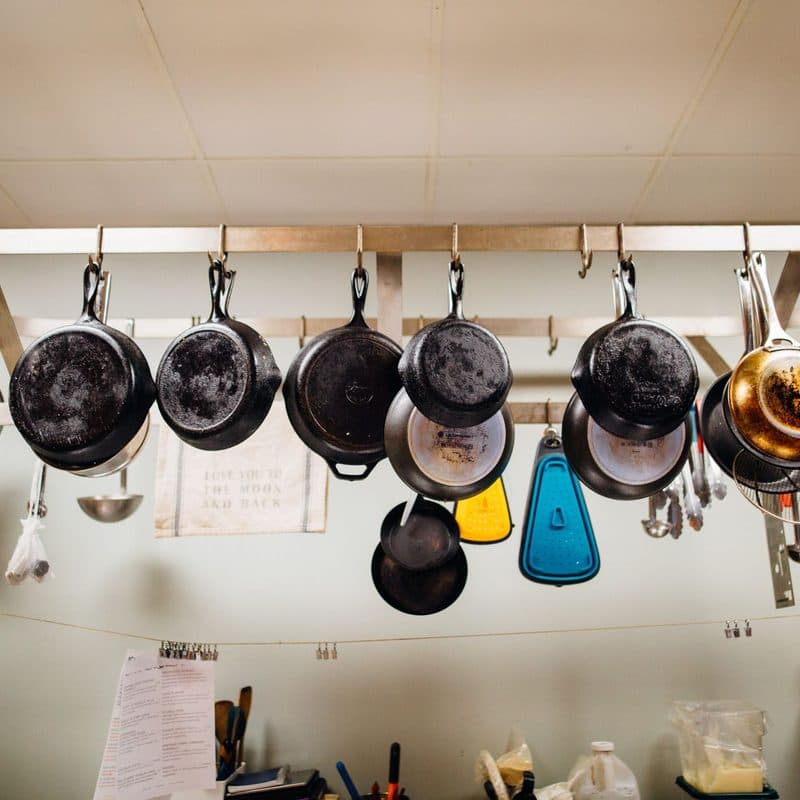 Heritage Steel Titanium Series Fry Pan316Ti, five plies, 800F, made in Tennessee. If your concern is the surface degrading over decades, this is the alloy to buy. | The most corrosion-resistant cooking surface we cover | 9.0 | |
| 2 | 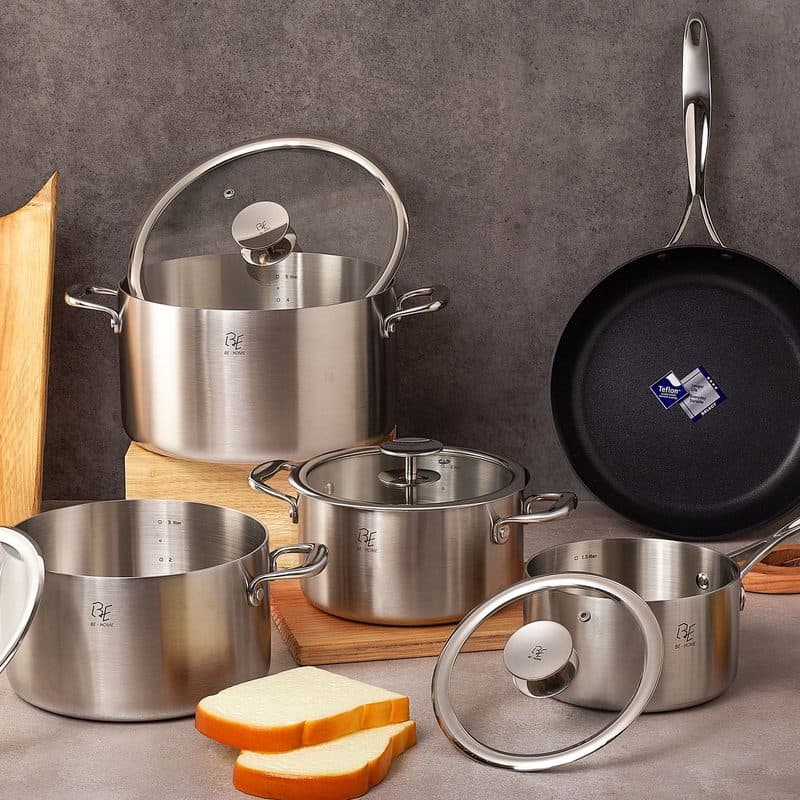 Hestan NanoBond Titanium SkilletHestan publishes NanoBond as made without PFAS, nickel, lead or cadmium. Almost nobody else in this category publishes a composition claim at all. | Anyone medically advised to limit nickel exposure | 8.6 | |
| 3 |  All-Clad D3 Stainless Fry PanNo coating, no mystery layer, nothing with a service life. The tri-ply benchmark is already the non-toxic answer. | Buying plain, honest, uncoated clad steel once | 9.0 | |
| 4 |  Tramontina Signature Tri-Ply Clad Cookware SetFully clad across the set, NSF-certified for commercial kitchens, dishwasher safe, at a price most brands charge for two pieces. | Outfitting a whole kitchen in uncoated steel without overpaying | 8.6 |
#ad Buy links are affiliate links. We never print a price — prices change weekly and a printed one is wrong within a month, so every link goes to the live Amazon listing. How we are funded.
The short answer
Uncoated clad stainless steel is already the non-toxic choice, and the Heritage Steel Titanium Series is the one we would buy. There is no coating to break down, nothing with a service life, and the aluminum core is sealed between stainless layers where food never reaches it. Heritage Steel wins because its 316Ti cooking surface resists chloride pitting — the only real degradation stainless suffers — better than the 18/10 everyone else uses. If nickel specifically is the concern, Hestan is the only brand here that publishes a nickel-free surface in writing.
What "non-toxic" is actually asking
The term is doing two different jobs in cookware listings, and it is worth separating them before spending money.
The first job is PFAS avoidance. This is the question most people are really asking, and for uncoated stainless the answer is structural: there is no fluoropolymer coating on the pan, so there is nothing to shed, scratch through or overheat. A ceramic-coated or PTFE-coated pan has a surface doing the work and that surface has a finite life. Stainless has no such part.
The second job is alloy composition — nickel, chromium, and what the steel can release under acid or salt. This is the question almost nobody answers properly, because most brands publish an alloy code like 18/10 and stop. Alloy detail is in 18/10 vs 18/8 vs 18/0, and the honest full discussion of safety claims is in is stainless steel cookware safe.
Side by side
| Pick | Cooking surface | Published composition claim | Oven rating | Made in |
|---|---|---|---|---|
| Heritage Steel Titanium Series | 316Ti, titanium and molybdenum strengthened | Alloy published; no PFAS claim needed, uncoated | 800F, broiler safe | Clarksville, TN |
| Hestan NanoBond | Titanium alloys bonded to stainless | No PFAS, nickel, lead or cadmium | 1050F | Italy |
| All-Clad D3 | Stainless over an aluminum core | Uncoated; no itemized composition claim | 600F, broiler safe | Canonsburg, PA |
| Tramontina Signature set | 18/10 stainless over an aluminum core | NSF-certified for commercial kitchens | 500F | Brazil / China by line |
What to look for
Uncoated, full stop. If a listing mentions a nonstick, ceramic, hybrid or "healthy coating" layer, it is a coated pan with a stainless body, not a stainless pan. The whole argument for steel disappears with the coating.
Fully clad rather than disc-bottomed. Not a safety issue, a longevity one — a welded disc is a discrete joint that can fail where a bonded laminate does not. See fully clad vs disc bottom.
A published alloy, not an adjective. "Surgical-grade" and "food-grade" are marketing; 18/10, 18/8 and 316Ti are specifications. Buy from a brand that states the number.
Glass lids counted separately. Lids are almost always rated lower than the pan they come with, and glass or porcelain parts are excluded from All-Clad's warranty by name.
No aggregate star rating from us. We have not run a laboratory migration test and nobody should pretend otherwise. Every composition claim on this page is the manufacturer's own published statement, linked at the foot of the page.
Keeping an uncoated pan intact
Two habits do all the damage. The first is salting still, cold water: salt settles on the base in a concentrated layer before it dissolves and pits the steel permanently. All-Clad's own care instructions say to bring liquids to a boil, or wait until food starts to cook, before adding salt. The second is leaving acidic food standing in the pan overnight, which does something similar more slowly.
Everything else is cosmetic. Rainbow heat tint is an inert oxide layer and an oxalic-acid cleanser removes it; white chalky spots are calcium from hard water and vinegar removes them. Neither is corrosion. The detail is in pan discoloration explained and does stainless steel cookware rust.
How long will it last?
This is the part of the non-toxic argument that gets underweighted. Uncoated steel has no consumable component, so the pan does not have a replacement clock attached to it. A coated pan does, and every replacement is another purchase, another manufacturing footprint and another set of composition questions you have to re-answer.
What ends a clad stainless pan is geometry rather than chemistry: a warped base from thermal shock, or rivets working loose over decades. Both are excluded from every lifetime warranty in this category, which is worth reading before you rely on one — we read all of them. Look after the geometry and an uncoated clad pan has no obvious end, which is the whole thesis of buy-it-for-life cookware.
The picks in full
1. Best overall
Heritage Steel Titanium Series Fry Pan
Heritage Steel
316Ti, five plies, 800F, made in Tennessee. If your concern is the surface degrading over decades, this is the alloy to buy.
- Materials
- 9.6
- Heat
- 9.0
- Durability
- 9.0
- Value
- 7.6
- 316Ti cooking surface: stainless strengthened with titanium and molybdenum
- Five-ply fully clad construction
- Oven safe to 800F and broiler safe (Heritage Steel published spec)
- Induction compatible; handwashing recommended
- Lifetime warranty; manufactured in Clarksville, TN
What it gets right
- 316Ti resists pitting from salt and acid better than the 18/10 everyone else uses
- The 800F oven rating matches Made In and beats All-Clad by 200F
- Made in a family-owned Tennessee factory, not assembled from imported bodies
Who should skip it
- Least-known brand here, so resale and second-hand parts are thin
- Priced against All-Clad without All-Clad's service history
- The clad steel is sourced from South Korea, so made-in-USA means built, not mined
Uncoated stainless does not have a non-toxic problem to solve, so the interesting question is which stainless. Heritage Steel builds the cooking surface from 316Ti — stainless strengthened with titanium and molybdenum — rather than the 18/10 that everyone else uses. Molybdenum is the element that stabilises the chromium oxide passive layer against chloride attack, which is why 316-series alloys resist pitting from salt and acid better than 304-series ones.
That matters here because pitting is the only form of genuine surface degradation stainless cookware suffers. It is cosmetic rather than hazardous, but it is permanent, and a surface that stays intact is the practical meaning of a cookware purchase you never have to redo.
The rest of the spec supports it: five plies fully clad, an 800F oven and broiler rating, induction compatible, lifetime warranty, manufactured in Clarksville, Tennessee. The honest caveats are that the brand is the least known here, the clad steel is sourced from South Korea so made-in-USA means built rather than mined, and it is priced against All-Clad without All-Clad's service history.
2. Best published nickel-free surface
Hestan NanoBond Titanium Skillet
Hestan
Hestan publishes NanoBond as made without PFAS, nickel, lead or cadmium. Almost nobody else in this category publishes a composition claim at all.
- Materials
- 9.4
- Heat
- 9.8
- Durability
- 9.0
- Value
- 5.8
- Titanium-based alloys bonded to stainless in nano layers
- Oven, broiler and grill safe to 1050F (Hestan published spec)
- Dishwasher safe; induction compatible
- Made without PFAS, nickel, lead or cadmium
- Lifetime warranty; handcrafted in Italy
What it gets right
- The 1050F rating puts grill and broiler work genuinely in spec
- A nickel-free cooking surface matters if you react to nickel
- Hestan claims four times the durability of plain stainless, and the surface does resist scratching
Who should skip it
- The most expensive skillet in this category, and it is not close
- The titanium surface changes appearance, not stick behavior; food still sticks if you rush the preheat
- Repair is not realistic, so a damaged surface means a replacement claim
18/10 stainless contains roughly 10% nickel, and nickel sensitivity is a genuinely common contact allergy. For most people this is not a meaningful exposure route — the nickel is alloyed into the steel rather than coating it, which is precisely why stainless is used as a food-contact material in commercial kitchens and medical equipment. We are not going to offer a medical opinion, and if you have been advised to limit nickel that conversation belongs with your doctor rather than a cookware site.
What we can do is tell you who publishes the claim. Hestan states that NanoBond is made without PFAS, nickel, lead or cadmium, which is a written composition commitment rather than an inference from an alloy code. The pan is also rated to 1050F, by a wide margin the highest oven rating in clad cookware, and it is dishwasher safe.
The cost is the obvious problem: this is the most expensive skillet on this site and it is not close. The titanium surface also changes appearance and scratch resistance, not stick behaviour — food still sticks if you rush the preheat.
3. Best uncoated default
All-Clad D3 Stainless Fry Pan
All-Clad
No coating, no mystery layer, nothing with a service life. The tri-ply benchmark is already the non-toxic answer.
- Materials
- 8.8
- Heat
- 8.8
- Durability
- 9.6
- Value
- 7.2
- Tri-ply: stainless interior, aluminum core, magnetic stainless exterior
- Oven and broiler safe to 600F (All-Clad published spec)
- Induction compatible on any stovetop
- Handwash only, per the manufacturer
- Limited lifetime warranty; bonded, engineered and assembled in Canonsburg, PA
What it gets right
- Survived America's Test Kitchen's concrete-strike abuse testing with barely a ding
- Rivets and handle join are the sturdiest in the category
- Decades of parts and service history standing behind the warranty
Who should skip it
- Costs roughly three times a Tramontina that cooks nearly as evenly
- The stick handle is narrow and bites into your palm on a loaded 12-inch pan
- Handwash only, which is a real constraint if you hate washing up
The structural point of this page is that uncoated clad stainless needs no special non-toxic variant. Food touches the stainless interior; the aluminum core is bonded between stainless layers across the whole pan and never contacts anything you eat. There is no coating to abrade, no coating to overheat, and no coating with a three-to-five-year countdown attached to it.
The D3 is the plainest expression of that: stainless, aluminum, magnetic stainless, 600F, handwash only, limited lifetime warranty, bonded in Pennsylvania since 1971. It is also the only pan in this category with published third-party abuse-test evidence behind its durability claim.
4. Best value
Tramontina Signature Tri-Ply Clad Cookware Set
Tramontina
Fully clad across the set, NSF-certified for commercial kitchens, dishwasher safe, at a price most brands charge for two pieces.
- Materials
- 8.2
- Heat
- 8.4
- Durability
- 7.8
- Value
- 9.6
- Tri-ply clad throughout, not disc-bottomed on the pots
- 18/10 stainless interior over an aluminum core
- Oven safe to 500F; dishwasher safe; NSF-certified
- Induction compatible across the set
- Tramontina lifetime warranty
What it gets right
- Fully clad at a price where most sets quietly switch to disc bottoms
- The one set we would hand to someone furnishing a first kitchen
- The dishwasher-safe rating applies across the set, not just the skillets
Who should skip it
- Sets always include a piece or two you will never reach for
- The 500F ceiling limits oven work compared with buying pieces individually
- Lids are the weakest component; treat their rating as lower than the pans'
A non-toxic kitchen is a cheaper project than the marketing around it suggests, because the answer is the oldest and least exotic material in the category. The Tramontina Signature set is tri-ply clad throughout rather than disc-bottomed on the pots, with an 18/10 interior over an aluminum core, and it carries NSF certification for commercial kitchens.
The trades are a 500F oven ceiling and a lighter gauge than the premium clads. Neither has anything to do with what the pan is made of. If replacing coated pans is the goal and budget is the obstacle, this is where we would start.
Frequently asked questions
What is the best non-toxic stainless steel cookware?
Heritage Steel Titanium Series, on the alloy: a 316Ti cooking surface resists pitting from salt and acid better than the 18/10 most brands use. All uncoated clad stainless is already free of nonstick coatings, so the choice is about which steel and which brand publishes its composition.
Is stainless steel cookware PFAS-free?
Uncoated stainless has no fluoropolymer coating at all, so there is nothing to shed or break down. Watch for hybrid pans that pair a stainless body with a nonstick or ceramic layer; those are coated pans.
Is there nickel-free stainless steel cookware?
Hestan publishes NanoBond as made without PFAS, nickel, lead or cadmium, which is the only written nickel-free claim among the brands we cover. Nickel-free 18/0 exists as an alloy but is not used as a cooking surface in quality clad pans.
Does the aluminum core in clad cookware touch food?
No. In clad construction the core is bonded between stainless layers across the entire pan. The only way it becomes exposed is severe delamination, which is a manufacturing defect and is the one failure every lifetime warranty covers.
What does 316Ti stainless steel mean?
A 316-series stainless strengthened with titanium and molybdenum. Molybdenum stabilises the chromium oxide passive layer against chloride attack, which is why 316-series alloys resist pitting from salt better than 304-series alloys like 18/10.
Is cheap stainless cookware less safe than expensive stainless?
Not in any way we can evidence. The differences between a Tramontina set and an All-Clad pan are gauge, oven rating, handle and warranty record, not the safety of the cooking surface.
Sources
- Heritage Steel — Titanium Series 10.5-inch Fry Pan, published specification
- Hestan Culinary — NanoBond titanium skillet, published specification
- All-Clad — D3 Stainless 12-inch Fry Pan, published specification
- All-Clad — Care and use instructions for stainless cookware
- All-Clad — Cookware Limited Lifetime Warranty (PDF)
- Tramontina — Signature Tri-Ply Clad Stainless Steel Fry Pan, published specification
- Xometry — 18/8 vs 18/10 vs 18/0 stainless steels compared
- US FDA — Food contact substances and cookware safety
- National Institutes of Health — Nickel fact sheet for health professionals