Construction & Materials
Stainless Steel vs Copper
Copper is genuinely better at one thing. For most kitchens, a copper core inside a stainless pan is the whole benefit with none of the cost.
Disclosure: Ply & Pan earns a commission on qualifying purchases made through links on this page. We take no free product and no sponsorship, and we never print a price. How we are funded.
Quick picks
The short answer. Tap any row for the full write-up.
| # | Product | Best for | Score | Price |
|---|---|---|---|---|
| 1 | 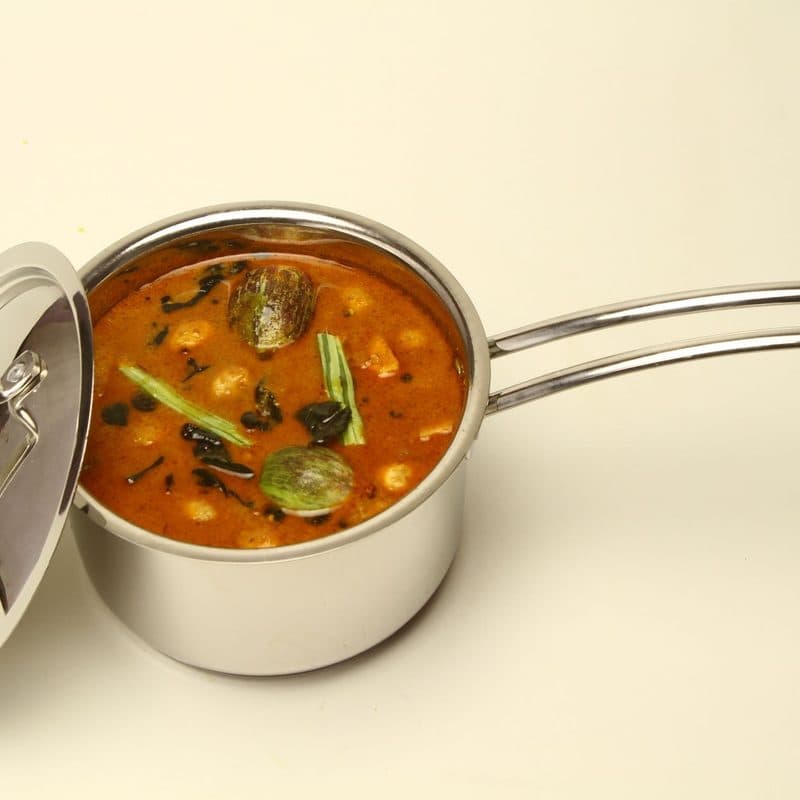 All-Clad Copper Core SaucierA sealed copper layer in a clad pan gets you the responsiveness without the relining or the polishing. | Copper's response with stainless maintenance | 8.9 | |
| 2 |  All-Clad D3 Stainless Fry PanTri-ply responds fast enough for almost everything, at a fraction of the copper premium. | Not needing copper at all, which is most people | 9.1 |
#ad Buy links are affiliate links. We never print a price — prices change weekly and a printed one is wrong within a month, so every link goes to the live Amazon listing. How we are funded.
Key takeaways
- Copper conducts heat better than any cookware metal, so it both heats and cools fastest.
- Solid copper is reactive and needs a tin or stainless lining, which wears and needs professional relining.
- Copper-core clad pans get most of the responsiveness with none of the maintenance.
- The advantage only shows in temperature-critical cooking: emulsions, custards, sugar work.
- For everything else, an aluminum core performs indistinguishably for far less money.
The quick answer
Copper's advantage is real and narrow. It gives heat up faster than anything else, which matters when you pull a pan off the burner and need it to stop cooking — emulsified sauces, custards, sugar work.
For most kitchens the sensible form of that advantage is a copper core inside a clad stainless pan, not solid copper. You get the responsiveness, a non-reactive stainless cooking surface, no lining to wear out, and no polishing obligation.
Three options compared
| Clad stainless, aluminum core | Clad stainless, copper core | Solid lined copper | |
|---|---|---|---|
| Response | Fast | Faster | Fastest |
| Cooking surface | Stainless | Stainless | Tin or stainless lining |
| Reactivity | None | None | None while lined |
| Lining wear | N/A | N/A | Tin wears; needs relining |
| Exterior maintenance | None | Copper band tarnishes | Whole pan tarnishes |
| Induction | Yes | Yes | Usually not |
| Dishwasher | Brand-dependent | No | No |
| Price | Moderate | High | Very high |
Why copper behaves differently
Copper conducts heat faster than aluminum, and the property is symmetrical: a copper pan both gains and loses heat more quickly than an equivalent aluminum one.
The losing half is what you are actually buying. When a butter emulsion nears its break point and you lift the pan off the heat, an aluminum-cored pan keeps pushing stored energy into the sauce for several seconds. A copper-cored pan stops sooner. That window is exactly where those sauces fail, and it is the only place the difference reliably changes an outcome.
Everywhere else — soup, rice, a reduction you are watching, a sear — nothing is decided in three seconds, and copper is an expensive irrelevance. The same logic distinguishes D5 from Copper Core.
The case against solid copper
Copper is reactive with acidic food, so a solid copper pan must be lined. Traditional tin linings are excellent and soft: they wear through with use and metal utensils, and restoring one means sending the pan to a professional for relining. Stainless-lined copper avoids that but costs more and slightly reduces the responsiveness advantage.
Solid copper also tarnishes across its entire exterior and needs polishing to look like the object you paid for, is usually not induction compatible because copper is not ferromagnetic, and is expensive enough to make the whole proposition a specialist one.
None of that makes solid copper a bad product. It makes it a professional or enthusiast tool with an ongoing maintenance relationship, which is a different purchase from a buy-it-for-life pan you can ignore.
Living with a copper core
A copper-cored clad pan puts the copper where it works and seals it away from food entirely. The only copper you see is the exposed band on the exterior of lines like All-Clad's Copper Core, and it will darken and spot within months.
That is normal oxidation, it has no effect on cooking, and it polishes back if you care. It also falls under the normal-wear exclusion in All-Clad's warranty, reasonably. We think of it as a wear indicator — an honest record of how hard the pan has been run, in a category where everything else hides its history.
Which lasts longest?
Copper-cored clad stainless, followed by aluminum-cored clad stainless, with solid lined copper last — and that ordering surprises people.
Clad pans of either core have the same failure modes: warping from thermal shock and rivets working loose, both behavioral and both excluded from warranty. The core material makes no difference, because it is sealed and inert inside the laminate. A copper-cored pan will outlive you exactly as readily as an aluminum-cored one.
Solid lined copper is different. The tin lining is a consumable: it wears through over years of use and the pan needs professional relining to continue in service. That is a maintainable pan rather than a permanent one, and whether that counts as buy-it-for-life depends on whether you consider a relining service part of ownership.
For a reader who wants to buy once and stop thinking about it, the answer is a copper core inside stainless, or no copper at all. See our Copper Core saucier review for whether you need it.
The picks in full
1. Best of both
All-Clad Copper Core Saucier
All-Clad
A sealed copper layer in a clad pan gets you the responsiveness without the relining or the polishing.
- Response
- 9.8
- Maintenance
- 8.8
- Durability
- 9.4
- Value
- 6.2
- Five-ply: copper core between two aluminum and two stainless layers
- Oven and broiler safe to 600F (All-Clad published spec)
- Induction compatible; handwash only
- Rounded saucier walls take a whisk into the corner
- Limited lifetime warranty; handcrafted in Canonsburg, PA
What it gets right
- Copper reacts fast enough that you can actually rescue a breaking sauce
- Rounded interior means no square corner for a roux or risotto to seize in
- The exposed copper band is a genuine wear indicator, not decoration
Who should skip it
- The most expensive pan on this site by a wide margin
- Copper's advantage is invisible unless you cook temperature-critical sauces
- The copper band discolors and needs polishing if you care how it looks
Five-ply with a copper core between two aluminum and two stainless layers, 600F, lifetime warranty, handcrafted in Canonsburg. The copper is sealed, so there is no lining to wear and no reactivity.
2. Best plain stainless
All-Clad D3 Stainless Fry Pan
All-Clad
Tri-ply responds fast enough for almost everything, at a fraction of the copper premium.
- Response
- 9.2
- Maintenance
- 9.4
- Durability
- 9.6
- Value
- 7.2
- Tri-ply: stainless interior, aluminum core, magnetic stainless exterior
- Oven and broiler safe to 600F (All-Clad published spec)
- Induction compatible on any stovetop
- Handwash only, per the manufacturer
- Limited lifetime warranty; bonded, engineered and assembled in Canonsburg, PA
What it gets right
- Survived America's Test Kitchen's concrete-strike abuse testing with barely a ding
- Rivets and handle join are the sturdiest in the category
- Decades of parts and service history standing behind the warranty
Who should skip it
- Costs roughly three times a Tramontina that cooks nearly as evenly
- The stick handle is narrow and bites into your palm on a loaded 12-inch pan
- Handwash only, which is a real constraint if you hate washing up
Worth stating plainly: a good tri-ply pan responds fast enough for almost all cooking. Copper is an upgrade for a narrow set of dishes, not a general one.
Frequently asked questions
Is copper cookware better than stainless steel?
For temperature-critical sauces, yes, because copper gives heat up fastest when you pull the pan off. For everything else the difference is invisible and the maintenance is substantial.
Is a copper core worth it?
Only if you make emulsified sauces, custards or sugar work. For soup, rice, searing and reductions, an aluminum core performs indistinguishably for far less money.
Does copper cookware need to be lined?
Solid copper does, because copper is reactive with acidic food. Traditional tin linings wear through and need professional relining. A copper core in a clad pan is sealed and needs nothing.
Does copper cookware work on induction?
Solid copper usually does not, because copper is not ferromagnetic. Copper-core clad pans do, because they have a magnetic stainless exterior layer facing the hob.
Why does the copper band on my pan turn dark?
Exposed copper oxidizes. It is cosmetic, has no effect on cooking, polishes back, and falls under the normal-wear exclusion in All-Clad's warranty.
Which lasts longer, copper or stainless?
Copper-cored clad stainless, because the copper is sealed and inert while the pan has the same failure modes as any clad pan. Solid lined copper needs periodic professional relining.