Construction & Materials
Stainless Steel vs Titanium Cookware
Titanium is a camping material and a surface treatment. As a pan body it solves a problem clad stainless already solved.
Disclosure: Ply & Pan earns a commission on qualifying purchases made through links on this page. We take no free product and no sponsorship, and we never print a price. How we are funded.
Quick picks
The short answer. Tap any row for the full write-up.
| # | Product | Best for | Score | Price |
|---|---|---|---|---|
| 1 | 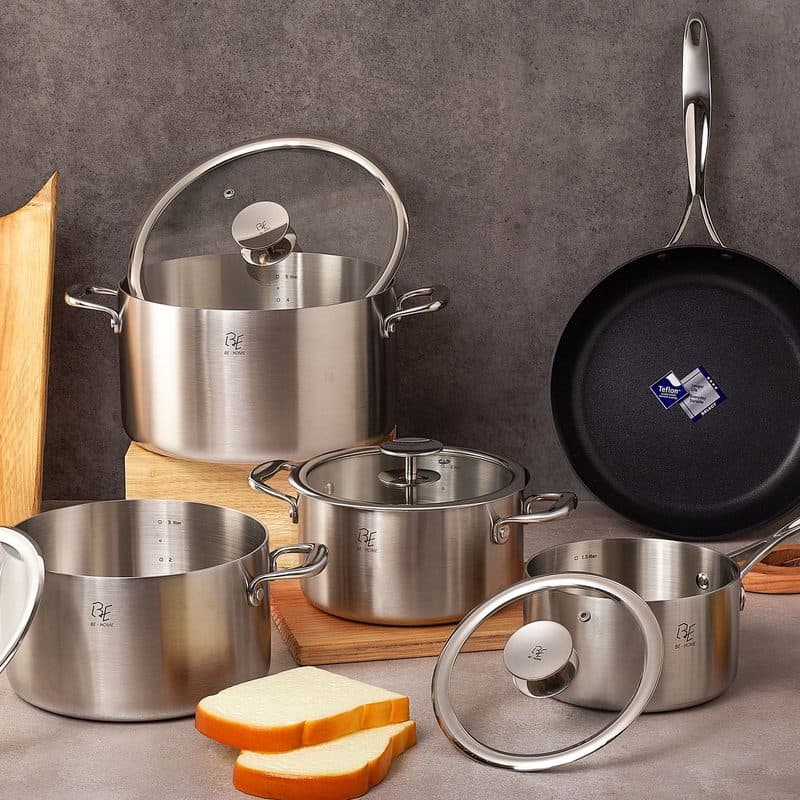 Hestan NanoBond Titanium SkilletTitanium alloys bonded to stainless in nano layers, rated to 1050F. Titanium used as a surface, which is the only place it earns its keep. | The highest oven ceiling in clad cookware | 8.6 | |
| 2 |  Heritage Steel Titanium Series Fry Pan316Ti puts titanium and molybdenum into the steel itself, which is the version of this idea that resists pitting. | Corrosion resistance rather than a headline temperature | 9.0 | |
| 3 |  All-Clad D3 Stainless Fry PanPlain tri-ply at a fraction of the titanium premium, with the only published abuse-test evidence in the category. | Not paying for a material advantage you will not feel | 9.1 |
#ad Buy links are affiliate links. We never print a price — prices change weekly and a printed one is wrong within a month, so every link goes to the live Amazon listing. How we are funded.
Key takeaways
- Titanium conducts heat at roughly 22.4 W/m·K. Type 304 stainless is about 14.4, aluminium about 236 and copper about 401. A titanium pan body is barely better than a stainless one and nowhere near a conductive core.
- Solid titanium cookware exists mainly for backpacking, where lightness beats cooking performance.
- In kitchen cookware, titanium appears as a bonded surface (Hestan NanoBond) or as an alloying element (Heritage Steel 316Ti) — both on a clad stainless body.
- Neither makes a pan nonstick. Titanium changes hardness, heat ceiling and corrosion resistance, not release.
- "Titanium" on a nonstick pan usually describes a reinforced coating, which is a coated pan with a finite life.
The quick answer
Buy clad stainless. Titanium is worth paying for only as a surface on top of it. Titanium is strong, light and corrosion-resistant, and it is a poor heat spreader — roughly 22.4 W/m·K against 236 for aluminium. A pan needs a conductive core far more than it needs an exotic skin, which is why no serious kitchen pan is made of solid titanium and why both titanium products we recommend are clad stainless pans with a titanium contribution.
Side by side
| Clad stainless | Solid titanium | Titanium-bonded stainless | |
|---|---|---|---|
| Thermal conductivity | Core does the work: aluminium about 236 W/m·K | About 22.4 W/m·K | Core does the work; titanium is a surface |
| Weight | Moderate to heavy | Very light | Moderate to heavy |
| Even heating | Good | Poor; hot spot over the flame | Good |
| Published oven ceiling | 500F to 800F by brand | Not published for kitchen use | 1050F for Hestan NanoBond |
| Nonstick | No | No | No |
| Typical use | Everyday kitchen cookware | Backpacking and camping | Premium kitchen cookware |
| Price | Wide range | High for what it does in a kitchen | Highest in the category |
Conductivity figures are the published values for titanium, Type 304 stainless, aluminium and copper in the materials reference cited at the foot of this page. The two titanium products above are quoted from their manufacturers' own specifications.
Why nobody sells a solid titanium frying pan worth buying
The appeal is obvious on paper: strong, light, corrosion-resistant, non-reactive. The problem is the same one stainless has, only you pay far more for it. Titanium spreads heat poorly, so a solid titanium pan over a gas ring gives you a scorching circle where the flame touches and cooler metal around it — the exact failure mode that made clad construction necessary in the first place.
Clad stainless solves it by putting a conductive metal in the middle and the durable, non-reactive metal on the faces. A titanium pan has no such core, and adding one would make it a clad pan with a titanium skin — which is precisely what Hestan built. The reasoning is the same argument as what clad means, applied to a different outer metal.
Where solid titanium does make sense is a backpacking pot, where every gram matters more than whether the rice is evenly cooked. That is a different product category with a different priority, and it does not transfer to a hob at home.
The "titanium" nonstick trap
Watch the wording on coated pans. A pan described as titanium-reinforced or titanium-infused nonstick is a coated pan: the part doing the release work is still a coating with a finite life, and titanium particles in it do not change that. The buy-it-for-life argument does not apply to any pan with a consumable surface, however the surface is marketed — stainless vs nonstick and stainless vs ceramic cover the full version.
Hestan's NanoBond is a different proposition and we are careful to separate them: it is a hardness and heat-ceiling treatment bonded to stainless, not a release coating, and Hestan does not claim it makes the pan nonstick. If a listing promises titanium and effortless release in the same sentence, it is selling a coating.
How long will each last?
A clad stainless pan has no consumable part and fails only through geometry — a warped base from thermal shock or rivets working loose over decades. A titanium-bonded pan inherits the same failure modes, with a harder surface that resists the cosmetic scratching a plain stainless interior accumulates.
The one practical difference cuts against the premium. A damaged NanoBond surface is not repairable, so recovery means a warranty claim rather than a polish, and the pan is expensive enough that this matters. A scratched plain stainless interior is cosmetic and nothing more, because the passive chromium oxide layer reforms immediately on the damaged metal. For a buy-it-for-life purchase, the repairable failure mode is the better one — the full durability ranking is in what cookware lasts the longest.
The picks in full
1. Best titanium-bonded pan
Hestan NanoBond Titanium Skillet
Hestan
Titanium alloys bonded to stainless in nano layers, rated to 1050F. Titanium used as a surface, which is the only place it earns its keep.
- Materials
- 9.4
- Heat
- 9.8
- Durability
- 9.0
- Value
- 5.8
- Titanium-based alloys bonded to stainless in nano layers
- Oven, broiler and grill safe to 1050F (Hestan published spec)
- Dishwasher safe; induction compatible
- Made without PFAS, nickel, lead or cadmium
- Lifetime warranty; handcrafted in Italy
What it gets right
- The 1050F rating puts grill and broiler work genuinely in spec
- A nickel-free cooking surface matters if you react to nickel
- Hestan claims four times the durability of plain stainless, and the surface does resist scratching
Who should skip it
- The most expensive skillet in this category, and it is not close
- The titanium surface changes appearance, not stick behavior; food still sticks if you rush the preheat
- Repair is not realistic, so a damaged surface means a replacement claim
This is what titanium in cookware should mean: a surface treatment on a clad stainless body, not a pan made of titanium. Hestan bonds titanium-based alloys to stainless in nano layers and publishes oven, broiler and grill safety to 1050F, far beyond anything else in the category, plus a dishwasher-safe rating and a composition made without PFAS, nickel, lead or cadmium.
Be clear about what it does and does not change. Hestan claims four times the durability of plain stainless and the surface does resist scratching. It does not change stick behaviour — food still sticks if you rush the preheat. And repair is not realistic, so a damaged surface means a replacement claim rather than a fix.
2. Best titanium-alloyed surface
Heritage Steel Titanium Series Fry Pan
Heritage Steel
316Ti puts titanium and molybdenum into the steel itself, which is the version of this idea that resists pitting.
- Materials
- 9.6
- Heat
- 9.0
- Durability
- 9.0
- Value
- 7.6
- 316Ti cooking surface: stainless strengthened with titanium and molybdenum
- Five-ply fully clad construction
- Oven safe to 800F and broiler safe (Heritage Steel published spec)
- Induction compatible; handwashing recommended
- Lifetime warranty; manufactured in Clarksville, TN
What it gets right
- 316Ti resists pitting from salt and acid better than the 18/10 everyone else uses
- The 800F oven rating matches Made In and beats All-Clad by 200F
- Made in a family-owned Tennessee factory, not assembled from imported bodies
Who should skip it
- Least-known brand here, so resale and second-hand parts are thin
- Priced against All-Clad without All-Clad's service history
- The clad steel is sourced from South Korea, so made-in-USA means built, not mined
The other legitimate use of titanium is as an alloying element. Heritage Steel's 316Ti cooking surface is stainless strengthened with titanium and molybdenum, which resists pitting from salt and acid better than the 18/10 everyone else uses — and pitting is the only genuine surface degradation stainless suffers.
Five plies fully clad, an 800F oven and broiler rating, induction compatible, lifetime warranty, made in Clarksville, Tennessee. It is the least-known brand we cover and it is priced against All-Clad without All-Clad's service record.
3. The thing titanium is competing with
All-Clad D3 Stainless Fry Pan
All-Clad
Plain tri-ply at a fraction of the titanium premium, with the only published abuse-test evidence in the category.
- Materials
- 8.8
- Heat
- 8.8
- Durability
- 9.6
- Value
- 7.2
- Tri-ply: stainless interior, aluminum core, magnetic stainless exterior
- Oven and broiler safe to 600F (All-Clad published spec)
- Induction compatible on any stovetop
- Handwash only, per the manufacturer
- Limited lifetime warranty; bonded, engineered and assembled in Canonsburg, PA
What it gets right
- Survived America's Test Kitchen's concrete-strike abuse testing with barely a ding
- Rivets and handle join are the sturdiest in the category
- Decades of parts and service history standing behind the warranty
Who should skip it
- Costs roughly three times a Tramontina that cooks nearly as evenly
- The stick handle is narrow and bites into your palm on a loaded 12-inch pan
- Handwash only, which is a real constraint if you hate washing up
Before paying a titanium premium, note what it is competing with: three bonded layers, a 600F rating, induction compatibility, a limited lifetime warranty and a pan that came out of America's Test Kitchen's concrete-strike abuse protocol with barely a ding. Titanium treatments improve surface hardness and heat ceiling. They do not improve how your food cooks.
Frequently asked questions
Is titanium cookware better than stainless steel?
Not for kitchen use. Titanium conducts heat at roughly 22.4 W/m-K against about 14.4 for Type 304 stainless and 236 for aluminium, so a titanium pan body heats unevenly and costs more. Titanium is useful as a bonded surface or an alloying element on a clad stainless pan.
Why is titanium cookware mostly for camping?
Because its advantage is weight rather than cooking performance. Backpacking pots trade even heating for lightness, which is the right trade on a trail and the wrong one on a hob.
What is titanium-bonded stainless steel?
A clad stainless pan with titanium-based alloys bonded to the surface. Hestan's NanoBond is the example we cover, published as oven, broiler and grill safe to 1050F.
What does 316Ti mean?
A 316-series stainless strengthened with titanium and molybdenum. Heritage Steel uses it as a cooking surface because it resists pitting from salt and acid better than 18/10.
Is titanium nonstick cookware really nonstick?
A titanium-reinforced nonstick pan is a coated pan. The release comes from the coating, which has a finite life; the titanium changes hardness, not release. Hestan does not claim NanoBond is nonstick.
Is titanium cookware safe?
Titanium is non-reactive and used widely in food and medical applications. The safety question in coated titanium pans is about the coating rather than the titanium.
Sources
- The Engineering ToolBox — Thermal conductivity of metals and alloys
- Hestan Culinary — NanoBond titanium skillet, published specification
- Heritage Steel — Titanium Series 10.5-inch Fry Pan, published specification
- All-Clad — D3 Stainless 12-inch Fry Pan, published specification
- America's Test Kitchen — Getting Whacked (how the abuse testing works)
- Xometry — 18/8 vs 18/10 vs 18/0 stainless steels compared