Construction & Materials
Copper Core vs Aluminum Core
The core is the part of a clad pan that does the work. Copper does it faster, and almost nobody needs faster.
Disclosure: Ply & Pan earns a commission on qualifying purchases made through links on this page. We take no free product and no sponsorship, and we never print a price. How we are funded.
Quick picks
The short answer. Tap any row for the full write-up.
| # | Product | Best for | Score | Price |
|---|---|---|---|---|
| 1 | 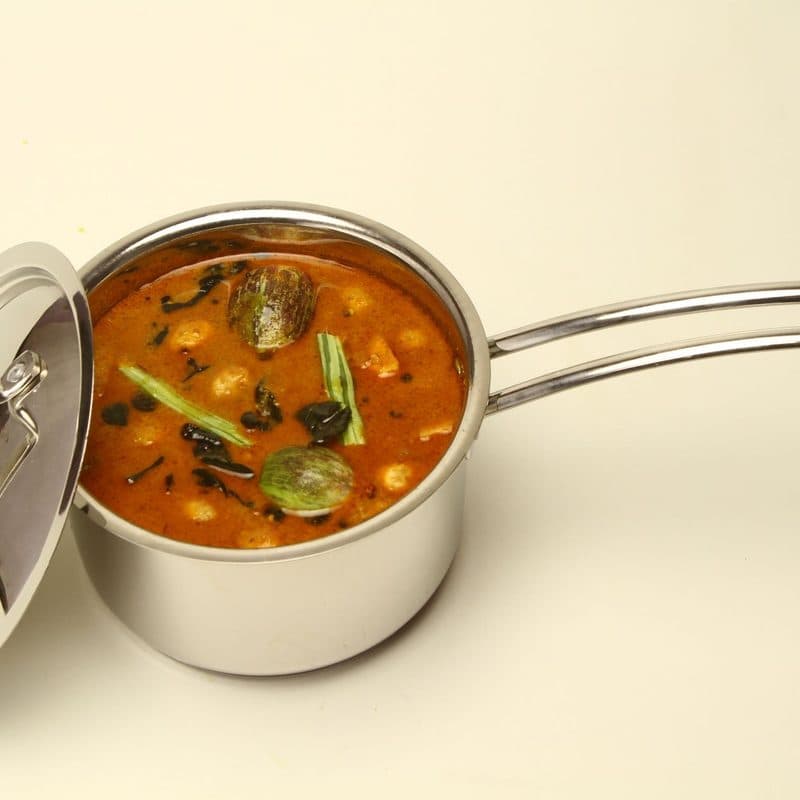 All-Clad Copper Core SaucierFive-ply with a genuine copper layer at the center. The most responsive clad pan All-Clad makes, at the price that implies. | Temperature-critical sauces, where seconds matter | 8.7 | |
| 2 |  All-Clad D5 Stainless Brushed Fry PanFive alternating layers of aluminum and stainless. Steadier than copper core, slower to answer, considerably cheaper. | Steadiness on an uneven burner, from the same factory | 8.4 | |
| 3 |  All-Clad D3 Stainless Fry PanOne aluminum core, three layers, and most of the responsiveness people buy copper for. The right default. | Most cooking, at a third of the copper-core price | 9.0 |
#ad Buy links are affiliate links. We never print a price — prices change weekly and a printed one is wrong within a month, so every link goes to the live Amazon listing. How we are funded.
The short answer
Copper conducts heat roughly twice as well as aluminum, which makes a copper-core pan noticeably faster to react when you change the heat. It also costs several times more. For almost all cooking, an aluminum core is the right choice, and buying a lighter aluminum pan gets you most of the responsiveness for a fraction of the money.
Side by side
| Copper core | Aluminum core | |
|---|---|---|
| Thermal conductivity | Roughly twice aluminum's | Roughly fifteen times stainless steel's |
| Response to a heat change | Fastest in clad cookware | Fast, and faster still in a thin tri-ply |
| Weight | Heavier — copper is dense | Lighter |
| Thermal mass | High | Lower at the same thickness |
| Cost | Several times higher | The category standard |
| Maintenance | Exposed copper band discolors and needs polishing if appearance matters | None — the aluminum is fully enclosed |
| Found in | A small number of premium lines, usually as a five-ply | Nearly every clad pan sold |
| Best for | Temperature-critical sauces and emulsions | Everything else |
What the core actually does
Stainless steel is a poor conductor of heat — roughly fifteen times worse than aluminum. A pan made of stainless alone would develop a hot spot exactly where the flame touches it and stay cool an inch away.
So every clad pan is really a conductive core wrapped in steel for durability and non-reactivity. The core spreads heat sideways across the base so the whole cooking surface arrives at a similar temperature; the steel faces exist because aluminum and copper are both reactive and soft. What does clad mean covers the construction, and tri-ply vs 5-ply covers how many layers of it.
Which means the core metal determines two things: how evenly heat spreads, and how fast the pan follows your hand when you turn the burner down or lift the pan off it.
Conductivity and mass are different levers
This is the point most comparisons miss. Copper's advantage is conductivity. But what you feel as "responsiveness" in a kitchen is conductivity divided by thermal mass, and a copper-core pan is heavy, because copper is dense.
The practical consequence: a thin aluminum tri-ply is often more responsive in use than a heavy copper-core five-ply, because it simply has less metal to heat and cool. That is why All-Clad D3 scores higher on response above than D5 does, and why a light Tramontina feels quicker on the hob than a Demeyere.
So if what you want is a pan that answers immediately, the cheap route is a thinner aluminum pan rather than an expensive copper one. The copper-core pan wins on a narrower axis: it combines fast response with high mass, so it holds temperature when food lands in it and lets go quickly when you pull it. That combination is genuinely hard to get any other way, and it is what you are paying for.
When copper genuinely wins
Temperature-critical emulsions and sauces. Hollandaise, beurre blanc, a custard, caramel, a pan reduction you are judging by eye. These are jobs where a few seconds of overshoot splits a sauce, and the recovery move is to pull the pan off the heat and have it stop cooking immediately.
Which is why copper cores appear overwhelmingly in sauciers rather than skillets, and why our saucier coverage treats it as a real option — best stainless steel sauciers and the All-Clad Copper Core saucier review. For searing a steak, boiling water or frying eggs, copper buys you nothing you can perceive.
Copper core is not a copper pan
Two things get conflated. A copper-core clad pan has a thin copper layer buried between aluminum and stainless, with a stainless cooking surface. A traditional copper pan is made of copper, usually lined with tin or stainless, and behaves far more dramatically — and needs far more maintenance.
A visible copper band around the outside of a clad pan is the edge of that internal layer, not a copper exterior. It is a genuine wear indicator rather than decoration, and it tarnishes. Stainless vs copper covers the solid-copper comparison, which is a different decision from this one.
What this means for buying
Buy aluminum core by default. It is what nearly every good pan uses, the aluminum is fully enclosed so it needs no maintenance, and the conductivity is more than adequate for every job except emulsion-sauce work.
Buy copper core for one pan, if you make temperature-critical sauces and you want that specific combination of mass and responsiveness — and buy it as a saucier, where the shape and the metal both serve the same job. Our ranked aluminum-core picks are in best tri-ply cookware and best 5-ply cookware.
Do not buy copper core expecting better searing, more even heat than a good aluminum five-ply, or less sticking. Sticking is a technique problem in any metal — why food sticks to stainless steel.
The picks in full
1. The copper-core option
All-Clad Copper Core Saucier
All-Clad
Five-ply with a genuine copper layer at the center. The most responsive clad pan All-Clad makes, at the price that implies.
- Response
- 9.8
- Evenness
- 9.4
- Durability
- 9.0
- Value
- 6.0
- Five-ply: copper core between two aluminum and two stainless layers
- Oven and broiler safe to 600F (All-Clad published spec)
- Induction compatible; handwash only
- Rounded saucier walls take a whisk into the corner
- Limited lifetime warranty; handcrafted in Canonsburg, PA
What it gets right
- Copper reacts fast enough that you can actually rescue a breaking sauce
- Rounded interior means no square corner for a roux or risotto to seize in
- The exposed copper band is a genuine wear indicator, not decoration
Who should skip it
- The most expensive pan on this site by a wide margin
- Copper's advantage is invisible unless you cook temperature-critical sauces
- The copper band discolors and needs polishing if you care how it looks
Five plies with copper between two aluminum and two stainless layers, oven and broiler safe to 600F, induction compatible, handwash only, limited lifetime warranty, handcrafted in Canonsburg, Pennsylvania. The rounded saucier walls take a whisk into the corner.
The reason to buy it is responsiveness rather than evenness. Copper reacts fast enough that you can actually rescue a breaking sauce by pulling the pan, where a heavy aluminum five-ply will keep cooking for a while after you move it. If you make hollandaise, custards or reductions by eye, that is a real capability.
The costs are blunt: it is the most expensive pan on this site by a wide margin, copper's advantage is invisible unless you cook temperature-critical sauces, and the exposed copper band discolors and needs polishing if you care how it looks.
2. The aluminum five-ply comparison
All-Clad D5 Stainless Brushed Fry Pan
All-Clad
Five alternating layers of aluminum and stainless. Steadier than copper core, slower to answer, considerably cheaper.
- Response
- 7.6
- Evenness
- 9.2
- Durability
- 9.4
- Value
- 6.8
- Five-ply: alternating layers of aluminum and stainless steel
- Oven and broiler safe to 600F (All-Clad published spec)
- Induction compatible; handwash only
- Brushed exterior hides scuffs better than the polished D3
- Limited lifetime warranty; made in All-Clad's Pennsylvania factory
What it gets right
- The extra stainless layer genuinely damps hot spots on a weak or uneven burner
- Brushed finish still looks composed after a year; polished D3 shows every scratch
- Heavier gauge means less flexing at the base over a decade
Who should skip it
- Slower to respond when you pull heat, which is the wrong trait for a pan sauce
- Costs meaningfully more than D3 for a difference most cooks will not feel
- Noticeably heavier in a 12-inch, which matters when you are tossing food
The cleanest way to isolate what copper buys is to compare it with the aluminum five-ply from the same brand, factory and warranty. D5 alternates aluminum and stainless, carries the same 600F rating and the same limited lifetime warranty, and is handwash only.
The extra stainless layer genuinely damps hot spots on a weak or uneven burner, so for a stove with one bad ring this is the better pan. The brushed exterior also hides scuffs where the polished D3 shows every scratch.
Against that, it is slower to respond when you pull heat — the opposite of the copper-core argument — costs meaningfully more than D3 for a difference most cooks will not feel, and is noticeably heavier in a 12-inch.
3. The aluminum tri-ply default
All-Clad D3 Stainless Fry Pan
All-Clad
One aluminum core, three layers, and most of the responsiveness people buy copper for. The right default.
- Response
- 9.2
- Evenness
- 8.8
- Durability
- 9.6
- Value
- 7.2
- Tri-ply: stainless interior, aluminum core, magnetic stainless exterior
- Oven and broiler safe to 600F (All-Clad published spec)
- Induction compatible on any stovetop
- Handwash only, per the manufacturer
- Limited lifetime warranty; bonded, engineered and assembled in Canonsburg, PA
What it gets right
- Survived America's Test Kitchen's concrete-strike abuse testing with barely a ding
- Rivets and handle join are the sturdiest in the category
- Decades of parts and service history standing behind the warranty
Who should skip it
- Costs roughly three times a Tramontina that cooks nearly as evenly
- The stick handle is narrow and bites into your palm on a loaded 12-inch pan
- Handwash only, which is a real constraint if you hate washing up
Tri-ply with a single aluminum core, 600F oven and broiler safe, induction compatible, handwash only, limited lifetime warranty, bonded in Pennsylvania. The thing worth noticing is that it is more responsive than the aluminum five-ply above, because it has less mass — which is most of what people think they are buying copper for.
It is also the only pan in this category with published abuse-test evidence: America's Test Kitchen's concrete-strike protocol left it with barely a ding while rivals dented.
The costs: 600F is below Made In and Heritage Steel, handwash only, the narrow stick handle is its owners' most common complaint, and it costs roughly three times a Tramontina that cooks nearly as evenly.
Frequently asked questions
Is copper core better than aluminum core cookware?
For temperature-critical sauces, yes, because copper conducts about twice as well as aluminum and the pan reacts faster when you pull it off the heat. For everything else the difference is not perceptible and the cost is several times higher.
What does copper core actually do in a pan?
It spreads heat sideways across the base faster than aluminum can, which makes the pan follow a change in burner setting more quickly. It does not make the pan sear better or stick less.
Is a copper core pan the same as a copper pan?
No. A copper-core clad pan has a thin copper layer buried inside with a stainless cooking surface. A traditional copper pan is made of copper, usually lined with tin or stainless, and needs far more maintenance.
Does copper core cookware need polishing?
Only the visible band at the rim or base, and only if appearance matters to you. The copper inside is fully enclosed. The exposed edge tarnishes, which is cosmetic and also a genuine wear indicator.
Why is my aluminum tri-ply pan more responsive than a copper core pan?
Because responsiveness is conductivity divided by thermal mass, and copper is dense. A thin aluminum tri-ply has less metal to heat and cool, so it often answers the burner faster than a heavy copper-core five-ply.
Is copper core worth it for searing?
No. Searing is about thermal mass and surface temperature, not conductivity, so a heavy aluminum five-ply does it just as well for far less money.
Sources
- The Engineering ToolBox — Thermal conductivity of metals and alloys
- All-Clad — Copper Core 5-Ply Bonded Saucier, published specification
- All-Clad — D5 Stainless Brushed 12-inch Fry Pan, published specification
- All-Clad — D3 Stainless 12-inch Fry Pan, published specification
- Prudent Reviews — 3-Ply vs 5-Ply Stainless Steel Cookware
- Made In — 3-Ply vs 5-Ply Stainless Steel Cookware (brand blog)