Construction & Materials
Is Stainless Steel Cookware Magnetic?
Only some of it, and the pans that are magnetic are magnetic by design rather than by accident.
Disclosure: Ply & Pan earns a commission on qualifying purchases made through links on this page. We take no free product and no sponsorship, and we never print a price. How we are funded.
Quick picks
The short answer. Tap any row for the full write-up.
| # | Product | Best for | Score | Price |
|---|---|---|---|---|
| 1 | 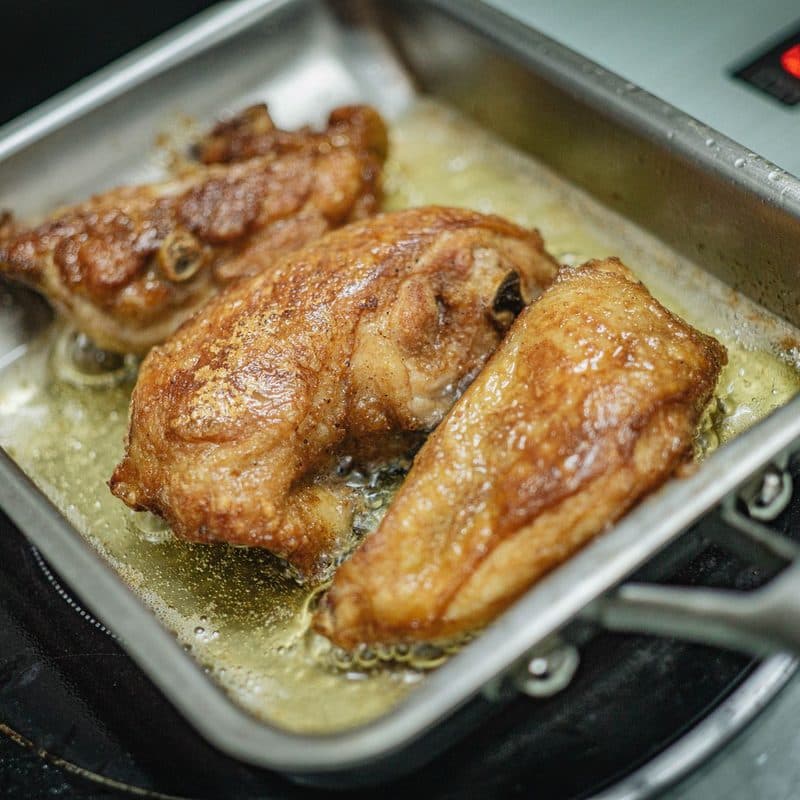 Tramontina Signature Tri-Ply Clad Fry PanTramontina publishes compatibility with gas, electric, ceramic glass and induction. The cheapest fully clad yes. | Induction without paying premium prices | 8.6 | |
| 2 |  All-Clad D3 Stainless Fry Pan18/10 facing the food, magnetic stainless facing the hob. The pan the two-alloy explanation is usually drawn from. | Seeing the two-alloy design working as intended | 9.1 | |
| 3 |  Demeyere Industry 5 Fry PanFive plies rim to rim with a commercial-spec gauge, which is what you want when the hob is doing the work unevenly. | Full five-ply contact across a wide base | 8.6 |
#ad Buy links are affiliate links. We never print a price — prices change weekly and a printed one is wrong within a month, so every link goes to the live Amazon listing. How we are funded.
The short answer
The outside of a good clad pan is magnetic and the inside is not, and that is deliberate. Nickel-bearing 18/10 stainless — the alloy you want facing food because it resists corrosion well — is non-magnetic. Nickel-free 18/0 stainless is magnetic. A clad pan therefore puts 18/10 inside and a magnetic stainless layer outside, so an induction hob can drive the pan while the better alloy does the cooking.
Why a pan needs two different steels
Stainless steel is not one material. The two numbers in 18/10 are percentages of chromium and nickel, and the nickel is what changes the crystal structure to the austenitic form — corrosion-resistant, bright, and non-magnetic. Drop the nickel to zero and you get 18/0, which is ferritic: still stainless, less resistant to pitting, and magnetic.
Induction works by inducing a current in a ferromagnetic base. Put a pure 18/10 pan on an induction hob and nothing happens. So a well-designed clad pan faces the right alloy at the right thing: 18/10 at the food, 18/0 at the hob, aluminum in between doing the conducting. That is not cost-cutting, it is the only arrangement that satisfies both requirements. The alloys in full are in 18/10 vs 18/8 vs 18/0.
The fridge-magnet test, and its limits
- Take any fridge magnet to the shop, or use one at home.
- Hold it flat against the centre of the pan's base.
- A firm grab means a ferromagnetic exterior and the pan will work on induction.
- A weak, draggy pull means marginal coupling. It may work, slowly and unevenly.
- Nothing at all means the pan will not work on induction.
Two limits worth knowing. The test tells you about coupling, not about quality — a cheap disc-bottom pot grabs a magnet hard and still cooks badly up the walls. And it tells you nothing about base flatness, which on induction matters more than on gas because the hob heats the metal it is touching rather than the air around it. Set the pan on something genuinely flat and press one edge; any rock is a pan that cooks unevenly from day one.
What to look for if you cook on induction
A published compatibility statement, not a magnet. Every brand we cover publishes induction compatibility in its own specification. Prefer that to your own inference.
Full base contact. A rounded saucier base has less contact area on a small induction ring than a flat-bottomed saucepan, which is a genuine trade — see saucier vs saucepan.
A base diameter matched to the ring. Induction only energises the area over the coil, so an oversized pan has a cool rim.
Gauge, for even results. Induction delivers heat abruptly, and a heavier base spreads that before it reaches the food. This is the one application where five-ply earns its weight.
The pans we would actually buy for an induction hob are in best stainless skillet for induction and best stainless cookware for induction.
Does magnetism mean anything else?
Not much, and it is worth saying so because the magnet test gets over-interpreted. Magnetism is a property of the crystal structure, not a measure of grade, thickness or durability. A magnetic pan is not a cheaper pan and a non-magnetic one is not a better one.
One genuine inference: a cooking surface that grabs a magnet strongly is more likely to be a lower-nickel alloy, which resists pitting from salt and acid less well. That is a reason to prefer 18/10 at the food rather than a reason to avoid magnetic steel at the hob. Both can be true in the same pan, and in a good pan they are.
What this means for longevity
The magnetic exterior layer is the most exposed part of a clad pan and the least consequential one. It takes the scuffs, the heat tint and the utensil marks, and none of that affects how the pan cooks or how long it lasts. Demeyere's Silvinox treatment slows that cosmetic aging; nobody else really tries.
The failure that does end an induction pan is a warped base, because an uneven base on induction is far more disruptive than on a gas ring — the hob can only heat metal it is in contact with. Thermal shock is the cause, every warranty excludes it, and on induction it is the difference between a pan with a cosmetic flaw and a pan you cannot use. What to do about it is in warped stainless steel pans.
The picks in full
1. Cheapest confirmed induction pan
Tramontina Signature Tri-Ply Clad Fry Pan
Tramontina
Tramontina publishes compatibility with gas, electric, ceramic glass and induction. The cheapest fully clad yes.
- Induction
- 9.0
- Heat
- 8.4
- Durability
- 7.8
- Value
- 9.7
- Tri-ply: aluminum core between two layers of 18/10 stainless
- Oven safe to 500F (Tramontina published spec)
- Dishwasher safe; works on gas, electric, ceramic glass and induction
- NSF-certified for commercial kitchens
- Mirror-polished exterior, riveted stainless handle
What it gets right
- Cooks close enough to All-Clad that most people could not pick them apart blind
- Dishwasher safe and NSF-certified, neither of which All-Clad's tri-ply is
- Cheap enough that replacing it in fifteen years still costs less than one D3
Who should skip it
- The 500F oven rating is 100F below All-Clad and 300F below Made In
- Handle is less comfortable and the polished finish scuffs faster
- Lighter gauge base is more prone to warping under thermal shock
Tramontina states induction compatibility explicitly in its own specification, which is what you want rather than an inference from a magnet test. Fully clad tri-ply, NSF-certified, dishwasher safe, and a 500F ceiling.
2. The textbook construction
All-Clad D3 Stainless Fry Pan
All-Clad
18/10 facing the food, magnetic stainless facing the hob. The pan the two-alloy explanation is usually drawn from.
- Induction
- 9.0
- Heat
- 8.8
- Durability
- 9.6
- Value
- 7.2
- Tri-ply: stainless interior, aluminum core, magnetic stainless exterior
- Oven and broiler safe to 600F (All-Clad published spec)
- Induction compatible on any stovetop
- Handwash only, per the manufacturer
- Limited lifetime warranty; bonded, engineered and assembled in Canonsburg, PA
What it gets right
- Survived America's Test Kitchen's concrete-strike abuse testing with barely a ding
- Rivets and handle join are the sturdiest in the category
- Decades of parts and service history standing behind the warranty
Who should skip it
- Costs roughly three times a Tramontina that cooks nearly as evenly
- The stick handle is narrow and bites into your palm on a loaded 12-inch pan
- Handwash only, which is a real constraint if you hate washing up
All-Clad publishes the D3 layer stack as stainless interior, aluminum core, magnetic stainless exterior, and states induction compatibility on any stovetop. That exterior layer is the reason the pan works on induction at all.
3. Best on a weak induction ring
Demeyere Industry 5 Fry Pan
Demeyere
Five plies rim to rim with a commercial-spec gauge, which is what you want when the hob is doing the work unevenly.
- Induction
- 9.2
- Heat
- 9.0
- Durability
- 9.2
- Value
- 6.6
- Five-ply construction from rim to rim
- Oven safe to 500F (Zwilling published spec)
- Dishwasher safe; induction compatible
- Patented Silvinox surface treatment resists fingerprints and acidic foods
- Lifetime warranty; made in Belgium
What it gets right
- Silvinox is the only surface treatment here that measurably slows cosmetic aging
- Built to a commercial-kitchen spec, and the gauge shows it
- Dishwasher safe despite the price bracket
Who should skip it
- A 500F ceiling is low for the money
- Heaviest pan on this site; genuinely tiring in the larger sizes
- Rare enough in US retail that replacing one piece takes effort
Induction heats the pan rather than the air, so base flatness and gauge matter more than on gas. Demeyere is the heaviest pan we cover, built to a restaurant spec, dishwasher safe, with a 500F ceiling that is low for the money.
Frequently asked questions
Is stainless steel cookware magnetic?
The exterior of a clad pan usually is, and the cooking surface usually is not. Nickel-bearing 18/10 stainless is non-magnetic; nickel-free 18/0 is magnetic, and clad pans use it on the outside so induction hobs can drive them.
Will my stainless pan work on an induction hob?
Hold a fridge magnet against the centre of the base. A firm grab means it will work. A weak drag means marginal coupling and uneven heating; no pull at all means it will not work.
Why is the inside of my stainless pan not magnetic?
Because it is 18/10 austenitic stainless, which contains roughly 10% nickel and is non-magnetic. That alloy resists corrosion better, which is why it faces the food.
Does a magnet test tell me if a pan is good quality?
No. Magnetism is a property of the alloy's crystal structure, not of thickness, construction or durability. A cheap disc-bottom pot grabs a magnet firmly and still heats badly up the walls.
Is 18/0 stainless steel worse than 18/10?
As a cooking surface, yes - it has no nickel and resists pitting from salt and acid less well. As the exterior layer of a clad pan it is the right choice precisely because it is magnetic.
Does base flatness matter more on induction?
Yes. Induction heats only the metal in contact with the hob, so a warped or rocking base produces genuinely uneven cooking rather than a cosmetic flaw.
Sources
- Xometry — 18/8 vs 18/10 vs 18/0 stainless steels compared
- Made In — What is 18/10 stainless steel?
- All-Clad — D3 Stainless 12-inch Fry Pan, published specification
- Tramontina — Signature Tri-Ply Clad Stainless Steel Fry Pan, published specification
- Zwilling — Demeyere Industry 5 11-inch Frying Pan, published specification
- Made In — Stainless Clad Frying Pan, published specification