Brands & Head-to-Head
Demeyere vs Hestan
Two of the most expensive clad pans sold in the US, and they are expensive for opposite reasons. Demeyere spends the money on gauge and a surface treatment that slows cosmetic aging. Hestan spends it on a bonded titanium surface and a 1050F ceiling.
Disclosure: Ply & Pan earns a commission on qualifying purchases made through links on this page. We take no free product and no sponsorship, and every price here is read from Amazon on the date shown. How we are funded.
Quick picks
The short answer. Tap any row for the full write-up.
| # | Product | Best for | Score | Price |
|---|---|---|---|---|
| 1 | 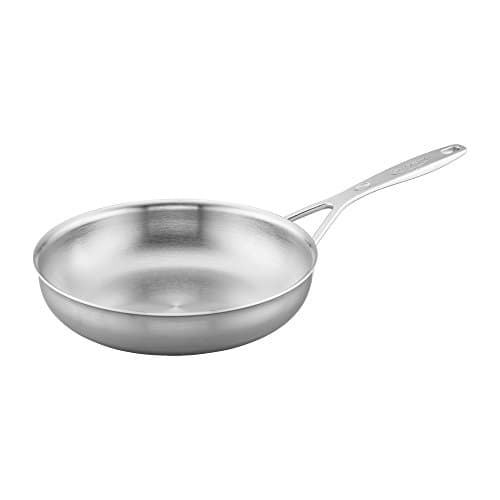 Demeyere Industry 5 Fry PanFive plies rim to rim, dishwasher safe, and the only surface treatment on this site that measurably slows cosmetic aging. The 500F ceiling is the price you pay, and it is a real one. | A cook who wants the heaviest gauge and a pan that still looks right in fifteen years | 8.6 | |
| 2 | 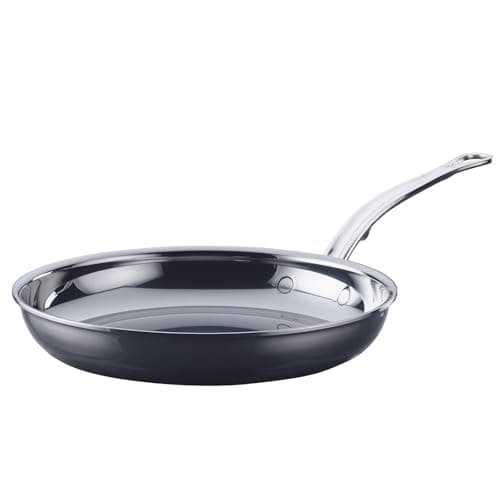 Hestan NanoBond Titanium Skillet1050F is not a marketing number, it is a different category of oven work. Titanium alloys bonded into the surface, nickel-free, dishwasher safe - and the most expensive skillet on this site by a wide margin. | Grill and broiler finishing, or a cook who reacts to nickel | 8.4 | |
| 3 | 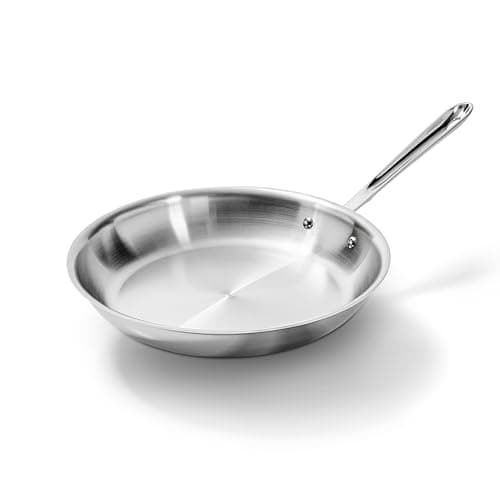 All-Clad D3 Stainless Fry PanTri-ply, 600F and broiler safe, bonded in Pennsylvania, with a warranty All-Clad has been honoring since 1971 - at roughly a third of what either premium pan costs. | Almost everyone who was about to spend premium money | 8.8 |
#ad Buy links are affiliate links. Prices come straight from Amazon, are stamped with the date they were read, and disappear rather than go stale if the feed stops. How we are funded.
The short answer
Buy the Demeyere if you keep cookware for decades, cook mostly on the hob, and want the pan to still look composed in fifteen years. Buy the Hestan if your cooking finishes under a broiler or on a grill, or if you need a nickel-free cooking surface. If neither of those sentences is about you, buy an All-Clad D3 and keep the difference — these two pans are both excellent and both solve problems most kitchens do not have.
The published specifications, side by side
Every number below is from the manufacturer's own published specification, not from a retailer listing.
| Spec | Demeyere Industry 5 | Hestan NanoBond |
|---|---|---|
| Construction | 5-ply, rim to rim | Titanium alloys bonded to stainless in nano layers |
| Oven rating | 500F | 1050F, oven, broiler and grill |
| Dishwasher | Yes | Yes |
| Surface treatment | Silvinox, patented | NanoBond, bonded titanium alloys |
| Published exclusions | Not published | No PFAS, nickel, lead or cadmium |
| Made in | Belgium | Italy |
| Warranty | Lifetime | Lifetime |
The oven ceiling is the real difference
550F separates these two pans, and that gap is not a rounding error on a spec sheet — it decides which recipes are inside warranty. A 500F ceiling rules out broiler finishing, rules out a hot grill, and makes a 500F oven-roasted chicken a borderline call. Demeyere builds to a commercial hob spec, and commercial hobs are where its gauge earns its money; they are not broilers.
Hestan's 1050F is the highest published rating in clad cookware by a wide margin, and it is the one specification on this site that genuinely changes what you can cook. Steak finished directly under an element, a frittata browned hard, a pan parked on a gas grill — all of that is in spec. If you want the comparison against the pan most people assume is the high-temperature choice, we ran it in Hestan NanoBond vs All-Clad, and the general question of which brands publish what is in oven-safe temperatures by brand.
Silvinox and NanoBond are not the same kind of claim
Both brands sell a proprietary surface, and it is easy to read them as competing versions of one feature. They are not.
Silvinox is a cosmetic-durability treatment. It changes the composition of the outermost layer of steel so the pan resists discoloration, fingerprint shadowing and the dull cast that acidic food and dishwasher detergent inflict on polished stainless. It does nothing for how the pan cooks. It is the reason a fifteen-year-old Demeyere looks newer than a five-year-old mirror-polished pan.
NanoBond is a hardness-and-temperature claim. Bonding titanium alloys into the surface is what lets Hestan publish 1050F and claim four times the durability of plain stainless. It also changes the color, which is why the pans look darker than ordinary steel. Neither treatment is nonstick, and neither replaces a proper preheat — the mechanism behind that is in why food sticks to stainless steel.
Weight, and who should care
The Demeyere is the heaviest pan we write about. That is an advantage for searing — thermal mass is what stops the pan temperature collapsing when cold food hits it — and a genuine problem if you have wrist or shoulder trouble, or if you routinely move a full pan to the oven one-handed. There is no spec sheet answer to this. Pick the pan up in a shop if you can, and if you cannot, read the weight figure on the listing and be honest with yourself.
Availability and replacing a piece
A lifetime warranty is only as good as the company's willingness to answer the phone, and both of these brands are fine on that score. Availability is the softer risk. Demeyere is sold through Zwilling and a thin layer of specialist retail in the US, so adding a matching piece or replacing a lid in three years takes effort. Hestan is a small brand selling at the top of the market. All-Clad, by contrast, is everywhere, which is worth something on a purchase you intend to keep. We go through what the warranty documents actually promise in cookware lifetime warranties compared.
The bottom line
These are both genuinely good pans and neither is the value answer. Demeyere wins on gauge, finish longevity and the fact that it will look right for decades; it loses badly on oven ceiling. Hestan wins on temperature range and a nickel-free surface; it loses on price, and the price gap is not small. If you are choosing between them because you want the best clad pan available, buy the Demeyere and accept the 500F limit. If you broil, buy the Hestan. If you are still reading because you have not decided whether either is worth it, the honest answer is that a D3 does ninety per cent of this for a third of the money.
The picks in full
1. Better if you keep cookware for decades
Demeyere Industry 5 Fry Pan
Demeyere
Five plies rim to rim, dishwasher safe, and the only surface treatment on this site that measurably slows cosmetic aging. The 500F ceiling is the price you pay, and it is a real one.
- Build
- 9.6
- Oven ceiling
- 5.0
- Finish
- 9.6
- Value
- 6.0
- Five-ply construction from rim to rim
- Oven safe to 500F (Zwilling published spec)
- Dishwasher safe; induction compatible
- Patented Silvinox surface treatment resists fingerprints and acidic foods
- Lifetime warranty; made in Belgium
What it gets right
- Silvinox is the only surface treatment here that measurably slows cosmetic aging
- Built to a commercial-kitchen spec, and the gauge shows it
- Dishwasher safe despite the price bracket
Who should skip it
- A 500F ceiling is low for the money
- Heaviest pan on this site; genuinely tiring in the larger sizes
- Rare enough in US retail that replacing one piece takes effort
Industry 5 is five-ply from the base all the way up the wall, and the gauge is the point. It is the heaviest pan written up on this site, which is a compliment when you are searing and a complaint when you are moving it full of braise from hob to oven. Thermal mass is what makes a pan forgiving: it does not drop twenty degrees the moment four chicken thighs hit it.
Silvinox is the feature nobody shops for and everybody notices later. It is an electrochemical surface treatment that leaves the steel richer in chromium and nickel, which is why these pans resist the dull grey cast and the fingerprint shadowing that mirror-polished cookware picks up over a few years of acidic food and dishwasher cycles. Zwilling publishes the pan as dishwasher safe, and at this price that matters.
Against it: a 500F oven ceiling is low for the money and it is 550F below the Hestan. If your cooking ends under a broiler, this is the wrong pan and no amount of gauge fixes that. It is also rare enough in US retail that adding a matching piece in three years takes effort, where All-Clad is on a shelf in every department store.
#ad Price as of October 17, 2026. How we are funded
2. Better if your cooking ends in the oven or under the broiler
Hestan NanoBond Titanium Skillet
Hestan
1050F is not a marketing number, it is a different category of oven work. Titanium alloys bonded into the surface, nickel-free, dishwasher safe - and the most expensive skillet on this site by a wide margin.
- Build
- 9.4
- Oven ceiling
- 10.0
- Finish
- 9.0
- Value
- 5.0
- Titanium-based alloys bonded to stainless in nano layers
- Oven, broiler and grill safe to 1050F (Hestan published spec)
- Dishwasher safe; induction compatible
- Made without PFAS, nickel, lead or cadmium
- Lifetime warranty; handcrafted in Italy
What it gets right
- The 1050F rating puts grill and broiler work genuinely in spec
- A nickel-free cooking surface matters if you react to nickel
- Hestan claims four times the durability of plain stainless, and the surface does resist scratching
Who should skip it
- The most expensive skillet in this category, and it is not close
- The titanium surface changes appearance, not stick behavior; food still sticks if you rush the preheat
- Repair is not realistic, so a damaged surface means a replacement claim
The 1050F rating is the whole argument. Most clad stainless stops between 500F and 800F, which means that finishing a steak directly under a broiler element or parking the pan on a grill is outside the published spec. Hestan puts both inside it. If you own a salamander, a high broiler or a gas grill you cook in, nothing else in clad cookware is rated for the way you actually cook.
The surface is the second argument, and it is more interesting than the usual coating story. NanoBond bonds titanium-based alloys into the steel in nano layers, so it is a material change rather than something sprayed on that can wear through. Hestan publishes it free of PFAS, nickel, lead and cadmium — the nickel-free part is the one that genuinely matters to a minority of cooks, and for them it is decisive. It is also dishwasher safe and handcrafted in Italy.
Be clear about what the surface does not do. Hestan claims four times the durability of plain stainless, and the surface does resist scratching, but it is not nonstick and food still welds to it if you rush the preheat. And repair is not realistic on a bonded surface, so damage means a warranty claim rather than a fix.
#ad Price as of October 17, 2026. How we are funded
3. The pan that makes this comparison hard to justify
All-Clad D3 Stainless Fry Pan
All-Clad
Tri-ply, 600F and broiler safe, bonded in Pennsylvania, with a warranty All-Clad has been honoring since 1971 - at roughly a third of what either premium pan costs.
- Build
- 9.4
- Oven ceiling
- 6.5
- Finish
- 7.6
- Value
- 8.6
- Tri-ply: stainless interior, aluminum core, magnetic stainless exterior
- Oven and broiler safe to 600F (All-Clad published spec)
- Induction compatible on any stovetop
- Handwash only, per the manufacturer
- Limited lifetime warranty; bonded, engineered and assembled in Canonsburg, PA
What it gets right
- Survived America's Test Kitchen's concrete-strike abuse testing with barely a ding
- Rivets and handle join are the sturdiest in the category
- Decades of parts and service history standing behind the warranty
Who should skip it
- Costs roughly three times a Tramontina that cooks nearly as evenly
- The stick handle is narrow and bites into your palm on a loaded 12-inch pan
- Handwash only, which is a real constraint if you hate washing up
Any honest Demeyere-versus-Hestan page has to put this pan on it, because the D3 answers most of what either premium pan is selling. It is broiler safe to 600F, which covers the finishing that a Demeyere cannot do. It survived America's Test Kitchen's concrete-strike abuse testing, which covers the durability a Hestan charges for. And it costs roughly a third as much as either.
What you give up is real but narrow. Three plies respond faster and hold less heat, so the pan drops temperature sooner when a cold steak goes in. It is handwash only, which Demeyere and Hestan are not. The polished exterior will dull and shadow over a decade in a way a Silvinox-treated pan will not. And the stick handle bites into your palm on a loaded 12-inch.
If none of those three sentences describes something you will notice, buy the D3 and spend the difference on a saucier. If one of them describes your kitchen exactly — you broil, or you refuse to handwash, or you are keeping this pan for thirty years — then the premium pan is a reasonable purchase and the rest of this page tells you which one.
#ad Price as of October 17, 2026. How we are funded
Frequently asked questions
Is Demeyere better than Hestan?
Neither is better across the board. Demeyere Industry 5 is heavier gauge, five-ply rim to rim and carries the Silvinox surface treatment that keeps it looking new for decades, but it is only rated to 500F. Hestan NanoBond is rated to 1050F for oven, broiler and grill and has a nickel-free bonded titanium surface, but it costs considerably more. Choose on oven ceiling: if you broil, Hestan; if you cook on the hob and keep cookware for decades, Demeyere.
What is Silvinox?
Demeyere's patented electrochemical surface treatment. It leaves the outer layer of steel richer in chromium and nickel, which is why Demeyere pans resist the dull grey cast, discoloration and fingerprint shadowing that polished stainless picks up over years of acidic food and dishwasher cycles. It affects how the pan ages, not how it cooks.
Is Hestan NanoBond worth the price?
Only if you need what it uniquely offers. The 1050F oven, broiler and grill rating is the highest in clad cookware by a wide margin and genuinely changes what you can cook in spec, and the surface is published free of PFAS, nickel, lead and cadmium, which matters if you react to nickel. If you do not broil and do not have a nickel issue, the extra money buys you very little over a 600F pan.
Is Demeyere dishwasher safe?
Yes. Zwilling publishes Demeyere Industry 5 as dishwasher safe, which is unusual at this price point - All-Clad's bonded tri-ply is handwash only. Hestan NanoBond is also published as dishwasher safe.
Where are Demeyere and Hestan pans made?
Demeyere is made in Belgium. Hestan NanoBond is handcrafted in Italy. Neither is made in the United States - for US-made clad the options are All-Clad's bonded lines, bonded in Canonsburg, Pennsylvania, and Heritage Steel, manufactured in Clarksville, Tennessee.
Sources
- Zwilling — Demeyere Industry 5 11-inch Frying Pan, published specification
- Hestan Culinary — NanoBond titanium skillet, published specification
- All-Clad — D3 Stainless 12-inch Fry Pan, published specification
- All-Clad — Cookware Limited Lifetime Warranty (PDF)
- America's Test Kitchen — Getting Whacked (how the abuse testing works)